Alaska Quitclaim Deed (Married Couple as Grantors)
Borough or Census Area Specific Legal Forms Validated as recently as September 30, 2026 by our Forms Development Team
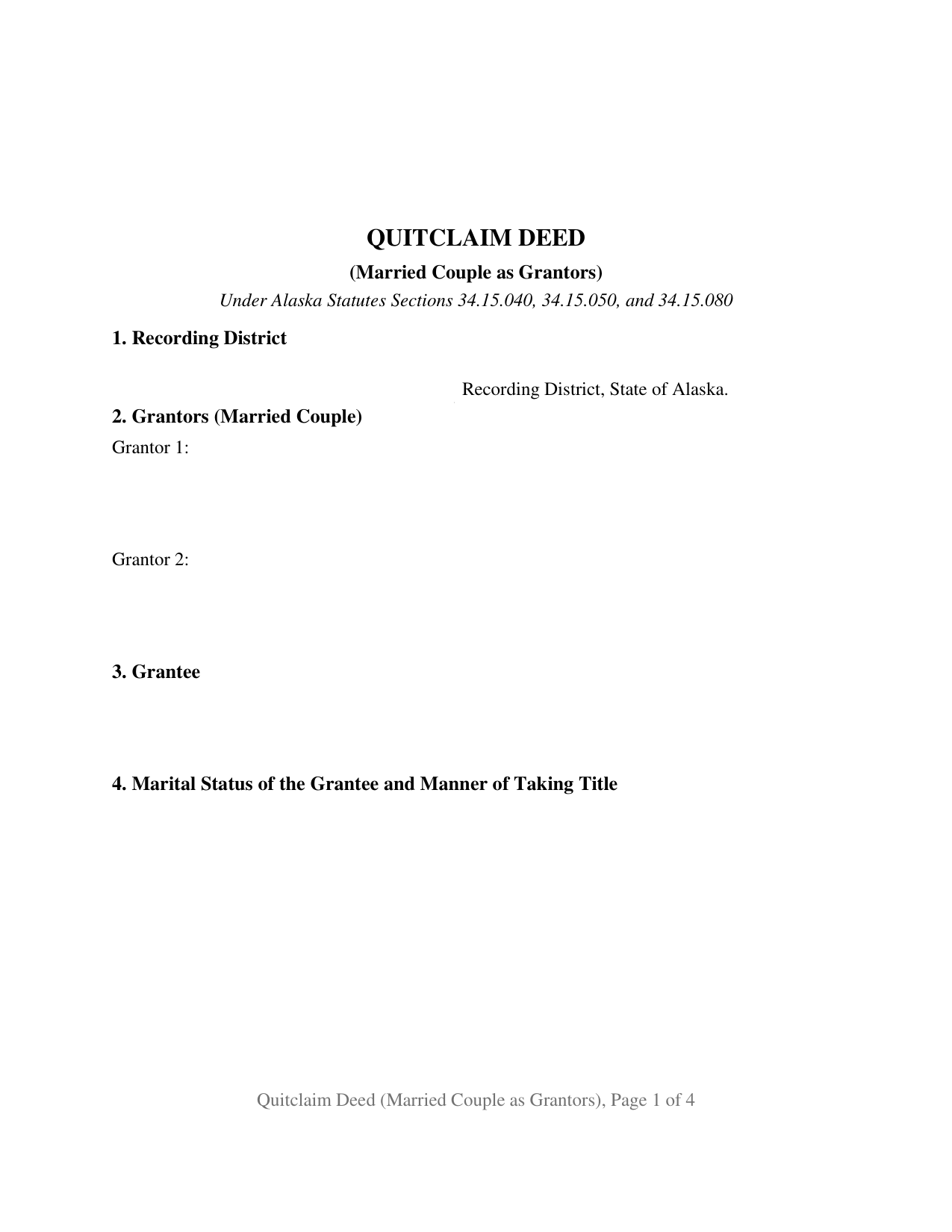
About the Alaska Quitclaim Deed (Married Couple as Grantors)
How to Use This Form
- Select your borough or census area from the list
- Download the borough or census area-specific form
- Fill in the required information
- Have the document notarized if required
- Record with your borough or census area recorder's office
What Others Like You Are Saying
"I purchased he Alabama Correction Warranty Deed Form to correct a mistake in the legal description. …"
"Download very easy. Forms are just what I need. Thanks"
"Great Forms, Detailed explanation on how to fill them out properly. No Issues at all. Very e-z to us…"
"Found just the form I was looking for. It was an easy download process. Now just have to complete th…"
"Easy to download. I like the fact that it gives me an example of how to fill it out and also the ins…"
4.8/5 from 4,821 reviews. Read all
Alaska's statutory quitclaim form carries its own parenthetical plural: the grantor conveys and quitclaims all interest which I (we) have, if any. This deed is built on that plural. Two grantors who are married to each other appear in the grantor section, both of them sign, and each signature carries its own acknowledgment certificate, so a married couple releases whatever interest the two of them hold in one parcel of Alaska real property, without warranty of title.
The Parenthetical (We) in Alaska's Statutory Form
AS 34.15.040(a) prints a short quitclaim form whose operative words, conveys and quitclaims, reach all interest which I (we) have, if any, in the described real estate, located in the State of Alaska. A deed substantially in that form passes, in fee, all the existing legal and equitable rights of the grantor. Alaska publishes that one form and no separate version for spouses conveying together. The deed promises nothing about title, the posture AS 34.15.080 fixes by barring implied covenants.
Two Owners, Two Signatures, Two Certificates
The form recites exactly two grantors, married to each other, each carrying the complete mailing address Alaska recording law asks of every party to a recorded deed. The conveyance section states the marriage and states that both grantors join. Two signature blocks follow, each with a printed name and a date line, and beneath each one a separate acknowledgment certificate in the individual short form Alaska supplies, so the spouses may appear before different notarial officers on different days; the completed example dates the two signatures two days apart. Ownership patterns that present this configuration in the record include spouses holding record title together who transfer a parcel to a family member outright, spouses releasing whatever interest they hold in an adjoining strip so a survey question clears, and spouses moving jointly held land into a family entity. The form is not set up as a conveyance by one record owner signing alone, as a deed on which an owner signs and a spouse who owns nothing signs only to join, or as a conveyance by two co-owners who are not married to each other, each passing an undivided fractional share.
Why Both Spouses Belong on the Grantor Side
Two Alaska rules converge on this signature pattern. Under AS 34.15.110(b) a husband and wife who acquire title hold the estate as tenants by the entirety unless the conveyance expressly declares otherwise, and AS 34.15.140(a) preserves that estate with its right of survivorship, so married co-owners commonly hold one undivided estate rather than two fractional shares. Separately, AS 34.15.010(b) has the husband and wife join in a deed of the family home or homestead, and AS 34.15.010(d) leaves a deed missing a non-title spouse's signature open to a suit or a recorded notice of interest for a year after recording. A quit claim deed both spouses sign as grantors answers both rules, with no conditional joinder block left blank for an examiner to read.
Where the Grantee's Marital Status Goes
AS 34.15.110(b) also has the conveyance state the marital status of the parties acquiring title, and Alaska's menu of co-ownership forms is short. Tenancy in common is the default for two or more grantees under AS 34.15.110(a), tenancy by the entirety is the spousal survivorship estate, and ordinary joint tenancy in land is abolished under AS 34.15.130, so a survivorship designation imported from another state does nothing for grantees who are not spouses. This form carries a numbered section for that entry, and the guide walks through each recognized form.
Recording in the Property's District
Alaska has no county recorders. The Department of Natural Resources records land instruments through 34 recording districts, and the district is named on the face of the deed as a condition of eligibility under AS 40.17.030(a)(9), along with both parties' mailing addresses and the return-to name and address. The first page reserves two inches at the top for the recorder, margins and type follow 11 AAC 06.040, and the fee is $20 for the first page and $5 for each page after it statewide, with no transfer tax on an ordinary deed. Under AS 40.17.080 recording is what supplies constructive notice against a later innocent purchaser for value.
The download delivers the fillable deed built to Alaska's recording standards, a completed example filled in for a Palmer Recording District parcel, and a plain-language guide covering each numbered section, the acknowledgments, and recording. The materials are informational and are not legal advice.
Important: Borough or Census Area-Specific Forms
Our quitclaim deed (married couple as grantors) forms are specifically formatted for each of the 27 borough or census areas in Alaska.
After selecting your borough or census area, you'll receive forms that meet all local recording requirements, ensuring your documents will be accepted without delays or rejection fees.