Arizona Affidavit of Death Beneficiary Deed (Community Property Without Survivorship)
County Specific Legal Forms Validated as recently as October 21, 2026 by our Forms Development Team
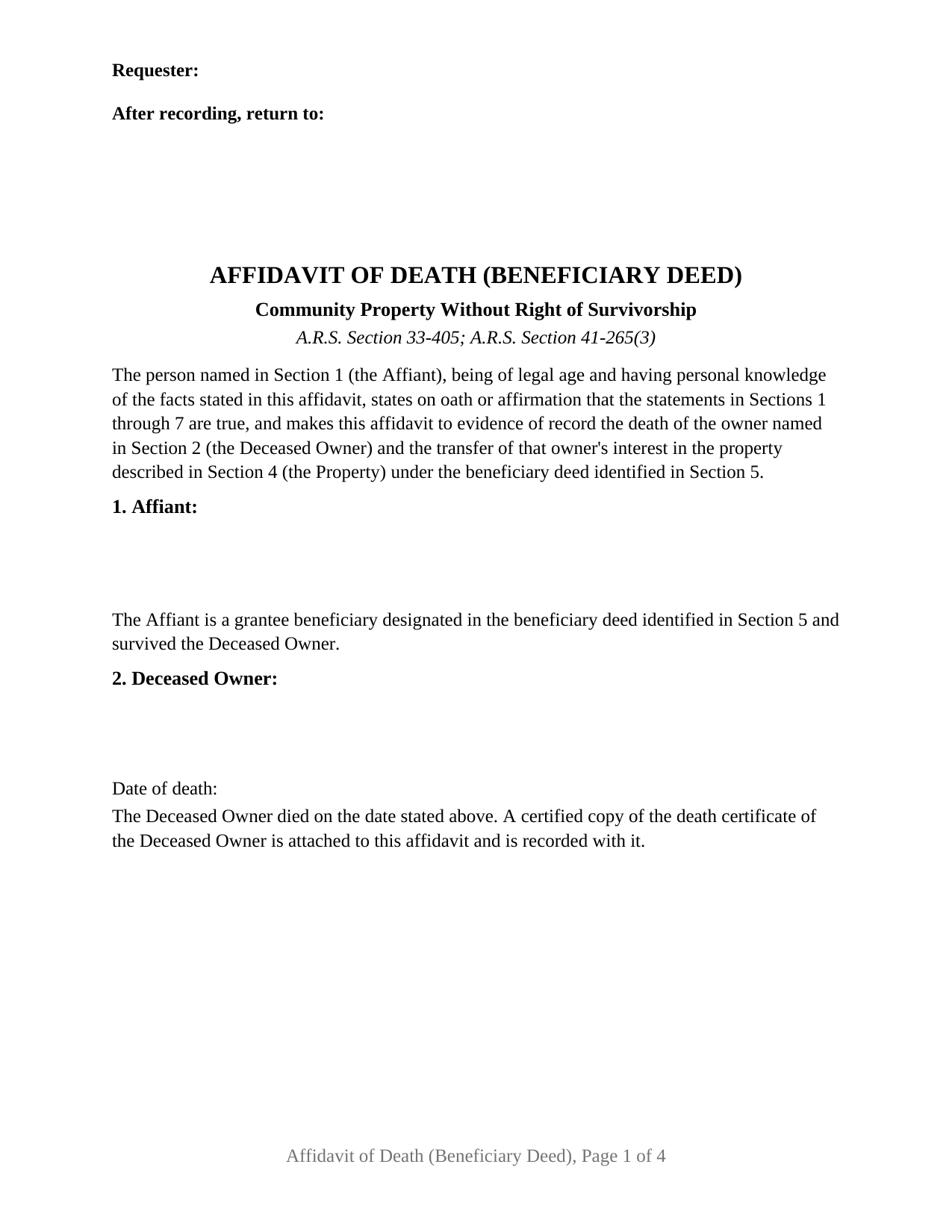
About the Arizona Affidavit of Death Beneficiary Deed (Community Property Without Survivorship)
How to Use This Form
- Select your county from the list
- Download the county-specific form
- Fill in the required information
- Have the document notarized if required
- Record with your county recorder's office
What Others Like You Are Saying
"I needed the deed forms for setting up our living trust. It appears this will do the trick! Steve"
"Great service, quick and easy!"
"Thanks"
"I purchased he Alabama Correction Warranty Deed Form to correct a mistake in the legal description. …"
"Was able to print my documents immediately. Documents included deed form, a guide, a sample document…"
4.8/5 from 4,829 reviews. Read all
Community property without a right of survivorship comes apart at the first death. The spouse who dies owns a half interest that the vesting itself sends nowhere, and when a beneficiary deed under A.R.S. Section 33-405 named someone to take that half, it changes hands the instant that spouse dies. This Arizona affidavit of death is the sworn instrument that puts such a first-death transfer into the county record, sworn by the grantee beneficiary who survived and recorded with a certified death certificate.
The half interest that moves first
A.R.S. Section 33-405(A) makes a beneficiary deed operate on the death of the owner, and the interest arrives carrying the mortgages, deeds of trust, liens and other encumbrances that owner created or was subject to while alive. Nothing in the subsection waits on a second person. Where the designation reached a community half held without survivorship, that half is what passes, and it passes at that owner's death, potentially years before the surviving spouse's own half is in play. Arizona names the designating instrument a beneficiary deed; elsewhere the same device is searched as a transfer on death deed or TOD deed.
Why the last surviving owner rule stays out of it
Subsection D of the same section is what defers a transfer to a second death, and it is written for two estates only: joint tenancy with right of survivorship, and community property with right of survivorship. There the deed is designated by all of the then surviving owners, states that it is effective on the death of the last surviving owner, and yields to a surviving co-owner whose rights prevail over a beneficiary named by fewer than all of them. Community property carrying no survivorship words falls outside those sentences, which is why the affidavit spells the vesting out and names both survivorship forms in order to negate them.
What the form fixes and what it leaves blank
The configuration is printed rather than chosen. Section 3 recites two spouses, married to each other, holding title as community property without right of survivorship. Section 7 recites that the deceased owner's interest transferred to the affiant effective on that owner's death and not on the death of a last surviving owner, that only that interest moved, and that no revocation appears of record and no later beneficiary deed is known. One signature block and one certificate follow, for the single affiant. What stays open is factual: names, the date of death, the county, the legal description and parcel number, and the recording data for the beneficiary deed and the deed that vested title. Couples who took title as community property long before either had heard of a beneficiary deed, and households where a designation covered one spouse's share alone, are the ownership patterns this affidavit recites.
The oath the certificate names
An affidavit is sworn, never acknowledged, and Arizona keeps a separate statutory short form for each act. The certificate here is a verification on oath or affirmation drawn from A.R.S. Section 41-265(3), carrying its own state and county lines, because A.R.S. Section 41-264(A) counts the jurisdiction of the notarial act as certificate content rather than borrowing it from where the land lies. Above the sworn sentence sits the record description A.R.S. Section 41-264(F) lists for a certificate riding on a separate sheet, page count included, with the line for other signers reading None.
Recording, and the filing that is not required
The affidavit and the death certificate go to the recorder for the county holding the property. A.R.S. Section 11-480 is the counter checklist: a caption, original signatures, an original clear enough for the recorder to copy, paper within 8.5 by 14 inches, ten point type or larger, and two clear inches atop page one, whose left three and one half inches may show the requester and return address. A.R.S. Section 11-475 puts the recording fee at thirty dollars, over county schedules that add their own detail. One Arizona filing does not follow: the affidavit of property value under A.R.S. Section 11-1133 answers to deeds evidencing a transfer of title and to sale contracts, so nothing here claims an exemption code.
This package carries the fillable affidavit, a completed example built on a Pima County fact pattern, and a guide covering each numbered section, the sworn certificate, the community property analysis, and Arizona recording mechanics. Everything in it describes the form and the statutes behind it in general terms, and none of it is legal advice.
Important: County-Specific Forms
Our affidavit of death beneficiary deed (community property without survivorship) forms are specifically formatted for each of the 15 counties in Arizona.
After selecting your county, you'll receive forms that meet all local recording requirements, ensuring your documents will be accepted without delays or rejection fees.