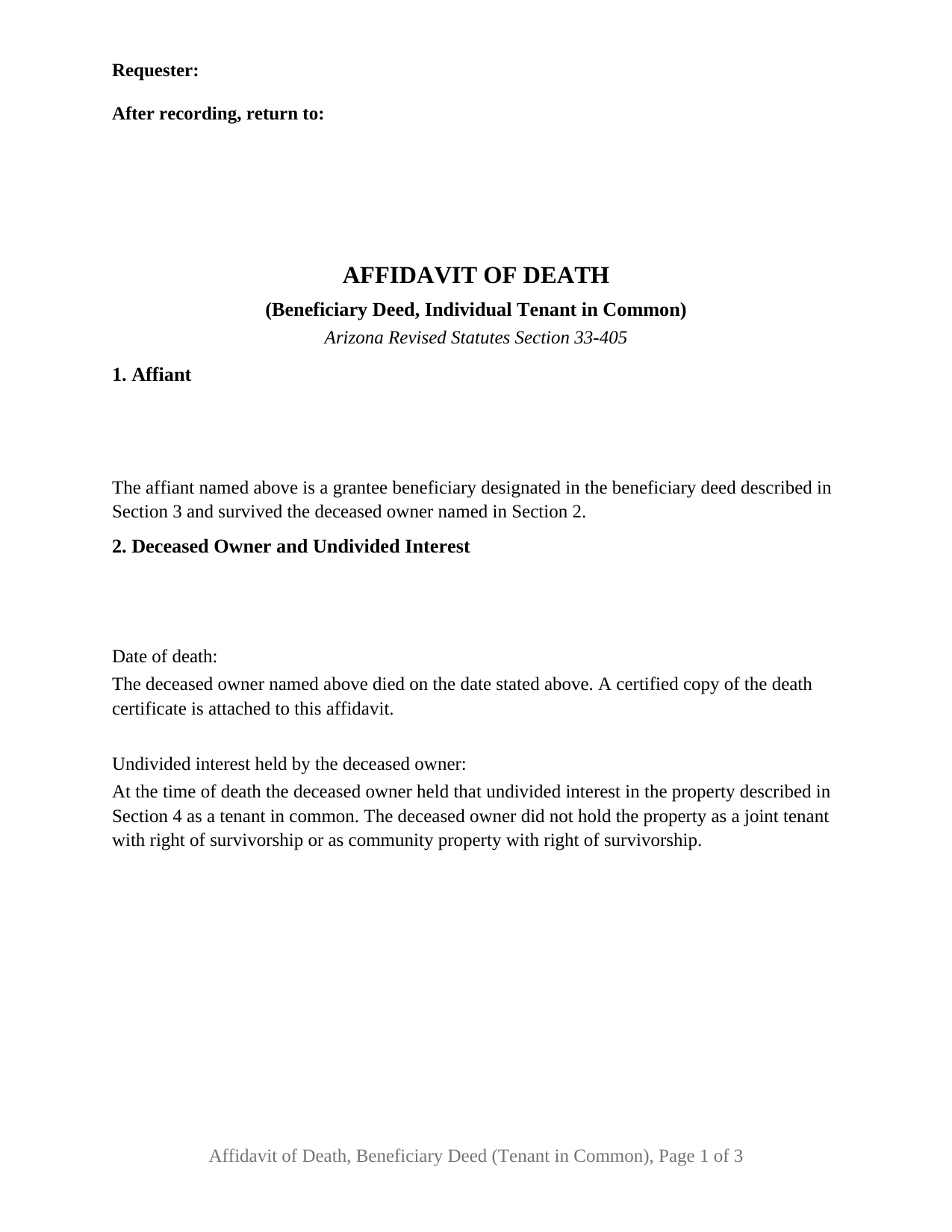
Arizona Affidavit of Death Beneficiary Deed (Individual Tenant in Common)
County Specific Legal Forms Validated as recently as October 22, 2026 by our Forms Development Team
About the Arizona Affidavit of Death Beneficiary Deed (Individual Tenant in Common)
How to Use This Form
- Select your county from the list
- Download the county-specific form
- Fill in the required information
- Have the document notarized if required
- Record with your county recorder's office
What Others Like You Are Saying
"Great service! The example completed form and instructions provided by Deeds.com were extremely help…"
"The document I needed and easy instructions!"
"Your documents resolved my problem. Thanks."
"Great service, truly helpful & saves time!!"
"Very easy to use and the forms were perfectly formatted. Great value and service!!"
4.8/5 from 4,829 reviews. Read all
A tenancy in common is a stack of separate shares that happen to sit on one parcel. When a cotenant dies holding a recorded Arizona beneficiary deed over that cotenant's own undivided share, the share moves and the parcel does not, and it moves at that cotenant's death rather than at anyone else's. This is the sworn affidavit that puts both facts, whose share and which death, into the records the beneficiary deed already sits in.
Why this death is the one that counts
A.R.S. Section 33-405(D) pushes a transfer forward to the death of the last surviving owner, and it reaches two vestings only: joint tenancy with right of survivorship and community property with right of survivorship. A cotenancy in common is neither, and A.R.S. Section 33-431(A) makes an estate in common what two or more grantees take unless the instrument says otherwise. What governs a share held in common is the general rule of Section 33-405(A): the interest passes to the designated grantee beneficiary effective on the death of the owner who signed, carrying every mortgage, lien, and other encumbrance that owner made or was subject to in life. Section 33-405(M) defines the owner, for that section, as a person who executes a beneficiary deed, which is how one cotenant of several qualifies alone.
The share that moves and the shares that stay
The death touches nothing outside the deceased cotenant's fraction. The other undivided interests are unaffected, and the grantee beneficiary arrives as a cotenant in the deceased owner's place, with the same rights of possession, rents, and partition. So the form asks for the fraction: a blank for the undivided interest, one-third in the completed example, copied from the vesting deed rather than assumed. The printed statements then close the circle, saying that the affidavit concerns that interest alone, says nothing about the interests of the other cotenants of record, and conveys nothing.
What this version fixes in print
The configuration is printed rather than left to a box to check: one deceased owner who held an undivided interest as a tenant in common and signed the beneficiary deed as owner of that interest, and one affiant, a grantee beneficiary designated in that deed who survived the owner. One signature block and one notarial certificate follow from a single swearing party. A parent who held half of a rental house with a sibling, heirs who never partitioned an inherited quarter section, and investors holding stated fractions all present the cotenancy pattern this affidavit states. Survivorship property, which Section 33-405(D) sends to the last surviving owner's death, an owner who held the whole parcel, and a successor beneficiary taking under Section 33-405(C), are configurations this form is not set up to state.
Sworn, not acknowledged
Arizona keeps the notarial acts distinct, and an affidavit takes the verification on oath or affirmation of A.R.S. Section 41-265(3) rather than the acknowledgment of Section 41-265(1). The certificate here is captioned for the act it performs and carries the statutory sworn sentence, the jurisdiction where the officer takes the oath, the officer's identity lines, and the record description that A.R.S. Section 41-264(F) attaches to a certificate on a separate sheet: what the record is called, its date, its page count, and any signer besides the affiant, of whom there is none.
What the recorder wants, and one thing it does not
The affidavit and a certified copy of the death certificate go to the recorder of the county where the land lies, where A.R.S. Section 33-411(A) locates the notice value of an instrument affecting real property. One Arizona requirement that catches post-death filings does not reach this one: Section 11-1133 appends an affidavit of property value to each deed evidencing a transfer of title and to each contract for the sale of real property, and an affidavit of death is neither, so this form claims no Section 11-1134 exemption and prints no exemption notation. The rest is ordinary counter format under Section 11-480, including the two inches left clear atop the first page, whose left three and one half inches carry the requester and return lines the statute allows there.
The package holds the fillable affidavit, a completed example set in Pima County around a one-third interest and a 2019 beneficiary deed, and a guide that walks the form section by section and covers the certificate, the page-count convention, and recording practice. Everything here describes the form and the statutes in general terms and is not legal advice.
Important: County-Specific Forms
Our affidavit of death beneficiary deed (individual tenant in common) forms are specifically formatted for each of the 15 counties in Arizona.
After selecting your county, you'll receive forms that meet all local recording requirements, ensuring your documents will be accepted without delays or rejection fees.