Arizona Warranty Deed Condominium
County Specific Legal Forms Validated as recently as October 14, 2026 by our Forms Development Team
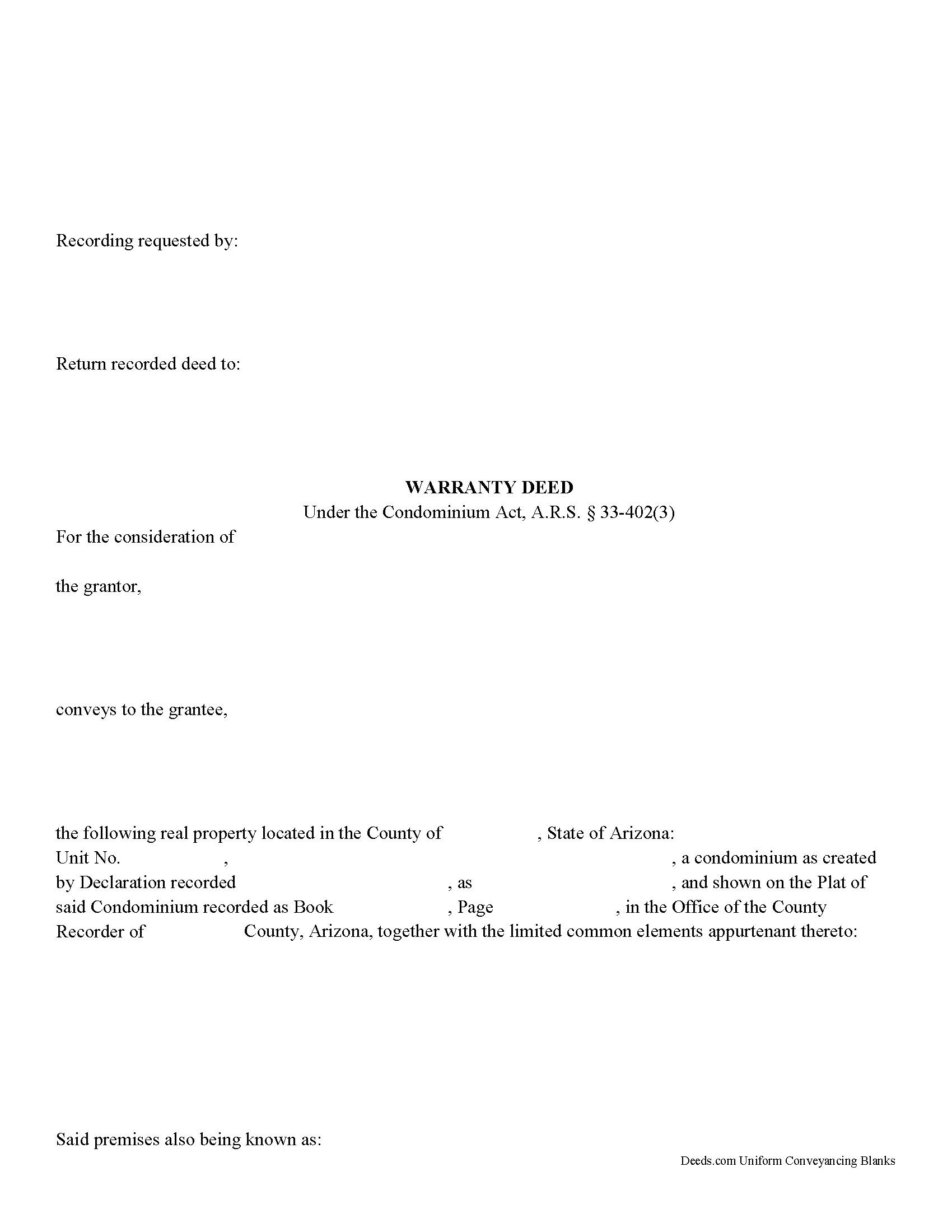
About the Arizona Warranty Deed Condominium
How to Use This Form
- Select your county from the list
- Download the county-specific form
- Fill in the required information
- Have the document notarized if required
- Record with your county recorder's office
What Others Like You Are Saying
"This process is outstanding, and it saved the hassle of going downtown and dealing with traffic."
"everything worked well,"
"Uploading the document was simple, and it was recorded much faster than I thought! Deeds.com makes t…"
"Great E-Service Provider!"
"Very helpful and easy to access."
4.8/5 from 4,829 reviews. Read all
The Arizona Warranty Deed Condominium form combines two sets of rules that rarely overlap elsewhere: the statutory warranty language at ARS 33-402, which binds the grantor to defend the title against all persons whomsoever, and the unit-specific conveyancing requirements under the Arizona Condominium Act (ARS 33-1201 et seq.), which dictate how a condominium unit must be described in any recordable deed. A warranty deed that is perfect for a single-family lot is not sufficient for a condominium — it has to identify the unit, the declaration, and the allocated interest in the common elements, or the conveyance does not reach everything the grantee is paying for. This form is drafted to satisfy both bodies of law in a single instrument.
When the Arizona Warranty Deed Condominium Is Used
Warranty deeds are the standard instrument for arm's-length sales of condominium units in Arizona, particularly when a title insurer and an institutional lender are involved. The buyer of a unit is not just acquiring four walls — the purchase is a unit plus an undivided interest in the common elements of the project, and any defect anywhere in the chain of title to either component can affect value. A general warranty extends the grantor's promise to cover defects predating the grantor's own ownership, which is the protection lenders typically require and what buyers expect on a market-priced sale. Special warranty deeds, which cover only defects arising during the grantor's ownership, are comparatively rare for Arizona condo sales and are more typical of fiduciary or estate conveyances.
The "Convey and Warrant" Language
ARS 33-402 supplies a statutory form for the warranty deed, and the operative phrase is "I hereby convey and warrant the title against all persons whomsoever." Two layers of protection attach. First, the word "convey" alone triggers the implied covenants of ARS 33-435 — that the grantor has not previously conveyed the same estate or any interest in it to another, and that the estate is free from encumbrances made by the grantor. Second, the "warrant the title against all persons whomsoever" phrase extends the grantor's promise to defend against every claim of title, including those predating the grantor's ownership. Deviations from the statutory phrasing matter: a deed reciting only "convey" gives the narrow 33-435 covenants without the general warranty, and language drawn from another state's forms may not trigger Arizona's statutory effect at all.
Unit-Specific Legal Description
ARS 33-1214 governs how a condominium unit must be described in a deed, and compliance is strict. The instrument must identify the unit by its designation in the declaration, name the condominium, recite the recording date and location of the declaration that created the project, and identify the county or counties where the condominium lies. The description must also address the common elements and the allocated interests appurtenant to the unit — the undivided interest in the common elements, the share of common expense liability, and the votes in the unit owners' association allocated to the unit under ARS 33-1202(2). The common elements themselves (ARS 33-1212(7)) include the hallways, exterior walls, landscaping, parking structures, and recreational facilities that the unit owners share.
The correct unit designation, declaration recording information, and allocated interest have to be pulled from the recorded declaration and any amendments — not reconstructed from memory or copied from an outdated source. Discrepancies between the deed and the recorded declaration are the leading cause of rejected condominium conveyances and of title problems that surface years later on resale.
Community Property, Marital Status, and Vesting
Arizona is a community property state, and the conveyancing clause must recite the marital status of each grantor and each grantee. Property acquired during marriage is presumed to be community property unless a separate-property exception applies (ARS 25-211). When the unit being sold is community property, both spouses must join in the warranty deed, because a conveyance by one spouse alone is voidable by the other; when title stands in one spouse as separate property, a contemporaneous disclaimer deed from the other spouse commonly accompanies the warranty deed to eliminate any community property presumption.
Available vesting options under ARS 33-431 include sole and separate property, tenancy in common, joint tenancy with right of survivorship, community property, and community property with right of survivorship. Without an express specification, a conveyance to two or more grantees defaults to tenancy in common. Survivorship features and the community property with right of survivorship form must be stated expressly; they are not implied from the fact of marriage.
Execution and Acknowledgment
Under ARS 33-401, a conveyance of real property must be in writing, subscribed by the grantor, and acknowledged before a notary public or other officer authorized to take acknowledgments. Witnesses are not required. Acknowledgments taken outside Arizona must comply with ARS 33-501, which recognizes notaries, judges, clerks and deputy clerks of courts of record, and other officers authorized to perform notarial acts in the state where the acknowledgment occurs. A statement of consideration on the deed should reflect the full amount paid for the transfer, including any liens assumed by the grantee (ARS 11-1131(2)).
Affidavit of Property Value
An arm's-length sale of a condominium unit is the paradigm case for the Affidavit of Property Value. ARS 11-1133 requires that the affidavit, signed by both the grantor and the grantee, accompany the instrument at recording unless the transaction falls within a specific exemption under ARS 11-1134. The affidavit reports the sale price, financing terms, and transaction characteristics for use by county assessors, and the deed's stated consideration must reconcile with the affidavit. For the narrow transfers that qualify as exempt, an exemption recital with the specific subsection citation belongs on the face of the deed, below the legal description; without that recital, the recorder treats the deed as non-exempt and will not accept it without the affidavit.
Resale Disclosures for Condominium Units
Arizona law requires a disclosure package to accompany most resale transactions, and ARS 33-1260 assigns the duty based on the size of the project. In condominiums with fewer than fifty units, the selling unit owner must furnish the buyer with the declaration, bylaws, current budget, and other statutory financial and insurance information within ten days after receiving a notice of pending sale. In projects of fifty or more units, the association is responsible for providing that information. The disclosure obligation is separate from the deed itself, but it is a feature of the transaction the grantor is warranting, and failures in the disclosure process can surface as claims after closing.
Formatting, Recording, and Priority
ARS 11-480 sets formatting requirements that apply to every recordable instrument: ten-point or larger legible type, white paper no larger than 8.5 by 14 inches, a caption identifying the document type, a top margin on the first page of at least two inches reserved for the recorder's stamp, and half-inch minimums elsewhere. Record the deed with the recorder in the county where the condominium is situated, and confirm current fees and accepted forms of payment in advance.
ARS 33-411.01 imposes an affirmative duty on the transferor to record the deed within sixty days of the transfer. Recording provides constructive notice to subsequent purchasers and encumbrance holders (ARS 33-411), and Arizona's race-notice rule at ARS 33-412 means an unrecorded conveyance is void as against a later purchaser for value who records first without notice of the prior transfer. For a warranty deed, prompt recording protects both the grantee's interest and any lender's security position.
What's Included in the Download Package
The Arizona Warranty Deed Condominium package includes the deed form built around the ARS 33-402 statutory language and the ARS 33-1214 unit description requirements, detailed guidelines covering Arizona-specific drafting and recording rules, and a completed example showing how the form should look for a typical unit sale. All files are available for instant download after purchase.
Important: County-Specific Forms
Our warranty deed condominium forms are specifically formatted for each of the 15 counties in Arizona.
After selecting your county, you'll receive forms that meet all local recording requirements, ensuring your documents will be accepted without delays or rejection fees.