Arkansas Disclaimer of Interest (Beneficiary Interest)
County Specific Legal Forms Validated as recently as November 9, 2026 by our Forms Development Team
About the Arkansas Disclaimer of Interest (Beneficiary Interest)
How to Use This Form
- Select your county from the list
- Download the county-specific form
- Fill in the required information
- Have the document notarized if required
- Record with your county recorder's office
What Others Like You Are Saying
"Access to all the necessary forms was easy. The detailed guide very helpful for ensuring a customer …"
"We liked the ease of filling out our document in a professional layout."
"Fast, inexpensive, great customer service. I will definitely use them a gain."
"Thank you . I appreciate your assistance Once again thanks"
"Loved it! Quick and easy, done in 24 hours."
4.8/5 from 4,847 reviews. Read all
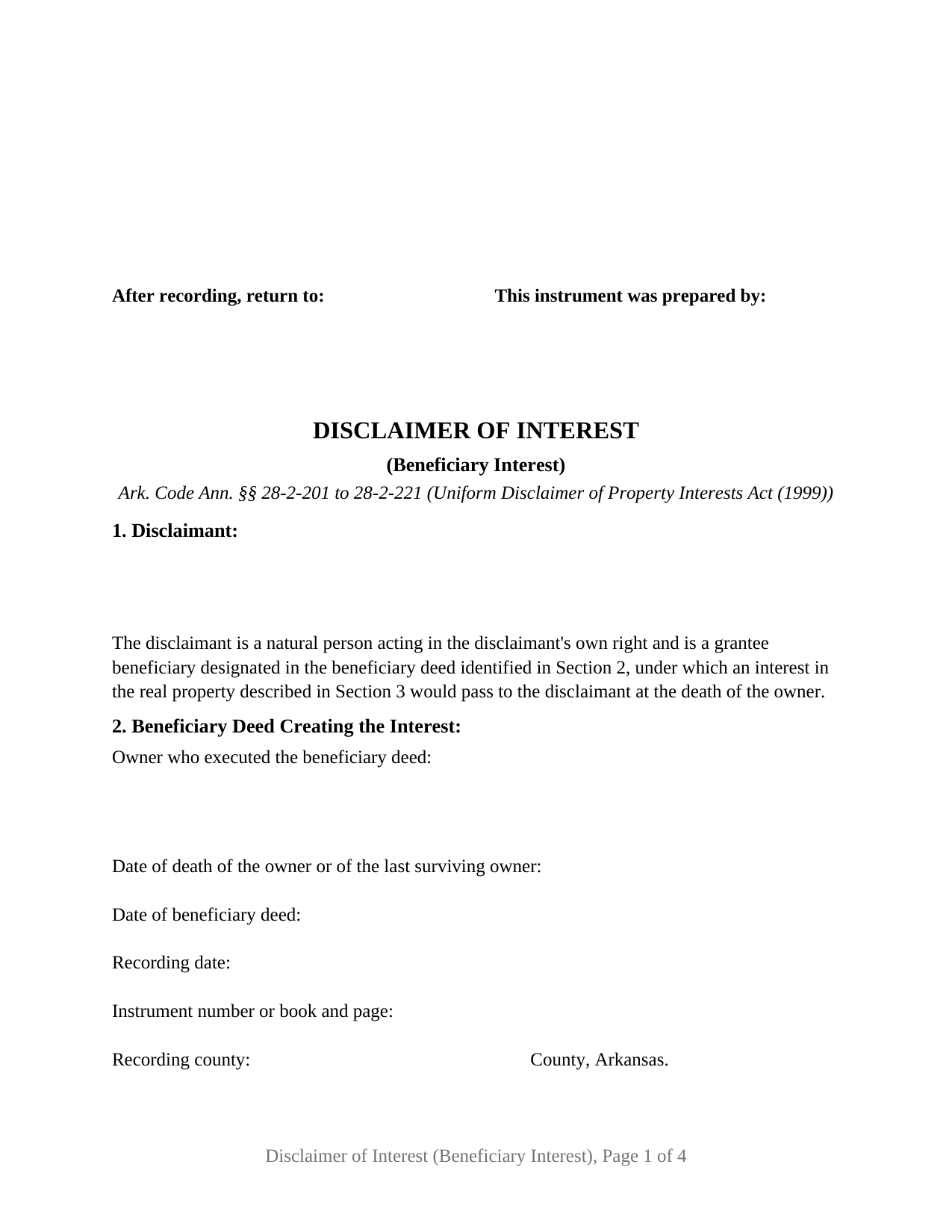
An Arkansas beneficiary deed hands real estate to a named grantee beneficiary the moment the owner dies, with no probate and no signature from the beneficiary. The Arkansas Disclaimer of Interest (Beneficiary Interest) is the instrument for the beneficiary who does not want it: one grantee beneficiary named in a recorded Arkansas beneficiary deed who refuses, in whole, the interest in real property that deed would pass at the owner's death. It is prepared under the Uniform Disclaimer of Property Interests Act (1999), Ark. Code Ann. sections 28-2-201 to 28-2-221, and built to be recorded with the circuit clerk of the county where the land lies.
A refusal that reaches back to the owner's death
Arkansas law treats a disclaimer as a refusal to accept, not as a gift onward. Section 28-2-205(f) says a disclaimer made under the chapter is not a transfer, assignment, or release, and section 28-2-206(b)(1) makes it effective as of the time the instrument creating the interest became irrevocable, which for a beneficiary deed is the owner's death. The disclaimant therefore never owns the property for even a day. Where the interest goes instead is decided by the beneficiary deed's own terms and by section 28-2-206: an individual disclaimant is treated as having died immediately before the time of distribution, so a successor grantee the owner named on that condition takes under section 18-12-608, and where the deed names none the chapter's default rules decide. The disclaimer names no recipient, because the statute does not let it.
That timing is also why the form is written for the period after the owner's death. Section 2 of the instrument identifies the beneficiary deed by its date, recording date, instrument number or book and page, and recording county, together with the owner who executed it and the date of death. Where two owners made the deed as tenants by the entirety or joint tenants with right of survivorship, the deed operated at the second death, and the form takes that date.
What the statute requires the writing to contain
Section 28-2-205(c) sets four requirements: the disclaimer is in a writing or other record, declares the disclaimer, describes the interest disclaimed, and is signed by the person making it, and it is delivered or filed as section 28-2-212 provides. The form meets the first three on its face. Section 1 identifies the disclaimant and recites the configuration the form carries, a natural person acting in the disclaimant's own right who is a grantee beneficiary under the identified deed. Section 3 carries the county, the legal description copied from the beneficiary deed, the street address, and the parcel number. Section 4 performs the act in fixed operative text: the disclaimant disclaims and refuses to accept, in whole, the interest in the described property that would otherwise pass under the deed. The same section states that none of the events section 28-2-213 names as bars has occurred, that the disclaimant receives no consideration, and that the disclaimed interest passes as section 28-2-206 provides.
Delivery is the fourth requirement, and it happens outside the recorder's office. Section 28-2-212(g) directs a disclaimer of an interest created by a beneficiary designation, a term the section extends to any nonprobate transfer at death, to the person obligated to distribute the interest, by personal delivery, first-class mail, or any other method likely to result in receipt. The guide walks through that provision and through section 28-2-214, under which a disclaimer is tax-qualified under federal law only if made within the federal period, generally nine months from the owner's death.
Why this disclaimer is recorded like a deed
A disclaimer of a bank account or of a bequest of personal property is delivered under section 28-2-212 and has no place in the land records. Real property is different. Section 28-2-215(a) provides that when real property or an interest in it is disclaimed, a copy of the disclaimer shall be recorded in the office of the circuit clerk of the county in which the property is located. A disclaimer that answers a recorded beneficiary deed belongs in the same records as the deed, where a title examiner reading the chain finds the refusal beside the designation it refuses. The form is therefore built to the Arkansas recording format of section 14-15-402(b)(1), with the two and one half inch recording space at the top of the first page and at the bottom of the last, and it carries the preparer statement section 14-15-403 places on the face of the first page. It also carries the transfer tax statement section 26-60-110(b)(3)(B) permits, since a disclaimer involves no consideration and is not a transfer.
The spouse's written consent and dower
Arkansas's disclaimer chapter carries a provision directed at the disclaimant's spouse. Under section 28-2-215(b), when an interest in or relating to real property is disclaimed and recorded, the spouse of the person entering the disclaimer, if the spouse has consented to the disclaimer in writing, is automatically debarred from any dower or curtesy interest in that real estate to which the spouse would otherwise have been entitled. The form carries that consent as Section 6: a fixed sentence by which the undersigned spouse consents in writing to the disclaimer, a signature block captioned SPOUSE OF DISCLAIMANT, and a separate acknowledgment certificate for the spouse. A disclaimant who is unmarried, or whose spouse does not consent, leaves the block and its certificate blank; the disclaimer itself is the disclaimant's act alone.
One disclaimant, the whole interest
The form recites exactly one disclaimant signing in that person's own right and disclaiming the entire interest. Two grantee beneficiaries who each refuse present two disclaimers, one per person. A partial disclaimer, which section 28-2-205(d) allows to be stated as a fraction, percentage, or other interest in the property, follows a different pattern than this form recites, as do disclaimers by a guardian, executor, or administrator for a minor, incompetent, or deceased beneficiary under section 28-2-216, disclaimers of devises under a will or of trust interests, and the surviving joint tenant's disclaimer of survivorship rights under section 28-2-207. The disclaimant signs before a notary public, and the certificate printed on the form follows the Arkansas statutory acknowledgment for an individual under section 16-47-107(b), with a second certificate for the consenting spouse so the two may acknowledge on different days or before different officers.
The package includes the fillable disclaimer of interest form, a completed example filled in for a Pulaski County fact pattern, and the guide that walks through every numbered section, the delivery and recording rules, and the time limits. This description and the guide describe the form and the governing Arkansas statutes in general terms; they are not legal advice.
Important: County-Specific Forms
Our disclaimer of interest (beneficiary interest) forms are specifically formatted for each of the 75 counties in Arkansas.
After selecting your county, you'll receive forms that meet all local recording requirements, ensuring your documents will be accepted without delays or rejection fees.