Arkansas Revocation of Beneficiary Deed
County Specific Legal Forms Validated as recently as November 9, 2026 by our Forms Development Team
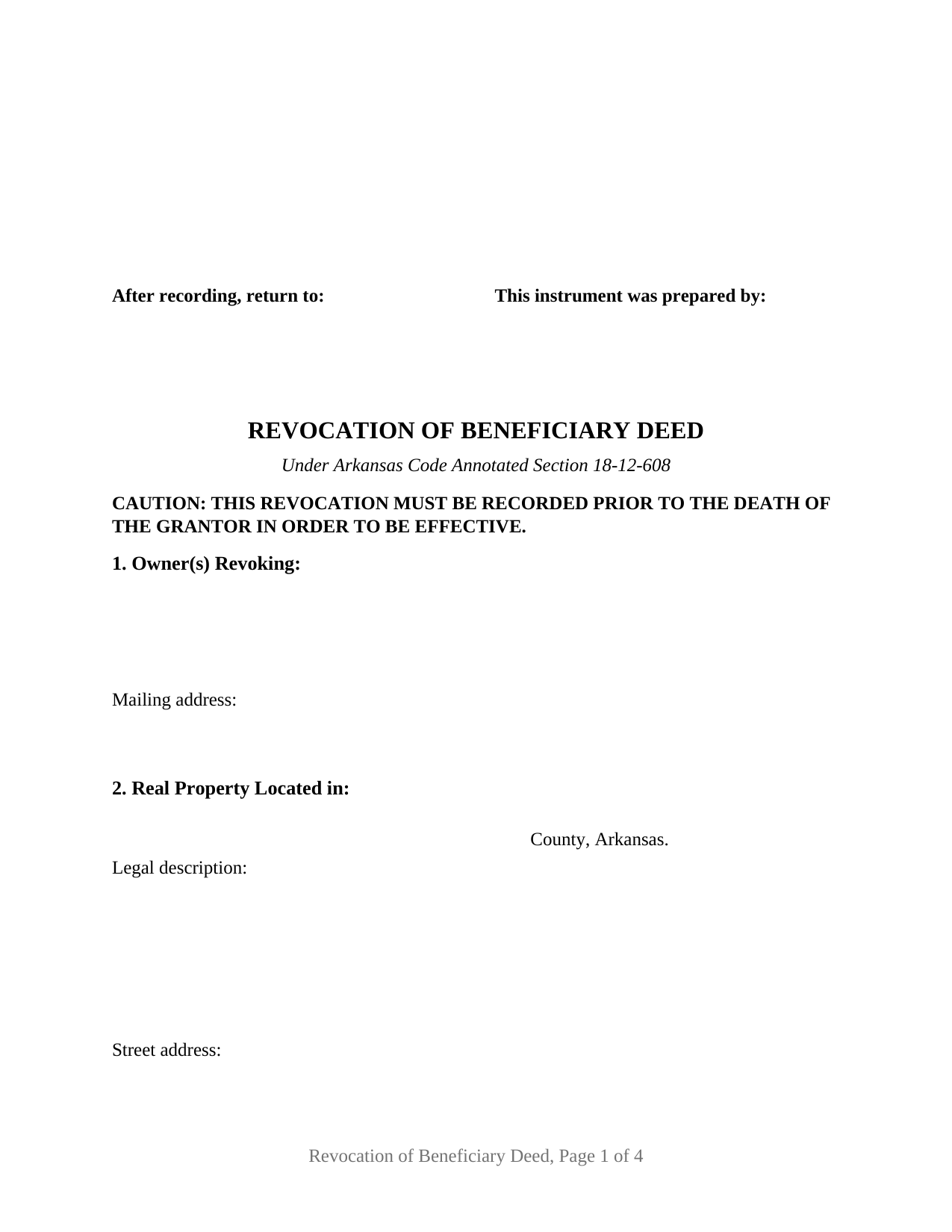
About the Arkansas Revocation of Beneficiary Deed
How to Use This Form
- Select your county from the list
- Download the county-specific form
- Fill in the required information
- Have the document notarized if required
- Record with your county recorder's office
What Others Like You Are Saying
"The form gave me a perfect place to start. I was looking for something regarding time-shares, so the…"
"I have yet to have my Certification of Trust notarized nor have I gone to my bank to see if it's acc…"
"So far so good"
"Great Transaction. Easy to follow instructions!"
"Easy to use but the quit claim deep looked old and dated. The example of how to fill out should have…"
4.8/5 from 4,847 reviews. Read all
An Arkansas beneficiary deed stays revocable for the owner's whole life, but taking it back is a recorded act: Arkansas Code Annotated Section 18-12-608(d) makes a revocation effective only when it is executed before the death of the owner who signs it and recorded, before that death, in the county where the property is located. This form prepares that instrument of revocation for a recorded Arkansas beneficiary deed signed by one or two owners, in the words the statute itself supplies.
A designation that ends only on the record
Under Section 18-12-608, a beneficiary deed conveys nothing while the owner lives; no legal or equitable interest vests in the grantee until the owner dies without having revoked it. That is what makes revocation a matter of record rather than intent. A signed revocation kept in a drawer at the owner's death revokes nothing, and the beneficiary deed operates exactly as recorded. A will cannot do the job either: subsection (d)(4) provides that a beneficiary deed that complies with the section may not be revoked, altered, or amended by the provisions of the owner's will. The one recorded path the chapter writes for an owner who wants no designation at all is the instrument of revocation this form prepares; the statute separately recognizes that a later beneficiary deed concerning the same property, last signed before death and recorded, displaces an earlier one, and that later deed is a separate instrument prepared and recorded separately and not included in this package.
The statute's own sentence does the revoking
Subsection (h) of Section 18-12-608 prints a revocation form and declares an instrument sufficient when it follows that form substantially. This product carries the form's two fixed passages word for word. The caution at the head of the instrument reads, in capital letters, that the revocation must be recorded prior to the death of the grantor in order to be effective. The operative sentence then revokes the beneficiary deed recorded on a stated date, in a stated docket or book and page or under a stated instrument number, in the records of a named Arkansas county, with each of those references drawn as a fillable entry in the order the statute prints them. Around those passages the form adds what the recording statutes and a clear chain of title call for: an owner block, the county and legal description copied from the beneficiary deed, the date the beneficiary deed was signed and the grantees it named, and the preparer statement that Section 14-15-403 places on the face of the first page of every instrument affecting title to Arkansas real estate.
One or two owners on a single instrument
The form recites no marital status, no vesting, and no capacity. Its owner block is free form and receives one or two natural persons who signed the beneficiary deed as its grantors, named as the recorded deed names them, with whatever status recital the owners state. Two signature blocks follow, headed OWNER and SECOND OWNER (if applicable), each with its own acknowledgment certificate; where one owner revokes, the second block and its certificate are simply left blank. The patterns that appear in the record are a sole owner revoking a deed that owner alone signed, two co-owners revoking together, one tenant in common revoking as to that owner's own interest, and the last surviving owner revoking alone a deed two owners signed. Section 18-12-608(d)(1) lets any owner who executed the beneficiary deed revoke it, and (d)(3) provides that a revocation not executed by all the owners is effective only when executed by the last surviving owner and recorded before that owner's death. The form is not set up for an owner signing through an attorney-in-fact, for a trustee or entity owner, or for three or more owners; each of those involves capacity recitals or representative certificates this instrument does not carry.
The Arkansas acknowledgment, in the statutory form
Each certificate on the form is the individual acknowledgment of Arkansas Code Annotated Section 16-47-107(b), the form the statute deems a valid acknowledgment and sufficient for recording: the officer certifies that the named owner, personally well known or satisfactorily proven, appeared and acknowledged signing, executing, and delivering the instrument for the consideration, uses, and purposes stated, closing with the officer's hand and official seal. The certificate's own words admit a notary public or any officer within or without the state qualified under existing law to take acknowledgments, so an owner living outside Arkansas acknowledges before a local officer. The two certificates are the form's architecture, allowing two owners to appear on different dates or before different officers; Arkansas law prints a certificate that can name more than one acknowledging person and sets no separate-certificate rule.
Recording where the beneficiary deed was recorded
The revocation goes to the circuit clerk and ex officio recorder of the county where the property lies, the same office that recorded the beneficiary deed. The instrument is built to Section 14-15-402(b)(1): letter size pages, the top of the first page reserved for the recorder's file mark, margins inside the statutory minimums, and the bottom of the last page left clear. The revocation conveys nothing and recites no consideration, and the real property transfer tax of Section 26-60-105 is levied on instruments conveying realty for consideration above one hundred dollars; the guide describes how county recorders handle the transfer tax affidavit and the exemption statement on an instrument of this kind, along with the photo identification step Act 752 of 2025 added for deeds to real estate presented in person or by mail.
The package includes the fillable revocation form, a completed example filled in for a realistic Pulaski County fact pattern, and a guide that walks through every numbered section, the signing and notarization steps, and the recording process. This description and the guide describe the form and the governing Arkansas statutes in general terms; they are not legal advice.
Important: County-Specific Forms
Our revocation of beneficiary deed forms are specifically formatted for each of the 75 counties in Arkansas.
After selecting your county, you'll receive forms that meet all local recording requirements, ensuring your documents will be accepted without delays or rejection fees.