California Notice of Pending Action
County Specific Legal Forms Validated as recently as October 7, 2026 by our Forms Development Team
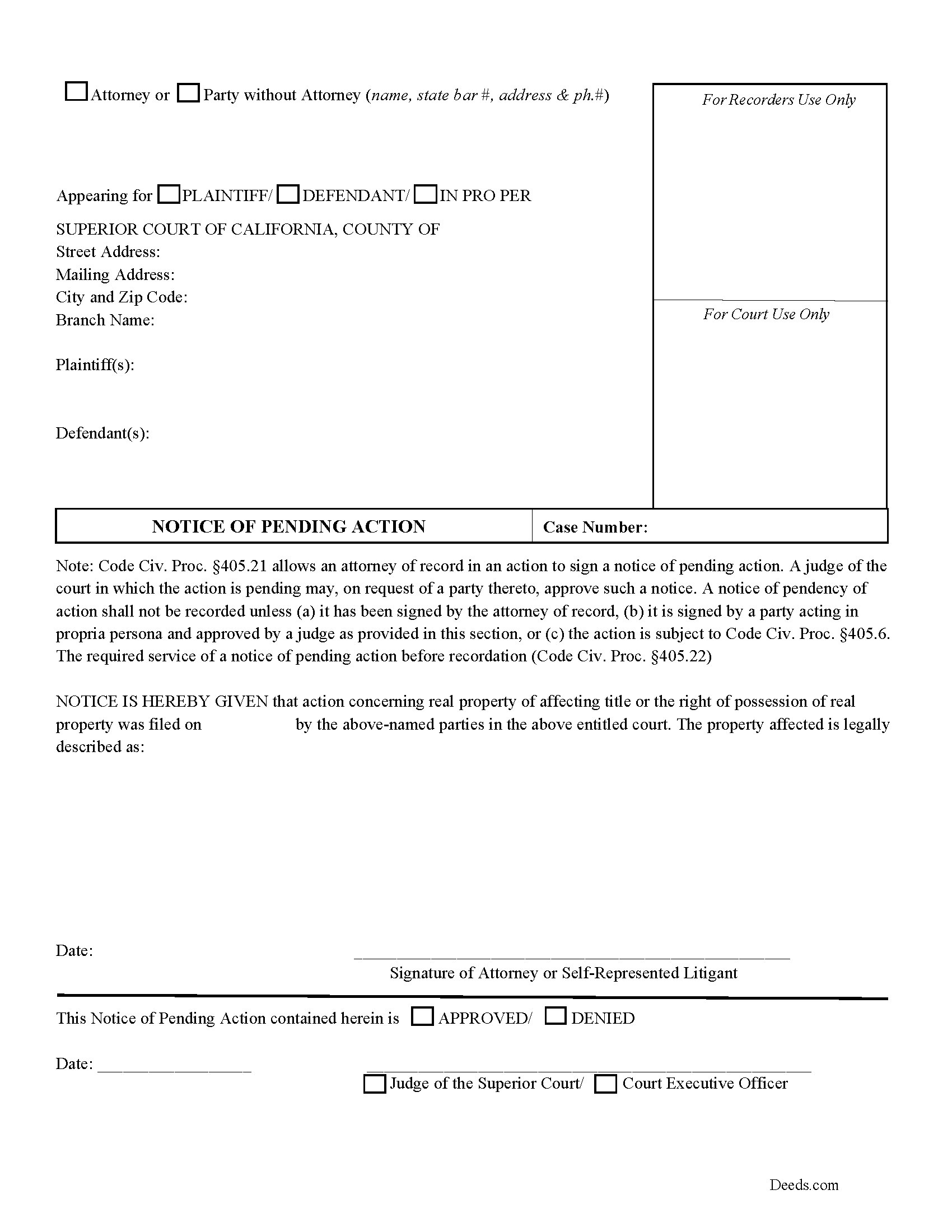
About the California Notice of Pending Action
How to Use This Form
- Select your county from the list
- Download the county-specific form
- Fill in the required information
- Have the document notarized if required
- Record with your county recorder's office
What Others Like You Are Saying
"The docs were precise and accurate for my specific needs. I greatly appreciated the accompanying for…"
"Very skeptical at first...but it worked easily and perfectly."
"I saved 225.00 with this purchase.Make sure you have an updated property description from your count…"
"5 Stars isn't enough! I worked with KVH today (12-30-20) to get some deeds filed in Dallas County be…"
"Just as advertised."
4.8/5 from 4,829 reviews. Read all
A Notice of Pending Action, formerly known as a lis pendens, is a document that is recorded to give constructive record notice of a pending lawsuit. The lawsuit must involve a claim which affects (a) title to, or right to possession of, real property; or (b) the use of an easement. [Code Civ. Proc. 405.4] When recorded, the notice lets subsequent buyers, transferees and encumbrancers know that an action is pending which affects the real property.
An attorney of record in an action may sign a notice of pendency of action. Alternatively, a judge of the court in which an action that includes a real property claim is pending may, on request of a party, approve a notice of pendency of action. A notice of pendency of action may only be recorded if: (1) it has been signed by the attorney of record; (2) it is signed by a party acting in propria persona ("for one's self," acting on one's own behalf) and approved by a judge; or (3) the action is one in eminent domain and subject to Code Civ. Proc. 405.6. [Code Civ. Proc. 405.21]
A party to an action who asserts a real property claim may record a notice of pendency in the action in which that real property claim is alleged. The notice must be recorded in the office of the recorder of each county in which all or part of the real property is situated. The notice must contain the names of all parties to the action and a description of the property affected by the action. [Code Civ. Proc. 405.20]
Except in eminent domain actions subject to Code Civ. Proc. 405.6, a real property claimant must, prior to recording the notice, mail a copy of it, by registered or certified mail with return receipt requested, to all known addresses of the parties to whom the real property claim is adverse, and to all owners of record of the real property affected by the claim. Immediately after recording, file a copy of the notice with the court in which the action is pending. [Code Civ. Proc. 405.22]
Any failure to meet the statutory obligations, including the Proof of Service requirement, will render the notice of pendency of action void and invalid as to any adverse party or owner of record. [Code Civ. Proc. 405.23]
Lawsuits can be complicated, and even small errors can affect the outcome of a case. Please contact an attorney with questions about using the Notice of Pending Action, or for any other issues related to real property in California.
(California Notice of Pending Action Package includes form, guidelines, and completed example)
Important: County-Specific Forms
Our notice of pending action forms are specifically formatted for each of the 58 counties in California.
After selecting your county, you'll receive forms that meet all local recording requirements, ensuring your documents will be accepted without delays or rejection fees.