California Warranty Deed (Two Grantors)
County Specific Legal Forms Validated as recently as October 9, 2026 by our Forms Development Team
About the California Warranty Deed (Two Grantors)
How to Use This Form
- Select your county from the list
- Download the county-specific form
- Fill in the required information
- Have the document notarized if required
- Record with your county recorder's office
What Others Like You Are Saying
"Website is user-friendly and very helpful, butI will have to wait until I submit my documents to the…"
"YOU WERE NOT ABLE TO PROVIDE SERVICE IN THE COUNTY WE NEEDED IN NEW MEXICO. YOUR RESPONSE WAS QUICK …"
"The website was very easy to navigate and I found it easy to get the documents I needed. I also foun…"
"This was exactly what I needed. For $25-$30 it gave me the formatted document I needed and made it s…"
"This was a great service! I was having trouble recording something and found this was the best, and …"
4.8/5 from 4,825 reviews. Read all
Two grantors join in this California warranty deed, so one recorded instrument carries both owners' conveyances, both signatures, and express covenants of title running from both of them. The form is configured for exactly two natural persons transferring California real property together, from the two-name grantor section through the pair of notary certificates at the end.
One deed, two signatures, two certificates
The grantor section recites two individual owners and how they hold, each grantor signs on a labeled line with a printed name and date, and the deed closes with a separate Civil Code Section 1189 acknowledgment certificate for each signer, each certificate opening with the boxed notary notice the statute prescribes and reciting the officer's name and title. California law does not require separate certificates for two signers; the two-certificate layout is what lets each grantor appear at a different time or place, and the completed example shows the pattern in action, with one acknowledgment taken in Sacramento County and the second taken in Placer County a day later. Everything the notary completes sits below a divider, so the grantors' portion of the deed ends cleanly at the signature lines.
Community property and the second signature
California is a community property state, and Family Code Section 1102 provides that both spouses join in executing an instrument by which community real property is sold, conveyed, or encumbered; Family Code Section 297.5 extends the same rule to registered domestic partners. A married couple deeding the community property home to a buyer therefore appears on the record as two grantors on one instrument, which is the configuration this deed carries. Two unmarried co-owners present the same pattern from a different direction: tenants in common or joint tenants passing their undivided interests to a single grantee convey the whole property through one deed with two signatures. The form is not set up as a sole-owner conveyance, an entity or trustee conveyance, or a signing through an attorney in fact; it recites exactly two record owners acting personally.
Both grantors stand behind the title
The covenant section speaks for both grantors at once. They covenant that they hold the property in fee simple, that they have full power to convey it, that no encumbrances burden it beyond the matters the deed itself lists, that the grantee's possession will be undisturbed, and that they will defend the title against all lawful claims. Those express promises reach back through the entire chain of title, and because the deed keeps the statutory word grant, the two covenants Civil Code Section 1113 implies and the after-acquired title rule of Civil Code Section 1106 operate alongside them. California publishes no statutory warranty deed form, so the covenants exist because the deed states them, and the exceptions section lets the grantors define exactly what the covenants except.
A first page the recorder can process
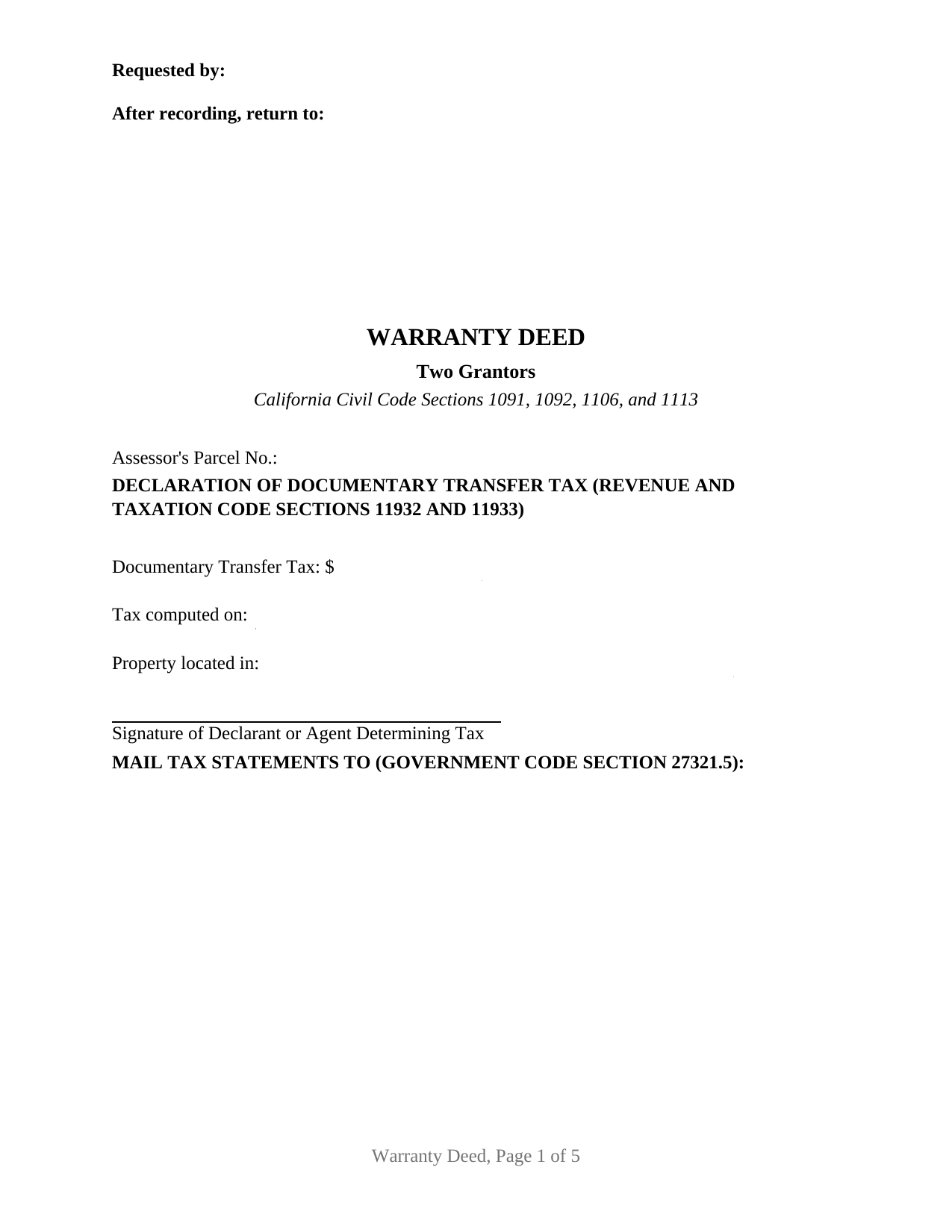
The first page carries the requester and return blocks inside the recording space California reserves, the title beneath it, an assessor's parcel number line, the signed documentary transfer tax declaration with its computation and location entries, and the mail tax statements block that a fee-title deed shows before acceptance. The guide that accompanies the form walks through the county recorder process for a two-grantor deed: county fees and the statewide surcharges, the Preliminary Change of Ownership Report signed by the transferee, city transfer taxes where they apply, and the race-notice priority a promptly recorded deed secures.
What arrives with the form
The completed example presents the whole document filled in for a Sacramento County sale by a married couple, from the transfer tax declaration through both notary certificates, so every entry has a model. This purchase delivers the blank two-grantor warranty deed as a fillable PDF, the completed example, and the guide; the materials are informational and are not legal advice.
Important: County-Specific Forms
Our warranty deed (two grantors) forms are specifically formatted for each of the 58 counties in California.
After selecting your county, you'll receive forms that meet all local recording requirements, ensuring your documents will be accepted without delays or rejection fees.