California Special Warranty Deed
County Specific Legal Forms Validated as recently as October 14, 2026 by our Forms Development Team
About the California Special Warranty Deed
How to Use This Form
- Select your county from the list
- Download the county-specific form
- Fill in the required information
- Have the document notarized if required
- Record with your county recorder's office
What Others Like You Are Saying
"Got me all the info I was looking for Thanks you deeds.com"
"Very happy with the service that you offer. My office will use you again."
"I was informed that a quit Claim Deed that I had submitted, did not meet county requirements. I orde…"
"Have yet to use. Appears over whelming, we will see."
"So thankful that I could just find the form and complete the estate I am working on for my parents. …"
4.8/5 from 4,825 reviews. Read all
California's codes never name a special warranty deed. The Civil Code prints a short grant deed form and implies two narrow covenants from the word grant; everything beyond that is drafted. This California special warranty deed writes the missing piece out: an express covenant by which the grantor warrants and defends the title, limited to claims arising by, through, or under the grantor, but not otherwise. The deed promises the grantor's own chapter of the chain of title and leaves the earlier chapters where a title search and title insurance address them.
A warranty that stops at the grantor's tenure
Civil Code Section 1113 implies two covenants from the word grant in a fee conveyance: no prior conveyance of the same estate by the grantor, and no encumbrance done, made, or suffered by the grantor. Both are already confined to the grantor's own acts, which is why California practice treats the grant deed as this state's counterpart to other states' special warranty instruments. What the bare grant deed lacks is a stated duty to defend. This form adds it expressly: the grantor binds the grantor and the grantor's heirs, successors, and assigns to warrant and forever defend the title against every person lawfully claiming the property by, through, or under the grantor, but not otherwise. The deed also states that the express covenant does not restrain the Section 1113 implied covenants, so the express and implied promises run together, each confined to the grantor's period of ownership. And because the deed uses the word grant, title the grantor later acquires passes to the grantee under Civil Code Section 1106.
Built for the California recording counter
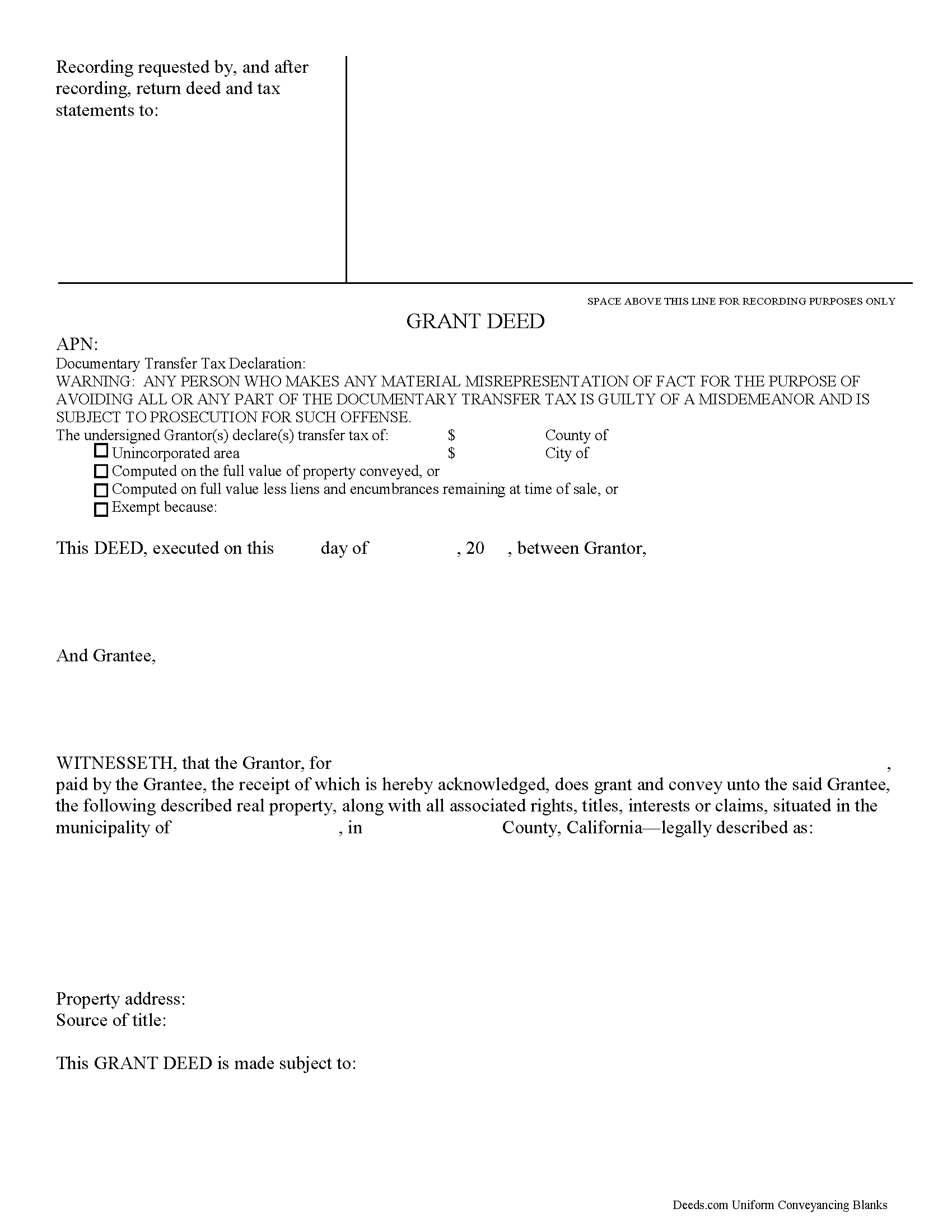
The first page reserves the recorder's two and one half inch space with the requester, return address, and assessor parcel number lines the county reads first, and carries the documentary transfer tax declaration that Revenue and Taxation Code Sections 11932 and 11933 require on the face of a taxable deed: the amount, one of the two computation statements, the city or unincorporated location, and an exemption line for a transfer the code exempts. A mail tax statements block satisfies Government Code Section 27321.5, and the acknowledgment certificates print the Civil Code Section 1189 text in full, boxed notice included, the certificate completed for every acknowledgment taken in California.
One or two grantors, one or two grantees
The face of this form carries no marital status, no capacity, and no form of co-ownership. Section 1 takes one or two grantor names on open lines with whatever status wording the transaction carries; Section 2 takes one or two grantees followed by the vesting designation they take under, written in rather than preprinted, from tenancy in common to joint tenancy to community property with right of survivorship. Two signature blocks follow, each with its own acknowledgment certificate, so co-owner grantors may sign on different dates or before different notaries; a sole grantor uses the first block and leaves the second blank. A sole owner selling to a purchasing couple, and two heirs passing an inherited house to a single buyer, both present the pattern this deed recites. The form is not set up as an entity, trustee, or power of attorney conveyance, and it recites at most two owners on each side.
What the record shows afterward
California runs a race-notice system: a recorded conveyance imparts constructive notice under Civil Code Section 1213, and Section 1214 makes an unrecorded deed void as against a later good-faith purchaser for value who records first, so the deed is built to go of record cleanly the day it is signed. Buyers and sellers searching for a limited warranty deed, or for a grant deed with an express defense covenant, are describing the same instrument this form prepares under its traditional name.
The purchase delivers the fillable special warranty deed formatted to California's recording statutes, a completed example filled for a two-grantor Placer County sale from the transfer tax figures through both notary certificates, and a guide that walks the form section by section, including the vesting menu, the signing formalities, and the county recorder's fees. The materials are informational and are not legal advice.
Important: County-Specific Forms
Our special warranty deed forms are specifically formatted for each of the 58 counties in California.
After selecting your county, you'll receive forms that meet all local recording requirements, ensuring your documents will be accepted without delays or rejection fees.