Colorado Warranty Deed
County Specific Legal Forms Validated as recently as October 20, 2026 by our Forms Development Team
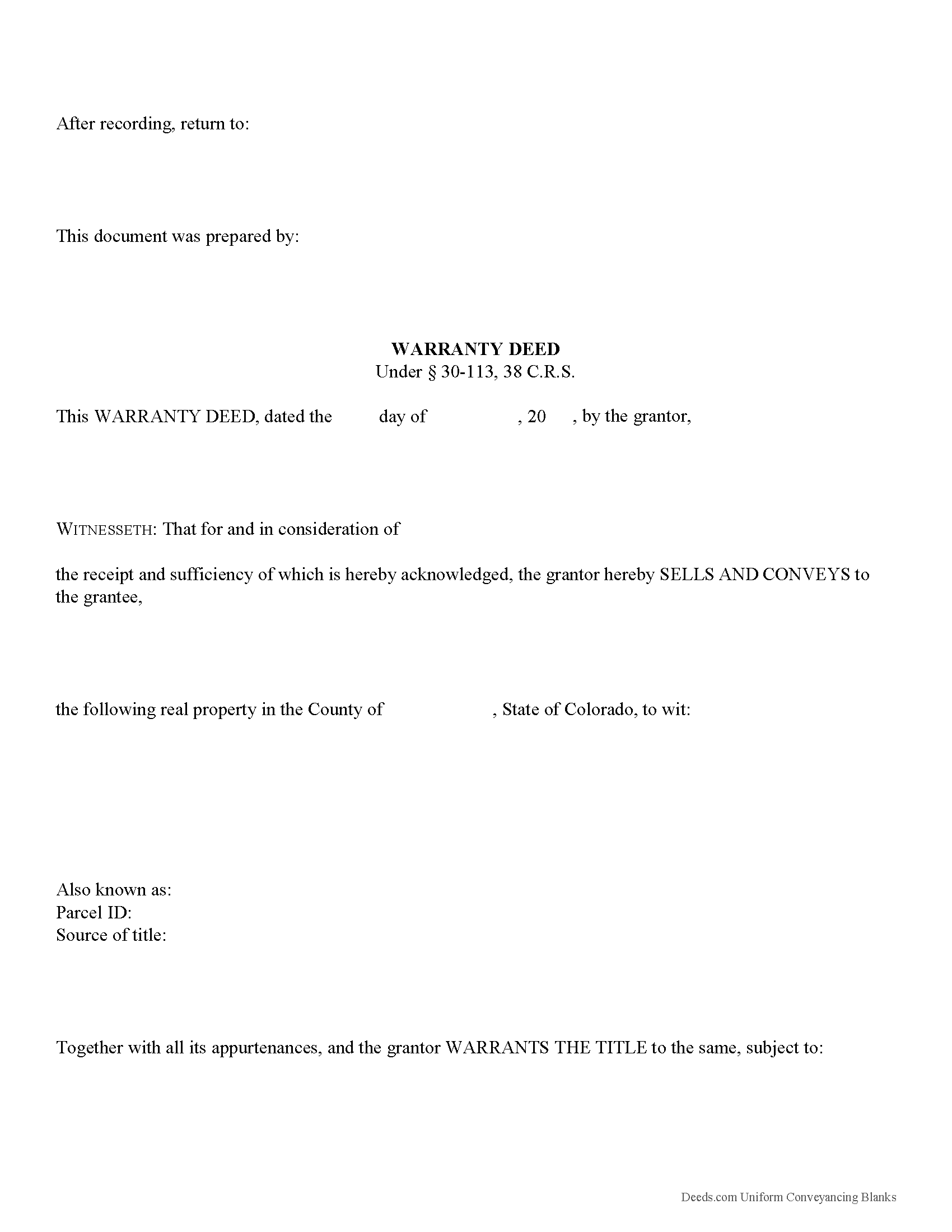
About the Colorado Warranty Deed
How to Use This Form
- Select your county from the list
- Download the county-specific form
- Fill in the required information
- Have the document notarized if required
- Record with your county recorder's office
What Others Like You Are Saying
"Thank you so very much I live in Texas but I Owned a home in Indiana with your help I could never ge…"
"Smooth and efficient. Great site for what you may need."
"The website worked fine and I would have been happy to pay the extra money except the deed I needed …"
"Easy to use!"
"Very easy to use, helpful instructions and examples. I also like the chat feature and the erecording…"
4.8/5 from 4,836 reviews. Read all
A Colorado deed takes its legal character from the words inside it, not from the heading printed across the top, and the warranty deed is the version whose words commit a seller to the strongest promise about title that state law supplies. This form prepares that instrument on the short statutory pattern at Section 38-30-113(1)(a), under which a grantor, for a stated consideration in hand paid, sell(s) and convey(s) the described land with all its appurtenances and warrant(s) the title to the same.
One statute, four deeds, a few decisive words
That section holds a single skeleton producing four different Colorado instruments, depending on what the drafter leaves in. Substitute quitclaim(s) for convey(s) and strike the warranty phrase, and the result moves whatever interest exists and no after-acquired title. Narrow the promise to claims arising through the grantor, and a special warranty deed emerges. Keep the granting words but delete the warranty, and the instrument is a bargain and sale deed, still passing after-acquired title while promising nothing about it. Leave the full phrase intact, as this form does, and the deed is a general warranty deed, what buyers and lenders expect at a market closing.
How far the promise reaches
Subsection (4)(a) unpacks four covenants from three words of warranty: fee simple ownership with power to convey, no encumbrances beyond those the deed itself lists, quiet possession for the person taking title, and a duty to defend when someone else claims the land. None of it is bounded by the years the seller happened to own the property, so a forged signature or a missed heir from decades earlier still lands on the grantor who signed. Under Section 38-30-121 the covenants run with the premises, reaching owners further down the chain.
Open party blocks, one or two names on each side
The deed is written as the general Colorado warranty deed, so its party blocks are open lines rather than fixed recitals. One or two individual grantors go in the first block, one or two individual grantees in the second, and any status or co-ownership wording, such as a joint tenancy declaration under Section 38-31-101, is entered by the parties instead of being preprinted by the form. Four count patterns therefore fit the same instrument: one name conveying to one, one conveying to two, two conveying to one, and two conveying to two. Execution follows the same shape, with blocks captioned GRANTOR and SECOND GRANTOR (if applicable), each paired with a certificate drawn from the RULONA short form at Section 24-21-516(1)(a); a conveyance signed by a single owner leaves the second block and its certificate empty. Deeds signed by a corporation or limited liability company, by a trustee, by an agent under a recorded power of attorney, or by three or more record owners call for authority recitals and signature counts this instrument does not draw.
The three entries a Colorado recorder cares about
Three blanks carry outsized weight at the counter. The exceptions line accepts Colorado's defined shorthand, subject to statutory exceptions, which Section 38-30-113(4)(b) reads as current-year taxes not yet payable, survey and inspection matters the grantor neither created nor knew about, and everything of record in the county; specific recorded matters can be listed there instead, or alongside it. The grantee block asks for a legal address because Section 38-35-109(2) directs the clerk to return an unrecorded deed that lacks one. And the consideration figure drives the state documentary fee, one cent per hundred dollars once total consideration passes five hundred dollars, which the clerk collects and notes on the face of the record before accepting it, while the TD-1000 transfer declaration rides along to the assessor without ever entering the record. Page one of the form keeps the top inch clear for the recording stamp, matching the margins Section 30-10-406(3)(a) sets for every recorded page.
The download holds three files: the blank warranty deed as a fillable PDF, a completed example worked through a Douglas County sale between two sellers and two buyers, and a plain-language guide covering each numbered section, the covenants behind the warranty words, every way Colorado grantees may hold title, and the fees and declarations that accompany the deed to the clerk and recorder. These materials explain Colorado law in general terms; they are not legal advice.
Important: County-Specific Forms
Our warranty deed forms are specifically formatted for each of the 64 counties in Colorado.
After selecting your county, you'll receive forms that meet all local recording requirements, ensuring your documents will be accepted without delays or rejection fees.