Connecticut Memorandum of Agreement
County Specific Legal Forms Validated as recently as October 9, 2026 by our Forms Development Team
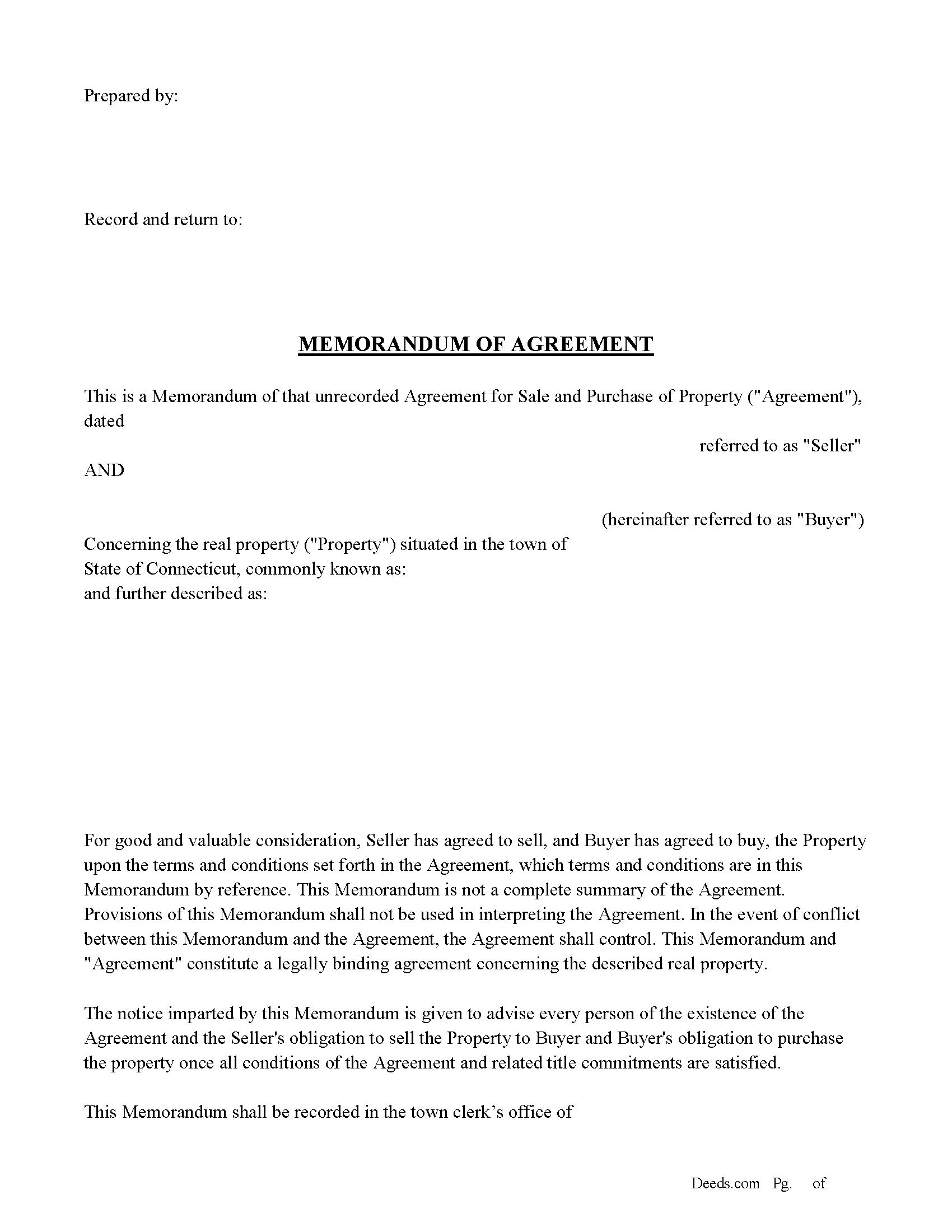
About the Connecticut Memorandum of Agreement
How to Use This Form
- Select your county from the list
- Download the county-specific form
- Fill in the required information
- Have the document notarized if required
- Record with your county recorder's office
What Others Like You Are Saying
"A very easy website....consumer friendly, which is what is so important to me. I will be using your …"
"Fast, effective, and good communication. I have no complaints at all."
"The document was easy to locate, pay for and download. I hope it will be this easy to process by the…"
"Very satisfied. Highly recommend!"
"Very easy site to use and reasonably priced. My document was received by the county and filed within…"
4.8/5 from 4,830 reviews. Read all
A memorandum under Connecticut’s Statute of Frauds (Sec. 52-550) serves as a written record that ensures a Purchase Agreement is legally enforceable. Here’s how it affects buyers and sellers in a Buy/Sell Purchase Agreement for real property:
1. Purpose of the Memorandum:
The memorandum fulfills the requirement that certain types of agreements, including land contracts, must be in writing. It doesn't necessarily need to be a formal, full-length contract but must contain the essential terms of the agreement. Without this, no civil action (lawsuit) can be maintained to enforce the land sale.
2. Required Elements of the Memorandum:
For a memorandum to be valid under Sec. 52-550, it must contain:
Identification of the parties: The names of the buyer and the seller must be clearly stated.
Description of the property: The land or real estate being sold must be sufficiently described to identify it (e.g., address, lot number, etc.).
Terms of the agreement: This includes the price or how the price is to be determined, and other key terms, like payment schedules or conditions for closing.
Signature: The memorandum must be signed by the party to be charged (the party against whom enforcement is sought) or their agent. Both parties' signatures are often ideal for clarity.
3. Effects on Buyers:
Protection: A written memorandum ensures that the buyer can enforce the contract if the seller attempts to back out or change the terms. If the seller refuses to complete the sale, the buyer can use the memorandum as evidence in court.
Clarity on Terms: The written memorandum helps avoid misunderstandings. It clearly sets out the terms that the buyer expects to be fulfilled, such as the price, property description, and deadlines.
4. Effects on Sellers:
Enforceability: The seller can use the memorandum to ensure the buyer is held to their promises, such as paying the agreed price on time. If the buyer tries to renegotiate or claim different terms, the seller has written evidence to support their case.
Prevention of Fraud: The memorandum helps the seller prevent fraudulent claims by ensuring all terms of the deal are clearly written down. The seller is protected from any claims that they promised different terms verbally.
5. Impact of an Incomplete Memorandum:
Risk of Non-Enforceability: If the memorandum lacks essential details (e.g., price, description of the property), it may not meet the requirements of Sec. 52-550 and could be deemed unenforceable in court. This would leave both parties vulnerable, especially if one tries to back out of the deal.
6. Flexibility of Memorandum:
The memorandum doesn’t have to be a formal contract but must include enough information to prove a deal was made and outline its basic terms. It could be as simple as a letter or note that describes the agreement, as long as it’s signed.
Summary:
A memorandum complying with Sec. 52-550 gives both sellers and buyers the legal certainty needed in a land contract. For the buyer, it protects the right to purchase the property under agreed terms. For the seller, it ensures that the terms are clearly defined and can be enforced if the buyer fails to follow through. Both parties should ensure that their memorandum includes all essential details and signatures to avoid disputes and ensure enforceability.
Important: County-Specific Forms
Our memorandum of agreement forms are specifically formatted for each of the 8 counties in Connecticut.
After selecting your county, you'll receive forms that meet all local recording requirements, ensuring your documents will be accepted without delays or rejection fees.