Delaware Easement Deed
County Specific Legal Forms Validated as recently as October 12, 2026 by our Forms Development Team
About the Delaware Easement Deed
How to Use This Form
- Select your county from the list
- Download the county-specific form
- Fill in the required information
- Have the document notarized if required
- Record with your county recorder's office
What Others Like You Are Saying
"My deed has now been recorded. Thank you so very much. I saved about $120.00 by doing this with your…"
"Easy download of correct fillable forms for specific State and County. The accompanying guides and e…"
"Deeds.com has become a great assistant to our firm! The service is of highest quality and consistent…"
"Couldn't be more simple. Good product"
"Nice!"
4.8/5 from 4,825 reviews. Read all
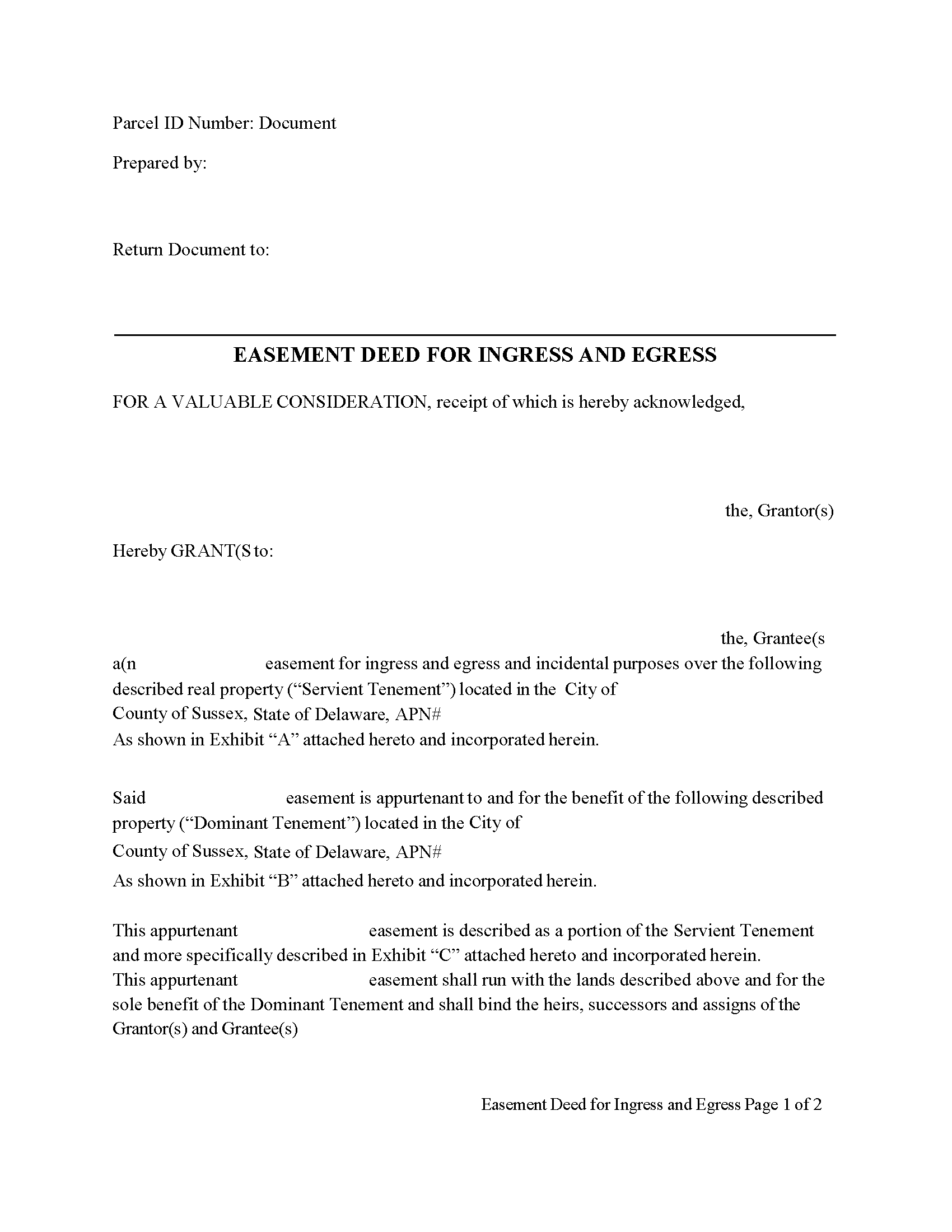
An easement deed in Delaware gives the easement holder a right to use the land of another for a specific purpose. This type of agreement gives the easement holder a non-possessory interest in the land. Once the easement has been granted, the grantor may not interfere with the grantee's use of the easement. Additionally, the easement holder generally cannot expand his use of the easement beyond the original purpose for which it was granted. Easements fall into two categories: an easement in gross or an easement appurtenant.
An easement in Delaware can be created by an express easement, an easement by prescription, or, an easement by necessity. A conservation easement, created for the purpose of protecting property, can also be created by a voluntary agreement that allows a landowner to limit the type or amount of development, while allowing the owner to maintain private ownership. Conservation easements are created in the same manner as other easements in this state ( 6902).
As an instrument that affects title to real property, an easement deed in Delaware must be signed by the grantor and duly acknowledged before it is presented for recording. An easement deed can be acknowledged in any county in Delaware, by any party to the instrument. Acknowledgements in Delaware may be made in the Superior Court, before any judge in Delaware, notary public, before two justices of the peace for the same county, or before the mayor of the city of Wilmington. Easements can also be proved in the court by one or more of the subscribing witnesses ( 122). The acknowledgement or proof of the instrument should be in a certificate that is attached to or endorsed on the easement deed ( 123). If the easement deed is acknowledged out of state, acknowledgements can be taken by any of the officers listed under 129 of the Delaware Revised Statutes.
Delaware has a pure race recording statute. Once an easement deed has been acknowledged or proved and certified as provided, it should be recorded in the recorder's office for the county where such lands are located ( 151). The recording of an easement for one county will take effect only in respect to lands or tenements mentioned in the deed situated in such county ( 152).The time of recording will determine the priority of the easement over other documents pertaining to the same property ( 153).
Important: County-Specific Forms
Our easement deed forms are specifically formatted for each of the 3 counties in Delaware.
After selecting your county, you'll receive forms that meet all local recording requirements, ensuring your documents will be accepted without delays or rejection fees.