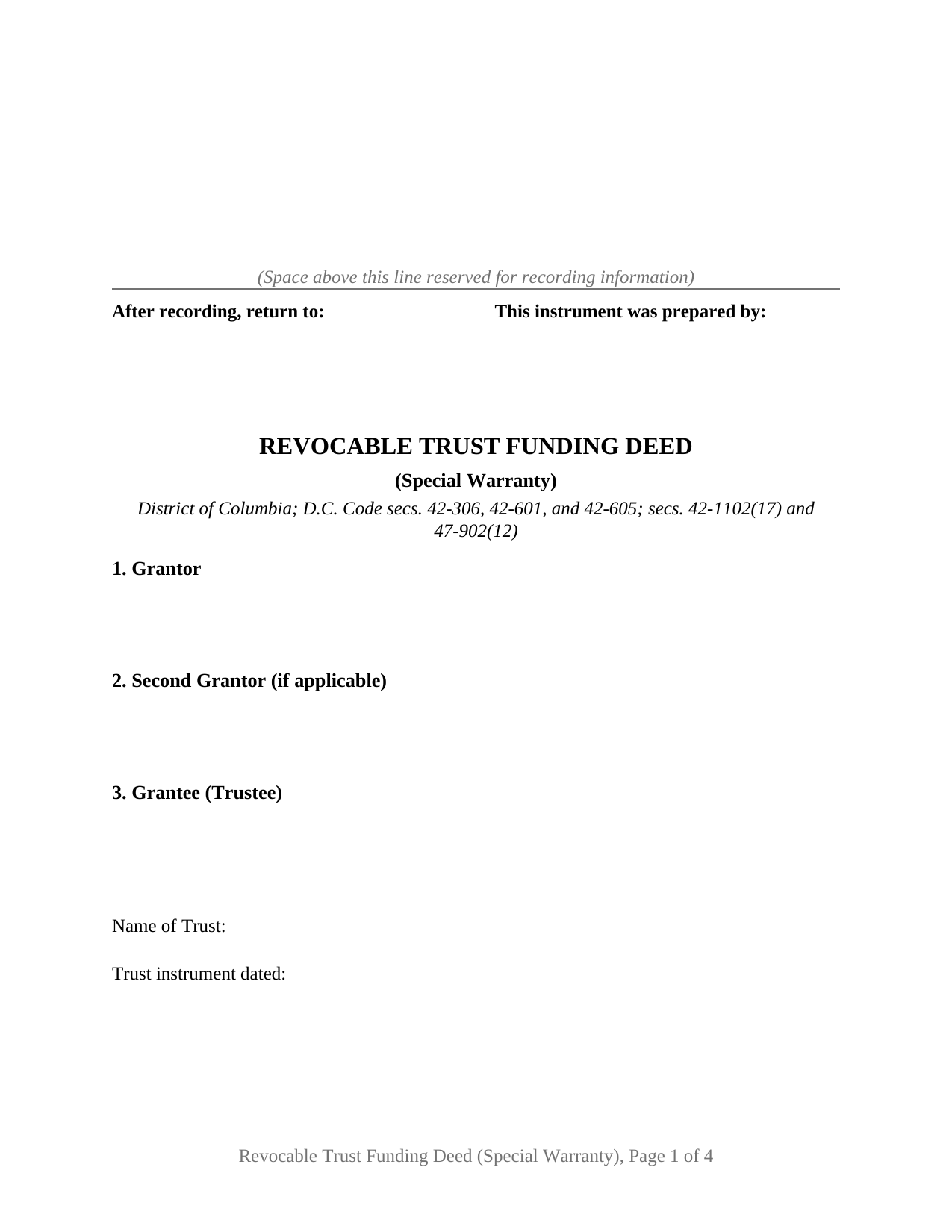
District Of Columbia Revocable Trust Funding Deed (Special Warranty)
County Specific Legal Forms Validated as recently as October 21, 2026 by our Forms Development Team
About the District Of Columbia Revocable Trust Funding Deed (Special Warranty)
How to Use This Form
- Select your county from the list
- Download the county-specific form
- Fill in the required information
- Have the document notarized if required
- Record with your county recorder's office
What Others Like You Are Saying
"This was really easy and very helpful. Thanks,"
"Excellent service and actually better than expected. Plus if the information is not available you re…"
"They always get me the information I need, in a timely manner."
"Deeds was very easy to use. I thought it might take weeks to complete, but the whole process was com…"
"Love the ability to e-record a single document as a private citizen. Other companies only want to do…"
4.8/5 from 4,849 reviews. Read all
A deed that moves a Washington, DC home into the owner's revocable trust usually carries no covenant of title. This District of Columbia Revocable Trust Funding Deed (Special Warranty) carries one: the grantor conveys to the trustee with special warranty under D.C. Code sec. 42-605, a covenant against the grantor's own acts and against anyone claiming by, through, or under the grantor, while the deed stays inside the District's deed tax exemptions for a transfer of bare legal title into a revocable trust.
A covenant that stops at the grantor's own chain
Title covenants in the District arise only from statutory shorthand, and sec. 42-605 supplies two triggers with one effect: a covenant that the grantor will warrant specially the property hereby conveyed, or granting words followed by with special warranty. Either binds the grantor and the grantor's heirs, devisees, and personal representatives to forever warrant and defend the property unto the grantee and the grantee's heirs, devisees, personal representatives, and assigns against the claims and demands of the grantor and all persons claiming by, through, or under the grantor. That is the whole distinction from the general warranty of sec. 42-604, which runs against all persons whomsoever: a defect that predates the grantor's ownership sits outside the special warranty, and the trustee takes title subject to it as the grantor held it. This deed prints both triggers.
What a special warranty does inside a trust transfer
Under sec. 42-603 the word covenant in a deed binds the covenantor and is deemed to be made with the grantee and the grantee's heirs, devisees, personal representatives, and assigns. The grant runs to the trustee and the trustee's successors in trust, so a later trustee holds the covenant without a new deed, and a buyer who takes from the trustee holds it as an assign. The covenant changes nothing about the tax treatment. Sections 42-1102(17) and 47-902(12) describe the exempt transfer by its consideration and by the transferor's position as beneficiary of a revocable trust, and neither says a word about covenants of title; the deed recites those facts in the statutes' own terms, and the exemptions are claimed on the Form FP-7/C that accompanies every District deed, supported by a copy of the complete trust instrument.
Grantor, trustee, and the exceptions the warranty carries
The deed recites one or two grantors, natural persons conveying in their own right, in Sections 1 and 2, and a grantee who takes as Trustee of the trust named and dated in Section 3; the person signing as grantor is often also the trustee, named in a different capacity. Section 7 lists the permitted exceptions the conveyance and the warranty are made subject to, beyond matters of record generally, which is where an existing deed of trust securing the grantor's own loan appears, since a lender's claim is a claim under the grantor. An owner who bought under a special warranty deed and carries the same covenant class forward into the trust, and co-owners of a rental rowhouse consolidating title under one trust instrument, present the patterns the two grantor sections recite. The form is not set up as a deed from an entity, a trustee, an attorney-in-fact, or three or more grantors, and its recitals describe a revocable trust of which the grantor is a current beneficiary, not an irrevocable trust or a trust created for someone else.
Sealed, acknowledged, and recorded within 30 days
Section 42-306(b) requires a District deed to be signed and sealed by the grantor, and each grantor signature rule on this deed ends in the printed scroll the sec. 42-601 forms use for that purpose. An acknowledgment certificate follows for each grantor, in the short form of the District's notarial act statute, and an acknowledgment taken in Maryland or Virginia has the same effect as one taken in the District (sec. 1-1231.10). Section 47-1431 calls for the acknowledged deed, carrying the property's lot and square number, to be recorded with the Recorder of Deeds within 30 days of execution, with a $250 penalty under sec. 47-1433(c) for a later presentation.
The package includes the fillable District of Columbia Revocable Trust Funding Deed (Special Warranty), a completed example filled in for a District fact pattern, and the guide that covers every section, the covenant, the exemptions, and recording. This description and the guide describe the form and the governing statutes in general terms; they are not legal advice.
Important: County-Specific Forms
Our revocable trust funding deed (special warranty) forms are specifically formatted for each of the 1 counties in District Of Columbia.
After selecting your county, you'll receive forms that meet all local recording requirements, ensuring your documents will be accepted without delays or rejection fees.