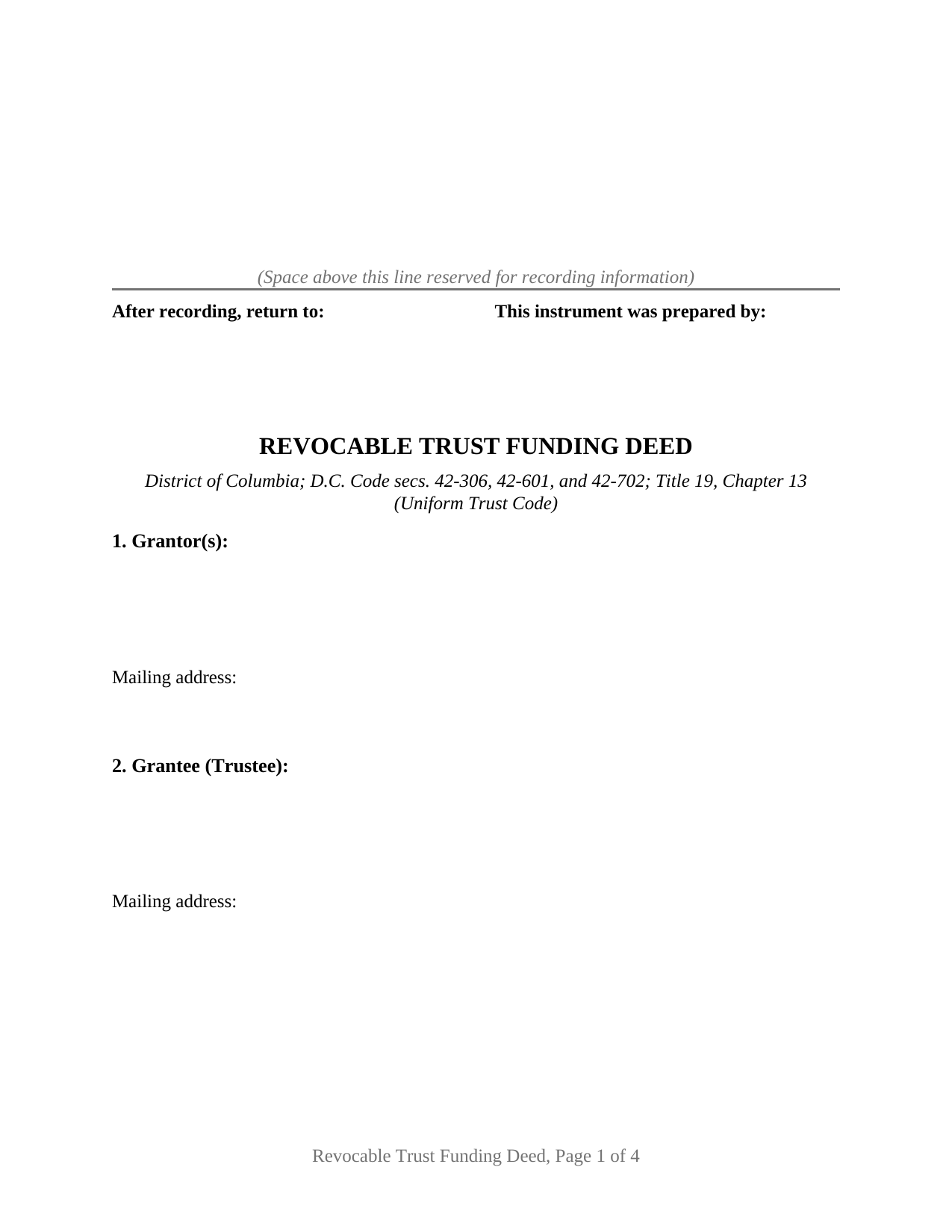
District Of Columbia Revocable Trust Funding Deed
County Specific Legal Forms Validated as recently as October 21, 2026 by our Forms Development Team
About the District Of Columbia Revocable Trust Funding Deed
How to Use This Form
- Select your county from the list
- Download the county-specific form
- Fill in the required information
- Have the document notarized if required
- Record with your county recorder's office
What Others Like You Are Saying
"Excellent! I was worried because I saw some negative reviews online but I really needed an e-recordi…"
"Excellent andeasy to navigate website for non-lawyers. Needed some forms for a specific county in a …"
"Very satisfied with service and form. Completed form, printed, and submitted to county for processin…"
"Disclaimer letter was just what I needed. Download worked without a hitch."
"Good document as expected"
4.8/5 from 4,849 reviews. Read all
Moving a Washington, DC home into a revocable living trust takes a recorded deed, and the District treats that deed differently from almost every other conveyance it records. A sale of the same house would owe recordation and transfer taxes of 2.2 to 2.9 percent of its value. A deed that conveys bare legal title to the trustee of a revocable trust, without consideration, where the person conveying is the beneficiary of the trust, is exempt from both taxes under D.C. Code secs. 42-1102(17) and 47-902(12). This District of Columbia Revocable Trust Funding Deed is drafted around that exemption: a fillable deed from one or two individual owners to the trustee of their revocable trust.
Legal title moves, control stays
A revocable trust, sometimes called a living trust, holds property under a written instrument that the settlor may revoke or amend at any time unless the instrument expressly says otherwise (D.C. Code sec. 19-1306.02), and while it is revocable the trustee's duties run to the settlor alone (sec. 19-1306.03). The deed conveys the owner's whole present interest (sec. 42-702) to the named trustee, to be held upon the trusts stated in the instrument as it may be amended, and it reaches the trustee's successors in trust so a later change of trustee needs no new deed. What changes is the name on the land records.
A deed without title covenants
District covenants of title are opt-in. A warranty exists only where the deed uses the statutory shorthand of secs. 42-604 through 42-608, and this deed uses none of it, stating on its face that the conveyance is made without covenant or warranty of title. The trustee takes exactly the title the owner held, subject to the liens and matters of record that already bind it.
One or two owners, one deed
The form is the general configuration of the trust funding deed. Its grantor section is a free-form block that receives one or two natural persons conveying in their own right, with whatever status words the signers use, and its grantee section receives the trustee or co-trustees of the revocable trust, named as trustee of the trust the deed identifies by name and date. A single owner funding a trust of which that owner is the sole trustee, and a married couple conveying a jointly held home into a joint trust, both present patterns the blocks carry. The deed carries two grantor signature blocks and two acknowledgment certificates, one for each signer, so two grantors may acknowledge on different dates or in different places; the second block simply stays empty when one owner conveys. What the form is not set up as: an entity grantor, a trustee conveying property out of a trust, an attorney-in-fact signing for an owner, or three or more grantors.
The seal, the square, and the lot
D.C. Code sec. 42-306(b) requires a deed to be signed and sealed by the grantor, and the statutory forms in sec. 42-601 satisfy the seal with a printed scroll, [Seal.], at the end of the signature line; this deed prints that scroll on each grantor's signature rule. And the District describes land by square, suffix, and lot, with sec. 47-1431(a) requiring the recorded deed to carry the lot and square; the form holds those identifiers in their own fields ahead of the full legal description copied from the current vesting deed.
Recording with the FP-7/C
Every District deed is recorded with the Real Property Recordation and Transfer Tax Form FP-7/C, signed under oath by every grantor and grantee. The exemption is claimed on that form by citing the code provisions, and the Recorder's published documentation list for a revocable trust asks for the newly drafted deed, the FP-7/C, and a copy of the complete trust instrument. The deed is recorded within 30 days of signing (sec. 47-1431), and a homestead deduction already in place is not disturbed by a transfer into a revocable trust without consideration where the owner keeps living there (sec. 47-850.03).
The package includes the fillable District of Columbia Revocable Trust Funding Deed, a completed example filled in for a realistic District fact pattern, and the guide that explains every section, the deed tax exemption, and the recording process. This description and the guide describe the form and the governing statutes in general terms; they are not legal advice.
Important: County-Specific Forms
Our revocable trust funding deed forms are specifically formatted for each of the 1 counties in District Of Columbia.
After selecting your county, you'll receive forms that meet all local recording requirements, ensuring your documents will be accepted without delays or rejection fees.