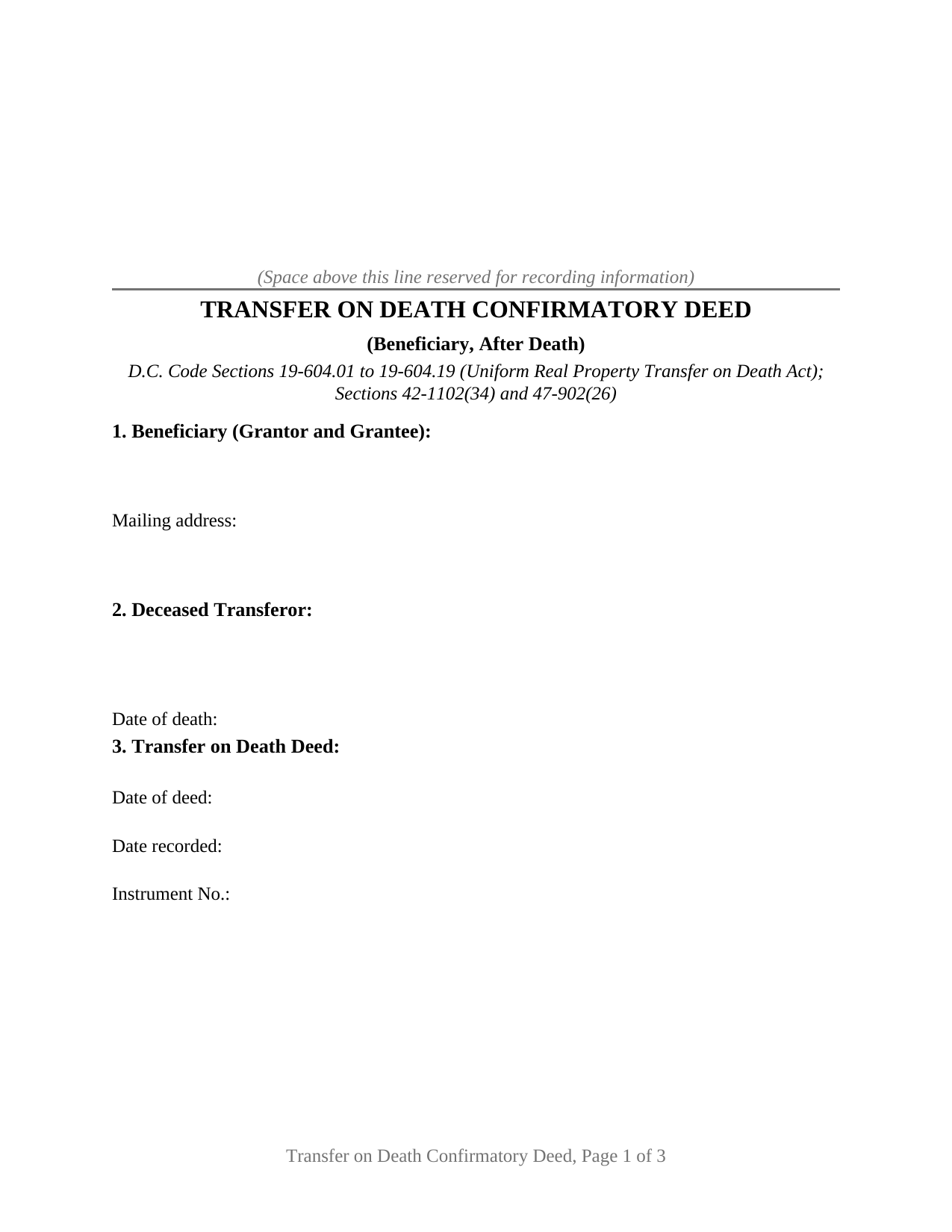
District Of Columbia Transfer on Death Confirmatory Deed (Beneficiary, After Death)
County Specific Legal Forms Validated as recently as October 21, 2026 by our Forms Development Team
About the District Of Columbia Transfer on Death Confirmatory Deed (Beneficiary, After Death)
How to Use This Form
- Select your county from the list
- Download the county-specific form
- Fill in the required information
- Have the document notarized if required
- Record with your county recorder's office
What Others Like You Are Saying
"Great!"
"This is the go to place for quick work. They are awesome."
"Very Easy to use, especially since the county recorder's office is closed due to COVID-19"
"It was a wonderful experience. Thank you for your help."
"Great experience, fast and efficient, no hassle. Will use again!"
4.8/5 from 4,842 reviews. Read all
When the owner of District of Columbia real estate who recorded a transfer on death deed dies, the statute moves the property to the named beneficiary at the moment of death. The land records do not yet say so. This form prepares the District of Columbia Transfer on Death Confirmatory Deed by which the beneficiary, as grantor and grantee, places that statutory transfer on the public record.
A transfer that happened by statute, and a deed that records it
Under D.C. Code Section 19-604.13, on the death of the transferor the interest in the property is transferred to the designated beneficiary in accordance with the transfer on death deed, provided the beneficiary survived the transferor. The transfer is complete at death, and no section of the District's Uniform Real Property Transfer on Death Act prescribes a follow-up instrument.
The Recorder of Deeds documents the filing instead. Its exemption documentation list (Form ROD 4, item 19) names a newly drafted confirmatory deed with the recording information of the transfer on death deed, Form FP-7/C, a copy of the grantor's death certificate, and a copy of the recorded transfer on death deed. This deed is the first item in that package. It identifies the deceased transferor and the date of death, the recorded TOD deed by date, recording date, and instrument number, and the property by square, suffix, lot, and legal description, and it states that the beneficiary survived the transferor by more than 120 hours, that no revocation was recorded before death, and that no joint owner with right of survivorship survived the transferor.
Exempt from both District deed taxes
The District taxes deeds twice, a recordation tax under Section 42-1103 and a transfer tax under Section 47-903, and both reach deeds without consideration by taxing fair market value. This deed is carved out of each: Section 42-1102(34) exempts deeds to property transferred to a named beneficiary of a revocable transfer on death deed by reason of the grantor's death, and Section 47-902(26) exempts the same transfer from the transfer tax. The exemption is claimed by citing those sections in the Tax Exemption Application column of Form FP-7/C, with the death certificate and the recorded TOD deed as the supporting documentation the form's instructions call for.
One beneficiary signing as grantor and grantee
This form states one beneficiary: the designated beneficiary named in the recorded transfer on death deed who survived the transferor and who is the only designated beneficiary entitled to the transferor's interest under that deed, whether as the sole primary beneficiary or as the alternate who took under the deed's own terms. The beneficiary signs once, as both grantor and grantee, the self-conveyance structure Section 42-516(b) authorizes, and the form carries one signature block with the printed seal scroll the District's deed statute contemplates and one acknowledgment certificate in the individual-capacity short form of Section 1-1231.15. An adult child taking a parent's rowhouse presents the pattern this deed states. A transfer on death deed naming two or more concurrent beneficiaries, who take equal undivided shares under Section 19-604.13(a)(3), follows a different pattern, as does a transferor who was survived by a joint tenant or tenant by the entirety, because the property then belongs to the surviving co-owner.
What the deed states about title
The deed is made without consideration and without covenant or warranty of title, the rule Section 19-604.13(e) applies to every transfer on death deed. The beneficiary takes subject to every mortgage, lien, and other interest that bound the property at the transferor's death, and under Sections 19-604.15 and 19-601.02 remains answerable for allowed claims against the probate estate to the extent the estate is insufficient, up to the value received, in a proceeding brought within one year of the death.
Recording in the District
The District has one recording office, the Recorder of Deeds at the Office of Tax and Revenue. The deed carries the lot and square number Section 47-1431(a) requires, that section's 30-day recording window runs from the date the beneficiary signs, and Section 42-407(2) stops any deed while District taxes or charges are owing on the property.
The package contains the fillable Transfer on Death Confirmatory Deed, a completed example filled in for a District of Columbia fact pattern, and a guide that explains each section, the statutes behind it, the FP-7/C exemption claim, and the Recorder's filing package. The description and the guide describe the form and the governing statutes in general terms; they are not legal advice.
Important: County-Specific Forms
Our transfer on death confirmatory deed (beneficiary, after death) forms are specifically formatted for each of the 1 counties in District Of Columbia.
After selecting your county, you'll receive forms that meet all local recording requirements, ensuring your documents will be accepted without delays or rejection fees.