District Of Columbia Trustee Deed (Revocable Trust to Beneficiary)
County Specific Legal Forms Validated as recently as October 21, 2026 by our Forms Development Team
About the District Of Columbia Trustee Deed (Revocable Trust to Beneficiary)
How to Use This Form
- Select your county from the list
- Download the county-specific form
- Fill in the required information
- Have the document notarized if required
- Record with your county recorder's office
What Others Like You Are Saying
"Great form and easy to complete. Sending a sample and instructions was very helpful. Thank you!"
"I appreciate being able to find the forms needed for my Gift Deed. It was simple to understand and c…"
"Great, immediate access to everything I needed to assist my client! This is truly a great resource f…"
"This link thankfully saved us much time and expense with positive correct completion of the forms ne…"
"Easy process considering not too technical savvy!"
4.8/5 from 4,849 reviews. Read all
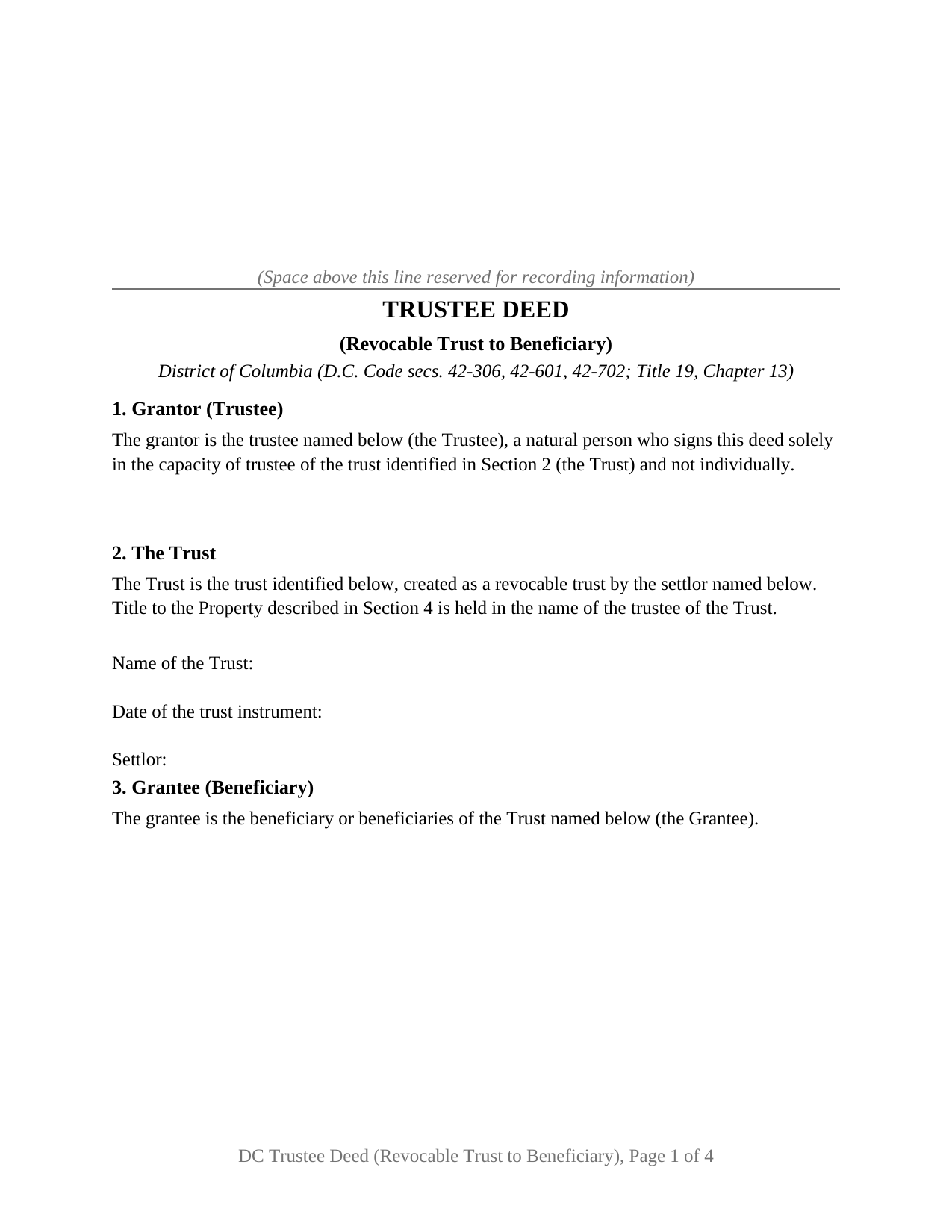
When a District of Columbia revocable trust reaches the point of distributing a house or other real property to a beneficiary, the trustee signs a deed. This form prepares that deed: a trustee deed by which the trustee of a revocable trust, signing in that capacity and not individually, conveys District real property to a beneficiary as a distribution under the trust's terms. It serves the common post-death distribution by a successor trustee and a lifetime distribution alike.
A conveyance out of the trust without a warranty
The deed conveys with the word grant, which under D.C. Code section 42-702 passes the grantor's whole estate and interest unless the deed limits it. What it deliberately omits is any covenant of title. District covenants arise only from express statutory shorthand, general warranty under section 42-604 and special warranty under section 42-605, and this deed contains neither phrase and says so. The beneficiary receives the title the trustee held, subject to whatever affects it, the posture a fiduciary distribution ordinarily takes. The deed recites the trustee's authority: the trust instrument together with D.C. Code sections 19-1308.15 and 19-1308.16, the Uniform Trust Code provisions on a trustee's powers to distribute trust property.
The deed-tax exemptions written for revocable trusts
The District taxes deeds twice, a recordation tax on the deed and a transfer tax on the transferor, and where a deed carries no consideration both taxes fall on fair market value. Two exemption paragraphs in each statute exist for exactly this deed. Sections 42-1102(18) and 47-902(13) exempt a transfer to a beneficiary of a revocable trust as the result of the death of the trust's grantor, the settlor. Sections 42-1102(19) and 47-902(14) exempt a transfer by the trustee where the same transfer made by the settlor would itself have been exempt, which reaches a lifetime distribution from a parent's trust to the parent's child under the family exemption. The claim is made on Form FP-7/C, and the Recorder's documentation list, Form ROD 4, calls for a copy of the complete revocable trust.
A sealed signature and a representative-capacity acknowledgment
D.C. Code section 42-306(b) requires a deed of District real property to be signed and sealed by the grantor; the statutory deed forms satisfy the seal with the printed scroll [Seal.] after the signature line, and this form prints that scroll beside the trustee's signature. And the District's notarial statute prints a separate short-form certificate for an acknowledgment in a representative capacity, section 1-1231.15(2), whose own text names trustee as an example; the form's certificate carries that sentence, with the trust named as the party on whose behalf the deed was executed. No witnesses are required, and no spouse of the trustee signs, because the trustee conveys as a fiduciary.
What this configuration recites
The form recites exactly one grantor, a natural person serving as trustee, original or successor, of one revocable trust identified by name, date, and settlor, and carries one signature block with the seal scroll and one acknowledgment certificate. The grantee section names the beneficiary or beneficiaries receiving the distribution, one or two natural persons, with whatever ownership designation the distribution carries where two take together; the guide describes the tenancy in common default of section 42-516(a), which reaches even a married couple, and the express words that create survivorship. A successor trustee winding up a parent's trust and distributing the family home to a child presents the single-trustee pattern this deed recites. The form is not set up as a deed from cotrustees who both act, a deed from a corporate trustee, a trustee's sale to a purchaser for value, a funding deed into a trust, or a distribution from an irrevocable or testamentary trust.
Built for the District's recording office
The District is one recording jurisdiction, so the property section names the District rather than a county and carries the square, suffix, and lot beside the full legal description, as section 47-1431(a) requires of the recorded copy. The deed is recorded with the Recorder of Deeds within 30 days after execution under the same section.
The package includes the fillable form, a completed example filled in for a realistic District of Columbia fact pattern, and the guide that walks through every numbered section, the trustee's authority, the exemption paragraphs, and recording. This description and the guide describe the form and the governing statutes in general terms; they are not legal advice.
Important: County-Specific Forms
Our trustee deed (revocable trust to beneficiary) forms are specifically formatted for each of the 1 counties in District Of Columbia.
After selecting your county, you'll receive forms that meet all local recording requirements, ensuring your documents will be accepted without delays or rejection fees.