District Of Columbia Trustee Deed (Trustee to Settlor or Third Party)
County Specific Legal Forms Validated as recently as October 21, 2026 by our Forms Development Team
About the District Of Columbia Trustee Deed (Trustee to Settlor or Third Party)
How to Use This Form
- Select your county from the list
- Download the county-specific form
- Fill in the required information
- Have the document notarized if required
- Record with your county recorder's office
What Others Like You Are Saying
"Clean and easy process. Super attentive and helpful."
"Documents are helpful and much appreciated. Grateful for this service when an attorney is not requir…"
"I used deeds.com to complete a gift deed for transferring a house to our son. Finding the correct fo…"
"so far getting what i needed was easy the site is well done thank you"
"Easy-peasy to find, download and use the forms!"
4.8/5 from 4,849 reviews. Read all
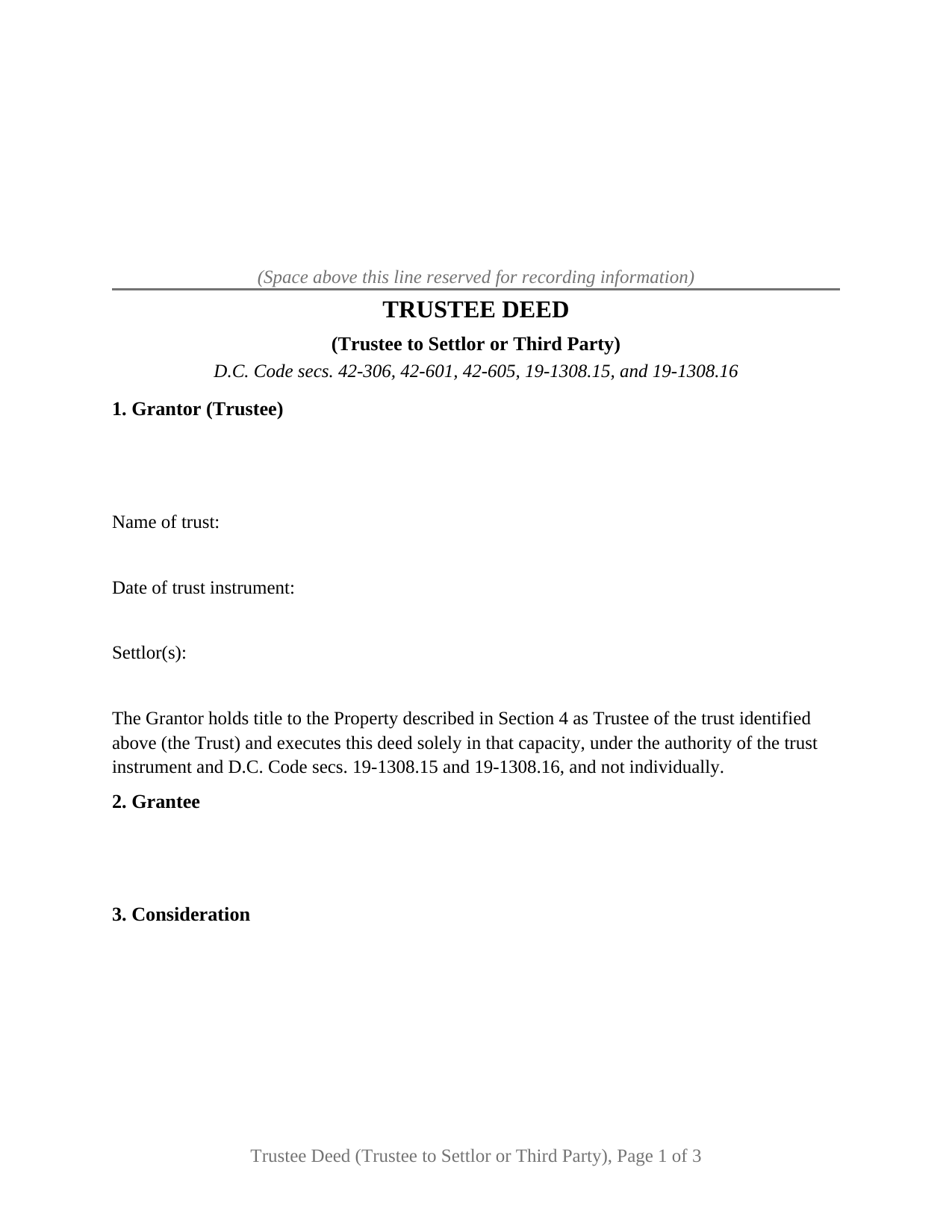
When real property sits in a trust, the trustee is the one who signs it out. This District of Columbia Trustee Deed (Trustee to Settlor or Third Party) is the instrument for that lifetime conveyance: the trustee conveys District real estate back to the settlor who created the trust, or to a buyer or other third party, while the trust is still being administered. The deed recites one trustee as grantor, identifies the trust by name, date, and settlor, and conveys with special warranty under D.C. Code sec. 42-605.
A conveyance made as trustee, not as an individual
D.C. Code sec. 19-1308.15 gives a trustee, without court authorization, the powers the trust instrument confers and, unless the instrument limits them, all powers over the trust property that an unmarried competent owner has over individually owned property; sec. 19-1308.16 names the power to sell property at public or private sale. The deed's capacity recital states that the grantor holds title as Trustee of the Trust and executes the deed solely in that capacity and not individually, the disclosure of fiduciary capacity that sec. 19-1310.10(a) ties to a trustee's freedom from personal liability on a contract.
Back to the settlor, or out to a buyer
The grantee section is open to either destination. A settlor who moves a house out of a revocable trust takes title back in the settlor's own name; while a trust is revocable, sec. 19-1306.03 makes the trustee's duties run exclusively to the settlor, and sec. 19-1306.02(d) has the trustee deliver trust property as the settlor directs on revocation. A purchaser takes under the same deed. Where two grantees take, the words that fix how they hold follow their names; under sec. 42-516(a) a deed that says nothing creates a tenancy in common, even between a married couple.
Special warranty, by, through, or under the trustee
District covenants of title exist only where the deed uses the statutory words. The phrase with special warranty carries, under sec. 42-605, a covenant to warrant and defend the property against the claims and demands of the grantor and all persons claiming by, through, or under the grantor, and no one else. The covenant reaches what happened on the trustee's watch; the general warranty of sec. 42-604 is not part of this deed.
The deed taxes turn on who the grantee is
A sale out of the trust is a taxable transfer: the recordation tax of sec. 42-1103 and the transfer tax of sec. 47-903 each run 1.1 percent of the consideration under $400,000 and 1.45 percent of the whole consideration at $400,000 or more. A reconveyance to the settlor of a revocable trust without consideration is measured against sec. 42-1102(19) and sec. 47-902(14), which exempt a trustee's deed where the same transfer would be exempt if the grantor of the revocable trust had made it. The Recorder of Deeds lists the intake package for a revocable trust exemption as a newly drafted deed, Form FP-7/C, and a copy of the complete trust, and sec. 47-1431(a) requires recording within 30 days after execution.
What this configuration recites
The form recites exactly one trustee, a natural person signing in a representative capacity, with one signature block and one acknowledgment certificate in the representative-capacity short form of sec. 1-1231.15(2), the sentence that ends as Trustee of the named trust. The signature line ends in the printed scroll [Seal.] of the sec. 42-601 statutory forms, because sec. 42-306(b) requires a District deed to be signed and sealed by the grantor. A successor trustee, and a settlor serving as trustee of the settlor's own revocable trust, each present the single-trustee pattern this deed recites. Two cotrustees signing together, a corporate trustee executing under sec. 42-602, and a distribution to a beneficiary by reason of the settlor's death are different patterns, and the form is not set up as any of them. No spouse of the trustee signs: the District abolished dower and curtesy in 2001 and has no spousal joinder rule for a lifetime conveyance.
The package includes the fillable form, a completed example filled in for a realistic District of Columbia sale out of a revocable trust, and the guide that walks through every numbered section, the trustee's authority, and the deed taxes. This description and the guide describe the form and the governing statutes in general terms; they are not legal advice.
Important: County-Specific Forms
Our trustee deed (trustee to settlor or third party) forms are specifically formatted for each of the 1 counties in District Of Columbia.
After selecting your county, you'll receive forms that meet all local recording requirements, ensuring your documents will be accepted without delays or rejection fees.