Florida Agents Affidavit (Under F.S. 709.2119)
County Specific Legal Forms Validated as recently as October 11, 2026 by our Forms Development Team
About the Florida Agents Affidavit (Under F.S. 709.2119)
How to Use This Form
- Select your county from the list
- Download the county-specific form
- Fill in the required information
- Have the document notarized if required
- Record with your county recorder's office
What Others Like You Are Saying
"Easy to complete. I would suggest, since it is 2 pages, make a bigger space for land descriptions &a…"
"Very good instruction for filling out the forms!"
"Great resource! Wish you could expand to more than just deeds, but then you would have to rename it.…"
"Quick, easy and reasonably priced."
"Very quick and responsive. Faster than finding out by mail if you've done something incorrectly. Ver…"
4.8/5 from 4,823 reviews. Read all
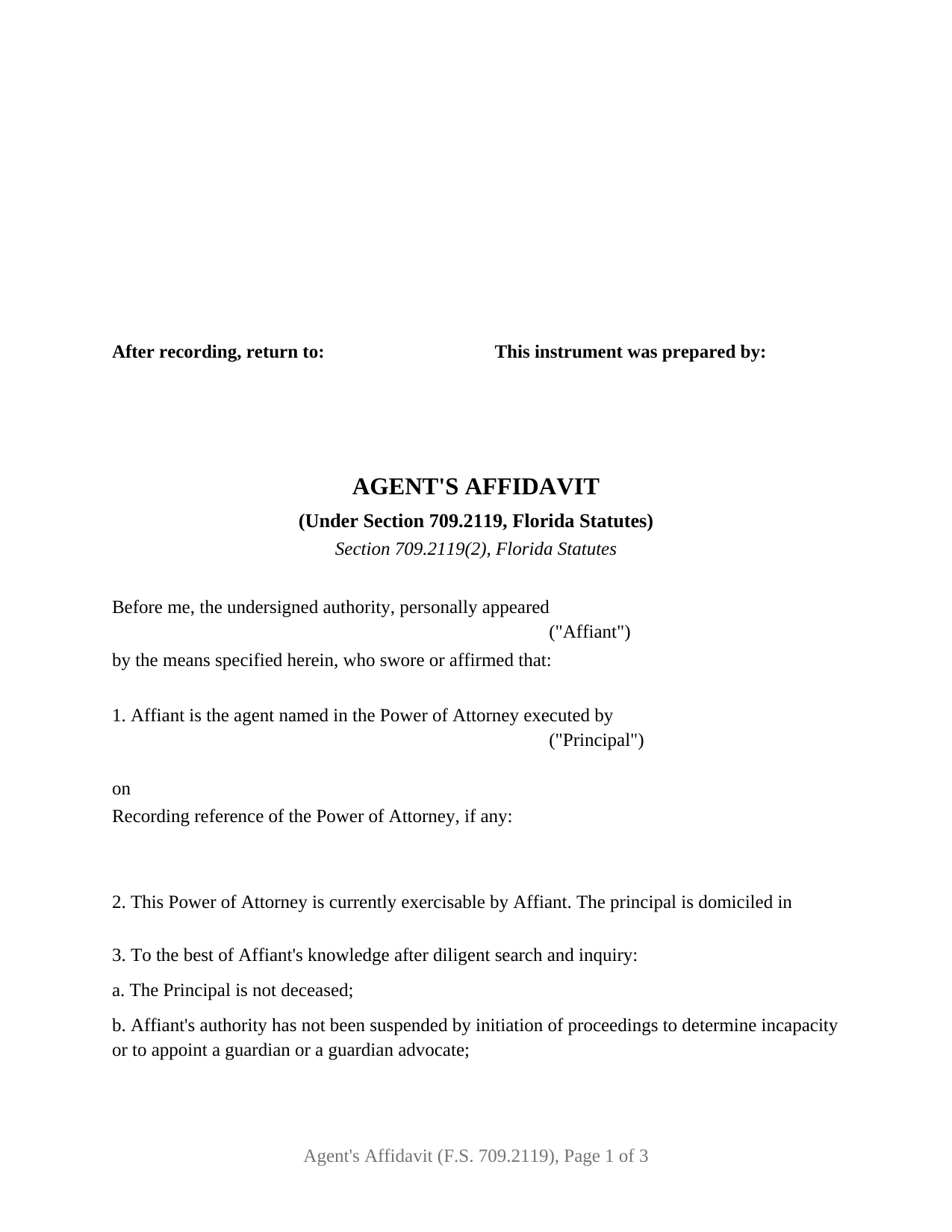
An agent signing a Florida deed or mortgage for a principal under a power of attorney is routinely asked for one more document before the closing agent, lender, or title examiner accepts the signature: a sworn statement that the power of attorney is still in effect and that the agent is acting within it. This form prepares that Florida agent's affidavit, also searched as an attorney-in-fact affidavit or power of attorney affidavit, in the statutory form printed in Section 709.2119(2)(c) of the Florida Statutes, with one affiant and a jurat.
The statement a third person may require
Florida's Power of Attorney Act lets a third person who accepts a power of attorney in good faith rely on it, and on the agent's acts within its scope, as if the instrument and the agent's authority were genuine, valid, and still in effect. Section 709.2119(2)(a) pairs that protection with a statement the third person may require from the agent: where the principal is domiciled, that the principal is not deceased, that there has been no revocation or termination, that no incapacity or guardianship proceeding has suspended the authority, that no dissolution, annulment, or legal separation between agent and principal has ended it, and, for a successor agent, why the predecessor agents are unavailable. Section 709.2119(3) lists the affidavit among the things a third person may request and rely upon without further investigation.
Six paragraphs, taken from the statute
The affidavit on this form carries the statutory paragraphs word for word. The opening sentence names the agent as the affiant. Paragraph 1 identifies the power of attorney by the principal's name and execution date, with a line beneath it for the official records reference of a recorded instrument. Paragraph 2 states that the power is currently exercisable and names the principal's domicile. Paragraph 3 carries the four statements made after diligent search and inquiry: the principal is living, no incapacity or guardianship proceeding has suspended the authority, no marital action between agent and principal has terminated it, and there has been no revocation or termination. Paragraph 4 states that the affiant is acting within the scope of the authority granted. Paragraph 5 is the successor-agent sentence, left blank by an original agent and completed by a successor with the predecessor's name. Paragraph 6 is the affiant's undertaking not to exercise the powers after learning of a revocation, termination, suspension, or the principal's death or adjudicated incapacity.
One affiant, a jurat, and a reserved seal
The form carries a single signature block for the agent, signing in the agent's own name, and no principal signature, because the affidavit is the agent's statement about the agent's own authority. Co-agents each execute their own affidavit, and an officer of a financial institution serving as agent executes the separate statement of title and authority that Section 709.2119(2)(b) describes rather than this form. The certificate is a jurat, the oath-or-affirmation certificate of Section 117.05(13)(a), with the physical presence and online notarization boxes the officer marks, the written date, the identification lines, and a reserved 3 inch by 2 inch area for the rubber-stamp seal that Section 117.05(3)(a) places on every notarized paper document. No subscribing witnesses sign the affidavit; the two-witness rule of Section 689.01 attaches to the deed or mortgage the agent signs.
Where it goes in the record
When an agent's deed is recorded, Section 695.01(1) protects the conveyance against creditors and later purchasers only where the power of attorney was recorded before their rights accrued, so the power of attorney, the affidavit, and the deed ordinarily go into the official records of the clerk of the circuit court together. The affidavit is formatted for that counter: a 3 inch recording band across the top of the first page, the affiant's printed name beneath the signature, an address line, and the preparer and return blocks, the Section 695.26 conventions clerks examine conveyances for, though the affidavit conveys nothing and carries no documentary stamp tax. Clerk charges under Section 28.24 run $10.00 for the first page and $8.50 for each additional page; the completed example records as three pages.
The package includes the fillable affidavit, a completed example filled in for a successor agent swearing before an Orange County notary, and the guide that walks through each paragraph, the signature block, and the jurat. This description and the guide describe the form and the governing Florida statutes in general terms; they are not legal advice.
Important: County-Specific Forms
Our agents affidavit (under f.s. 709.2119) forms are specifically formatted for each of the 67 counties in Florida.
After selecting your county, you'll receive forms that meet all local recording requirements, ensuring your documents will be accepted without delays or rejection fees.