Florida Decedent Interest in Homestead Affidavit
County Specific Legal Forms Validated as recently as October 20, 2026 by our Forms Development Team
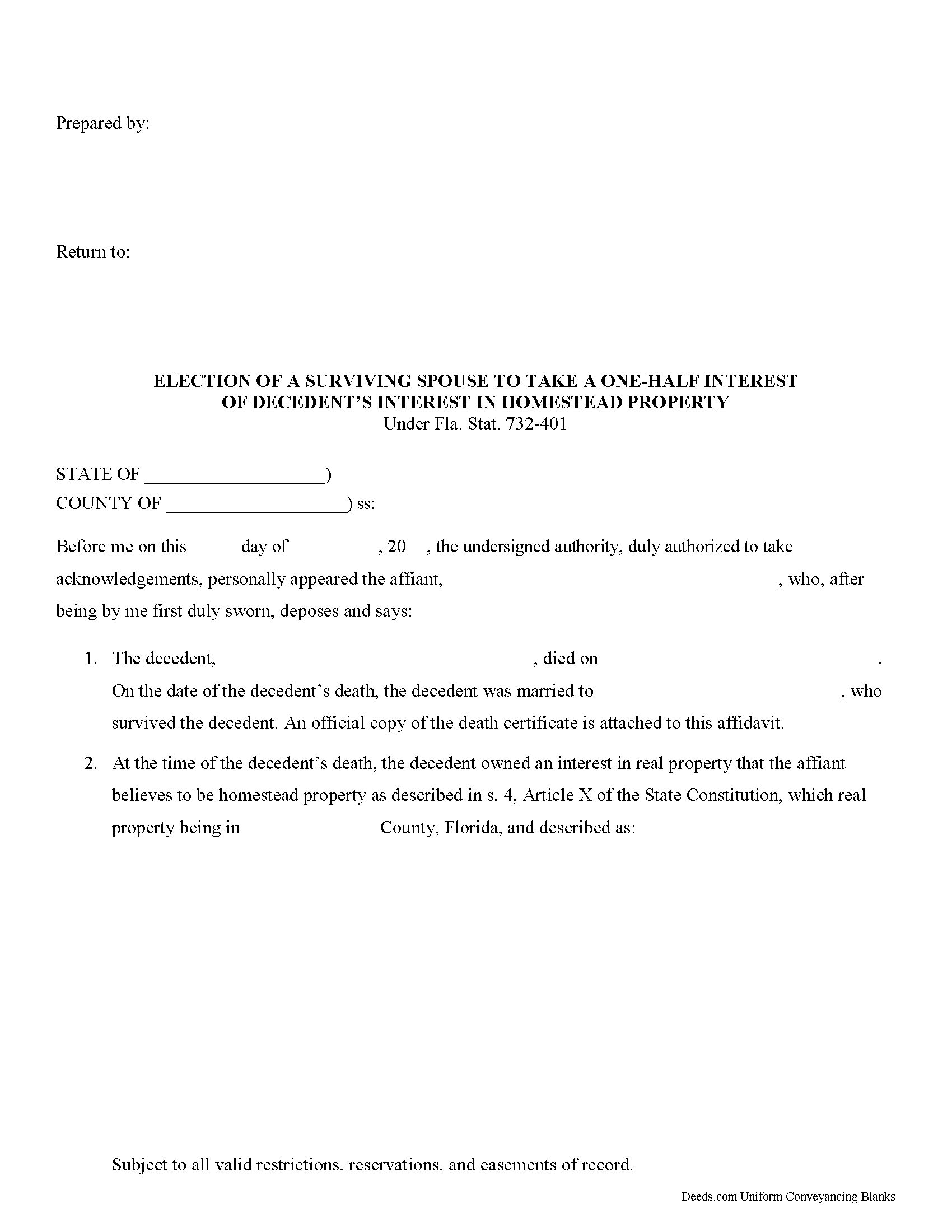
About the Florida Decedent Interest in Homestead Affidavit
How to Use This Form
- Select your county from the list
- Download the county-specific form
- Fill in the required information
- Have the document notarized if required
- Record with your county recorder's office
What Others Like You Are Saying
"I found what I needed easily."
"Easiest Filing I've ever done, and filed in 24 hours."
"Exceeded expectations; bundle included not only the form but also detailed instructions and definiti…"
"The explanation sheet and example was very handy."
"The service was simple and easy enough but the UI isn't the easiest on the eyes and the process is a…"
4.8/5 from 4,836 reviews. Read all
Florida is one of only a few states where the constitution itself shields the family home from creditors and tightly limits how the owner can devise it at death. When a Florida homestead owner dies without effectively devising the property and leaves behind both a spouse and descendants, Florida law gives the surviving spouse a default life estate with a vested remainder to the descendants. The Florida Decedent Interest in Homestead Affidavit is the recorded writing through which the surviving spouse trades that life estate for an undivided one-half interest as a tenant in common — an option that exists only in Florida and only under the narrow conditions set out in section 732.401 of the Florida Statutes.
What the Florida Decedent Interest in Homestead Affidavit Does
This affidavit is used after a Florida homestead owner has died and the property was not effectively devised by will, leaving the homestead to descend under section 732.401. By recording the affidavit, the surviving spouse elects an undivided one-half interest in the homestead as a tenant in common with the decedent's descendants, who together hold the remaining one-half per stirpes. After the affidavit is filed, each holder may sell, mortgage, or convey a fractional interest without joinder from the others — a markedly different ownership structure than the default life estate, where the spouse holds possession but the descendants own the remainder.
Florida Homestead Descent Under Section 732.401
Section 732.401(1), Florida Statutes, sets the default rule: when the decedent is survived by a spouse and one or more descendants, the surviving spouse takes a life estate in the homestead with a vested remainder to the descendants per stirpes — a Black's Law Dictionary term for proportional distribution by representation through a deceased ancestor's line.
Section 732.401(2) provides the alternative this affidavit triggers: an undivided one-half interest in the homestead as a tenant in common, with the remaining one-half vesting in the decedent's descendants in being at the date of death, per stirpes. The surviving spouse may also disclaim the interest entirely under Chapter 739, Florida's disclaimer statute, which then routes the disclaimed share as if the spouse had predeceased the decedent.
The election only matters where there is both a surviving spouse and at least one descendant of the decedent. Without descendants, the homestead passes to the spouse outright and no election is needed. Without a spouse, the descendants take under intestacy and this affidavit has no role.
Constitutional Limits on Devise of Florida Homestead
Florida's homestead protection is constitutional, not merely statutory. Article X, section 4(c) of the Florida Constitution prohibits the owner from devising the homestead at all if the owner is survived by a spouse or a minor child, with one narrow exception: the homestead may be devised to the spouse outright if there is no minor child. When a will attempts a devise that the constitution forbids, the homestead descends as if the owner had died intestate as to that property — and that is precisely the scenario in which the section 732.401 framework, and this affidavit, come into play.
Who Must Sign and How the Affidavit Is Executed
The affidavit is signed by the surviving spouse and acknowledged before a notary public. Section 732.401(2)(c) allows an attorney in fact acting under a properly authorized power of attorney, or a court-appointed guardian of the property of the surviving spouse, to make the election on the spouse's behalf — but a guardian's election requires approval from the court with jurisdiction over the real property. The instrument must also satisfy section 695.26, Florida Statutes, which governs the form of recordable documents: a three-inch top margin on the first page for the clerk's stamp, a complete legal description of the homestead, and the name and post office address of the natural person who prepared the document.
Florida-Specific Traps to Watch For
- The six-month deadline is strict. Section 732.401(2)(d) requires the election to be filed in the official records of the county where the homestead is located within six months after the decedent's date of death and during the surviving spouse's lifetime. A late filing is ineffective and the default life estate stands.
- The election is irrevocable once recorded. The spouse cannot reverse the choice after the affidavit hits the public record; title vests as a tenancy in common from that moment forward.
- Address only is not enough. Florida clerks reject documents that identify property by street address alone. The full legal description from the most recent vesting deed must appear on the face of the affidavit.
- Preparer identification is mandatory. Section 695.26(1)(b) requires the name and post office address of the document's preparer on the instrument itself, not just on a cover sheet.
- Multi-county homesteads require multiple recordings. If the homestead lies in more than one county, the affidavit must be recorded in each county where any portion of the property is located.
- The affidavit does not open probate. Filing the election is a separate act from administering the decedent's estate. Probate may still be required to address non-homestead assets and to resolve the homestead's status if it is contested.
- Non-homestead real estate is unaffected. Section 732.401 governs only property that qualified as the decedent's homestead at death. Other Florida real estate the decedent owned descends under different rules and is not within this affidavit's reach.
Recording the Affidavit in Florida
The affidavit is recorded with the Clerk of the Circuit Court in the Florida county where the homestead is located. Recording fees are governed by section 28.24, Florida Statutes, with a set fee for the first page and a per-page fee for each additional page. Documentary stamp tax under section 201.02 generally does not apply because the affidavit is an election rather than a conveyance for consideration, but the clerk's office will assess the document at intake. Prompt recording matters: until the writing is on the public record, the title configuration the statute presumes by default remains in place, and the six-month statutory window keeps running.
Vesting After the Election
After recording, the surviving spouse and the descendants hold the homestead as tenants in common — not as joint tenants and not with any right of survivorship. Florida does not presume survivorship between tenants in common, so each holder's fractional interest passes through that holder's own estate at death unless transferred during life. Each tenant in common can sell, mortgage, or convey a fractional interest without notice to or consent from the others, though the practical realities of marketing a fractional share in occupied homestead property tend to keep the co-owners at the negotiating table.
What Is Included in the Download Package
The Florida Decedent Interest in Homestead Affidavit package from Deeds.com includes the fillable affidavit form, a guidelines document that walks through the statutory framework and step-by-step completion instructions, and a completed example showing how the form looks when properly filled out. The forms are prepared by the Deeds.com forms development team and are formatted to meet Florida recording requirements under section 695.26. After purchase, the documents are available for instant download from your Deeds.com account.
Important: County-Specific Forms
Our decedent interest in homestead affidavit forms are specifically formatted for each of the 67 counties in Florida.
After selecting your county, you'll receive forms that meet all local recording requirements, ensuring your documents will be accepted without delays or rejection fees.