Citrus County Conditional Waiver and Release of Lien upon Final Payment Form
Last validated November 13, 2026 by our Forms Development TeamFormatted for recording in Citrus County, for property anywhere in the county: rural and unincorporated areas as well as Beverly Hills, Crystal River, Dunnellon, Floral City, Hernando, Holder, Homosassa, Homosassa Springs and 2 more.
- 3 documents included
- Immediate PDF download
- Formatting guarantee
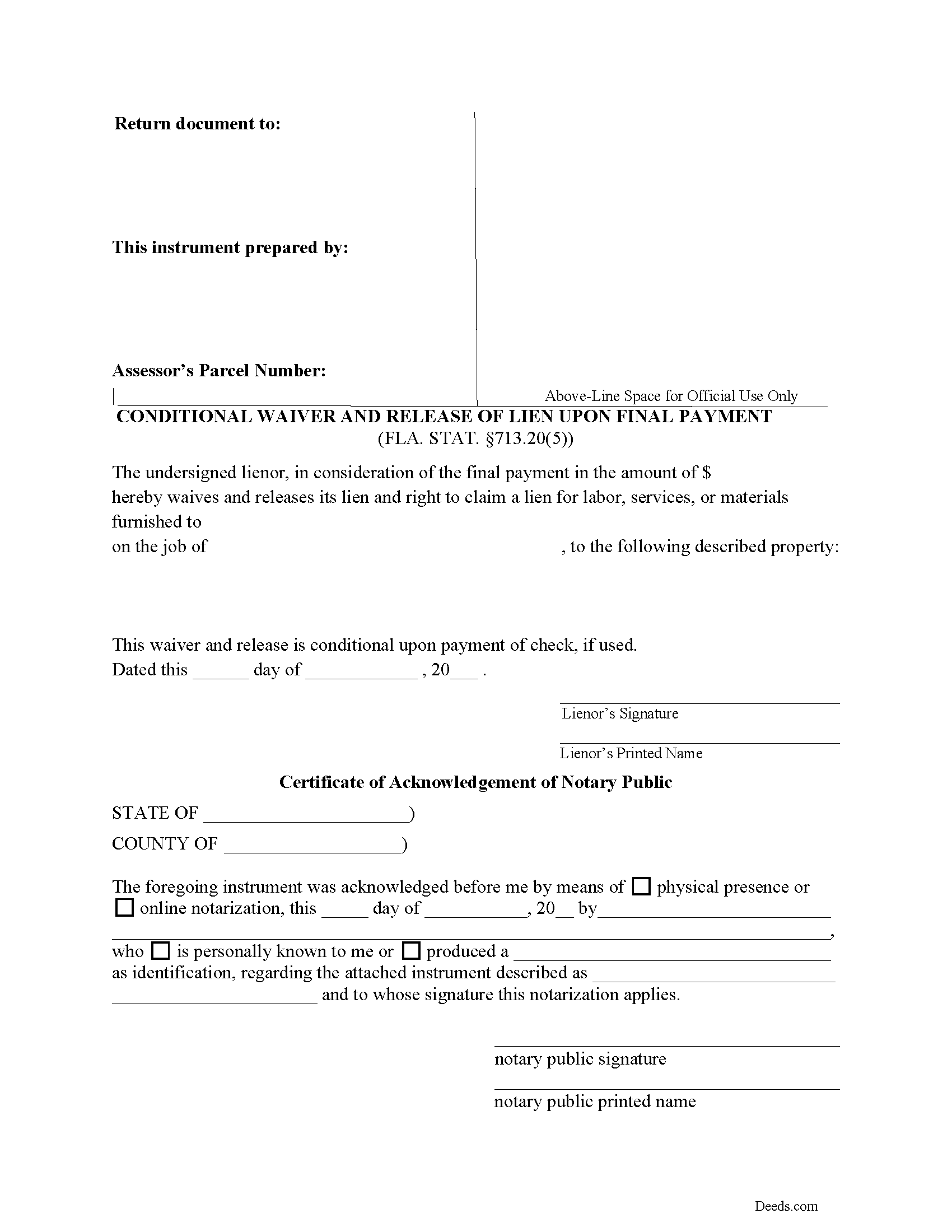
Citrus County Conditional Waiver and Release of Lien upon Final Payment Form
Fill in the blank form formatted to comply with all recording and content requirements.
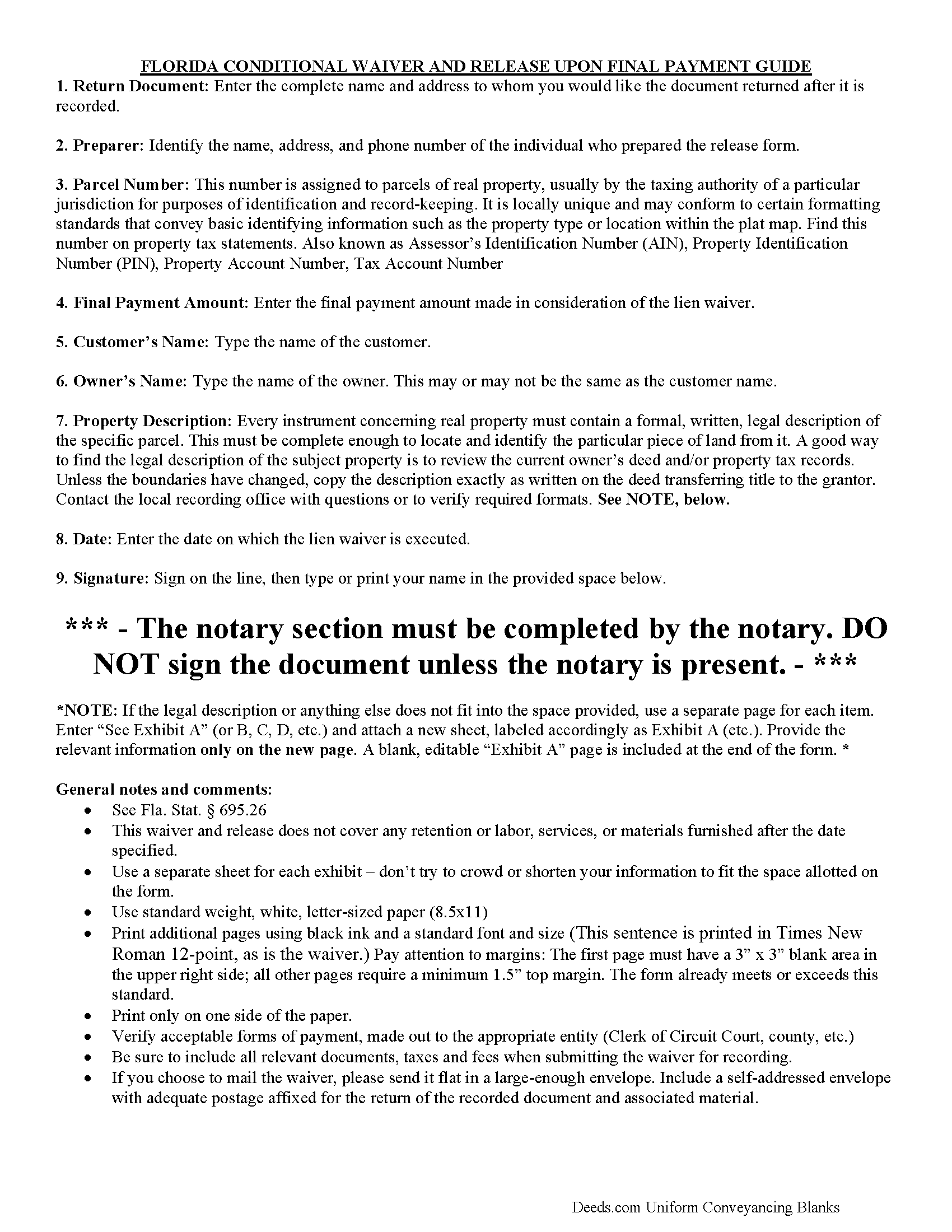
Citrus County Conditional Waiver and Release of Lien upon Final Payment Guide
Line by line guide explaining every blank on the form.
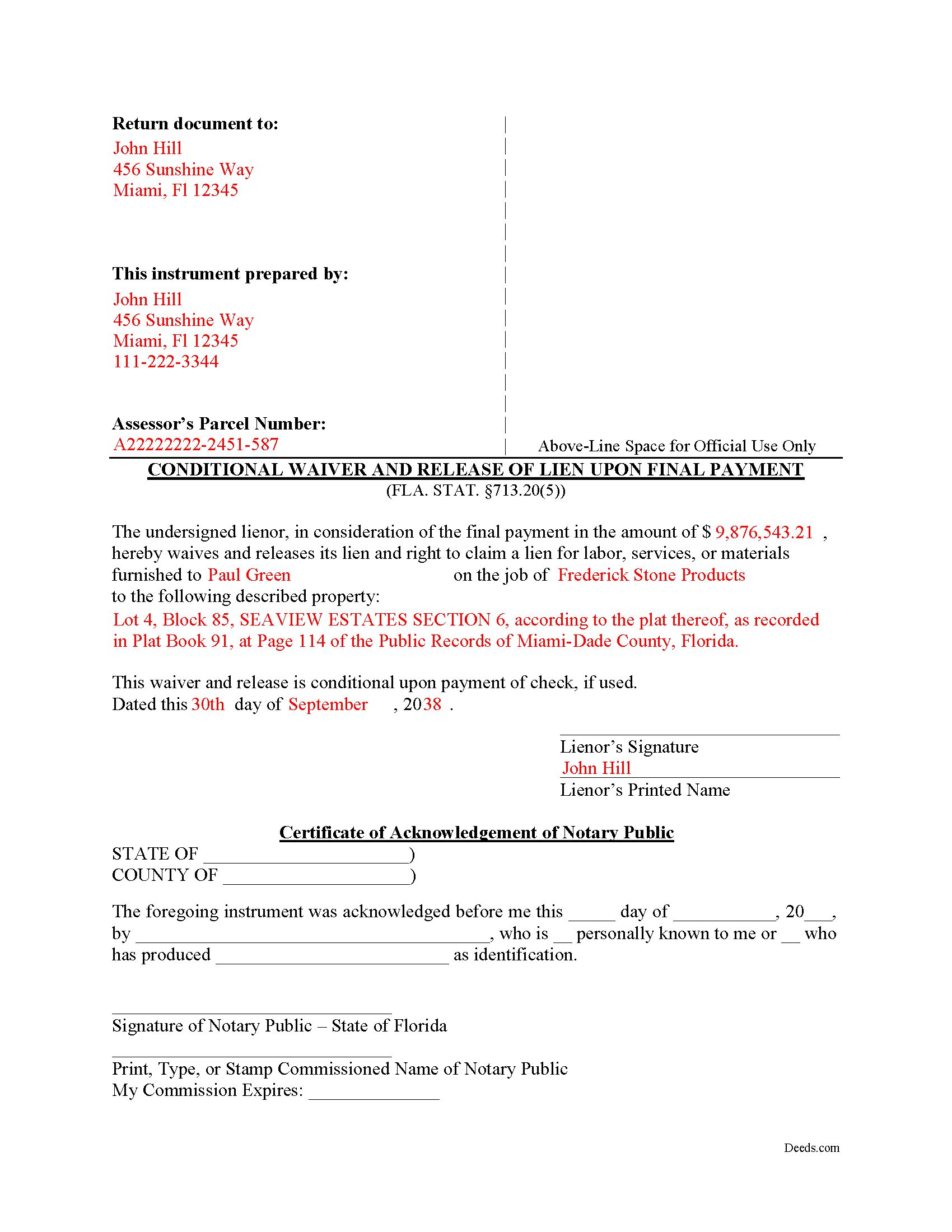
Citrus County Completed Example of the Conditional Waiver and Release of Lien upon Final Payment Document
Example of a properly completed form for reference.
All 3 documents above included • One-time purchase • No recurring fees
Immediate Download • Secure Checkout
Additional Florida and Citrus County documents included at no extra charge:
Where to Record Your Documents
Main Office - Inverness Courthouse
Inverness, Florida 34450
Hours: 7:30am to 5:00pm M-F, with extended hours until 6pm on Tuesdays.
Phone: (352) 341-6424
West Citrus Government Center
Crystal River, Florida 34429
Hours: 8:00am - 5:00pm M-F
Phone: (352) 341-6424
Recording Tips for Citrus County:
- Bring your driver's license or state-issued photo ID
- Ensure all signatures are in blue or black ink
- Ask for certified copies if you need them for other transactions
- Ask if they accept credit cards - many offices are cash/check only
- Check that your notary's commission hasn't expired
Cities and Jurisdictions in Citrus County
Properties in any of these areas use Citrus County forms:
- Beverly Hills
- Crystal River
- Dunnellon
- Floral City
- Hernando
- Holder
- Homosassa
- Homosassa Springs
- Inverness
- Lecanto
Hours, fees, requirements, and more for Citrus County
How do I get my forms?
Forms are available for immediate download after payment. The Citrus County forms will be in your account ready to download to your computer. An account is created for you during checkout if you don't have one. Forms are NOT emailed.
Are these forms guaranteed to be recordable in Citrus County?
Yes. Our form blanks are guaranteed to meet or exceed the applicable formatting requirements used for recording in Citrus County, including margin requirements, font requirements, and other layout standards. This guarantee applies to formatting, not to the legal sufficiency of information entered by the user or the suitability of a form for a particular transaction.
Can I reuse these forms?
Yes. You can reuse the forms for your personal use. For example, if you have multiple properties in Citrus County you only need to order once.
What do I need to use these forms?
The forms are PDFs that you fill out on your computer. The free Adobe Acrobat Reader is recommended, and most PDF apps also work. You do NOT enter your property information online - you download the blank forms and complete them privately on your own computer.
Are there any recurring fees?
No. This is a one-time purchase. Nothing to cancel, no memberships, no recurring fees.
How much does it cost to record in Citrus County?
Recording fees in Citrus County vary. Contact the recorder's office at (352) 341-6424 for current fees.
Questions answered? Let's get started!
Lien waivers or releases are used to surrender the right to a lien, either in full or in part depending on the type of lien release form selected. Florida's Construction Lien Law authorizes statutory waivers at 713.20 Fla. Stat. (2016).
Under 713.20(5), lienors may waive, on condition
The Florida Conditional Waiver and Release of Lien upon Final Payment is the closeout counterpart to the conditional progress waiver in section 713.20 of the Florida Statutes — total in scope, but conditioned on the final payment actually clearing. Where the unconditional final waiver releases all remaining lien rights immediately on signing regardless of whether the lienor is paid, the conditional final version keeps the lienor protected until the funds are actually in the account. Florida is one of the few states to legislate this kind of scenario-specific waiver wording, and the conditional final waiver exists for the closeout situation that comes up on most jobs: the lienor needs to deliver a final release in exchange for the final draw, but the check is being handed over at settlement rather than after the funds clear.
What the Florida Conditional Waiver and Release of Lien upon Final Payment Does
This form is signed by a lienor at project close to release all remaining lien rights against the property, with the release becoming effective only when the final payment is actually received and clears. "Conditional" assigns the credit risk of the payment to the customer or owner; "final" makes the waiver total in scope rather than tied to a single progress billing. The most common use is at the closing of a final draw or settlement disbursement — the lienor signs the conditional final waiver to provide closing parties with documentation of intent to release, while preserving lien rights as a backstop until the wire or check actually settles.
Florida Statutory Requirements Under Section 713.20
Florida codifies four statutory lien waiver forms in section 713.20 — conditional or unconditional, paired with progress or final payment — and requires that any waiver "substantially follow" the statutory wording for the matching scenario. The statute supplies the conditional language that makes the release contingent on payment, and the final language that makes the release total. Mixing scenarios, deleting required fields, or rewriting the conditional clause can convert the document into something other than a section 713.20 conditional final waiver. Title companies, construction lenders, and counsel reviewing closeout files typically check the wording against the statute precisely because the four forms are not interchangeable.
The form must identify the lienor, the customer, the property owner, the amount of the conditional final payment, and the property — typically by parcel identifier and legal description (§ 713.20).
Execution: No Witnesses, No Notary Required
Section 713.20 statutory waivers do not require witnesses or notarization to be effective. The lienor signs and dates the form. As with the unconditional final waiver, construction lenders and title insurers handling closing on a completed project may insist on notarized closeout waivers as a matter of internal underwriting policy. Notarization is not a statutory prerequisite, but it is often a practical one when the document is being delivered into a closing.
Florida-Specific Traps
The conditional final waiver shares some traps with the conditional progress waiver and others with the unconditional final waiver, and adds a few of its own:
- Advance waivers are void. Lien rights for labor, services, or materials not yet furnished cannot be released in advance under Florida law (§ 713.20).
- The condition is automatic and absolute. Until the final payment is actually received and clears, no lien rights are released. If the wire fails or the check is dishonored, the lienor's chapter 713 rights remain intact.
- Banks and title companies often will not rely on it. Because the release is contingent on payment clearance, a conditional final waiver does not give the closing parties documented proof that lien rights have been extinguished. Title underwriters issuing policies free of construction lien exceptions, and lenders authorizing final disbursement on the construction loan, frequently require the unconditional version and treat the conditional final waiver as a placeholder until the payment clears.
- Retainage and final draw mismatches. The "final payment" recited on the form should be the actual final payment, including any retainage being released. A waiver that recites the wrong amount, or that is signed against a payment that does not include retainage everyone assumes is being closed out, can leave a portion of the lienor's exposure outside the scope of the release.
- Punch list and warranty work. Once payment clears, the conditional final waiver releases all remaining lien rights — including for any unbilled corrective work the lienor has performed. As with the unconditional version, the lienor should make sure that all extras, change orders, and stored materials are billed and accounted for in the final payment amount before signing.
- "Substantially follow" still applies. A non-conforming conditional final waiver may not be enforceable as a section 713.20 waiver, which is the worst possible outcome at closeout — the lienor may have given up nothing, and the closing parties may have received a document that does not deliver what they thought it did.
- Notice of Commencement and Notice of Termination alignment. The property described in the waiver should match the property described in the Notice of Commencement (§ 713.13), and lienors closing out near the recording of a Notice of Termination (§ 713.132) should confirm their post-termination work is fully billed before signing.
- Two-step closings. On many Florida projects, a conditional final waiver is delivered into closing to provide intent-to-release documentation, and the lienor then issues an unconditional final waiver after the funds clear. Lienors should understand whether they are delivering only the conditional waiver, only the unconditional version, or both — and at what stage — so that the correct document carries the correct risk allocation.
How the Waiver Is Used
The conditional final waiver is not recorded in the county's official records. It is delivered to the owner, general contractor, construction lender, or title company at the final draw or settlement, and is retained with the closing file. Closing parties typically pair it with bank confirmation that the underlying payment has cleared, at which point the conditional final waiver functions as the lienor's complete release. On jobs where the closing parties require an unconditional final waiver to issue title insurance or fund the final disbursement, the conditional version is often delivered first as evidence of intent and then replaced with the unconditional form once the payment is settled.
Download Package
The download package includes the Florida Conditional Waiver and Release of Lien upon Final Payment, drafted to follow the statutory wording at section 713.20, a completed example showing how each field is filled in, and a guide explaining the form's role at closeout, the conditional structure, and how it fits with the other three section 713.20 waiver scenarios. The forms are prepared by Deeds.com's forms development team and are delivered as instant downloads.
of payment, a lien they already filed against the owner's interest in the improved property. The release contains information about the lienor, the customer, the property owner, the property description, the payment amount, and a date to finalize the work covered by the waiver.
Each case is unique, so contact an attorney with specific questions on lien waivers or any other issues related to Florida Construction Liens.
Important: Your property must be located in Citrus County to use these forms. Documents should be recorded at the county recording office listed above.
This Conditional Waiver and Release of Lien upon Final Payment meets all recording requirements specific to Citrus County.
Our Promise
The documents you receive here are guaranteed to meet or exceed the applicable Citrus County recording format requirements. If there is a rejection caused by our formatting, we will correct the issue or refund your payment. This guarantee applies to document formatting only and does not extend to information entered by the user, the selection of the form, or the legal effect of the completed document.
Save Time and Money
Get your Citrus County Conditional Waiver and Release of Lien upon Final Payment form done right the first time with Deeds.com Uniform Conveyancing Blanks. At Deeds.com, we understand that your time and money are valuable resources, and we don't want you to face a penalty fee or rejection imposed by a county recorder for submitting nonstandard documents. We constantly review and update our forms to meet rapidly changing state and county recording requirements for roughly 3,500 counties and local jurisdictions.
4.8 out of 5 - ( 4,864 Reviews )
Juanita B. 5 out of 5 stars
Very easy and fast transaction. Thank you for complete set of forms needed for property transfer.
Thank you for your feedback. We really appreciate it. Have a great day!
Marina M. 4 out of 5 stars
Very easy to choose template and download. The price seems fair. Not sure the section on the deed for 6 witnesses is necessary....
Thank you for your feedback. We really appreciate it. Have a great day!
Janet M. 5 out of 5 stars
This site is amazing! What a time saver from driving somewhere and standing around waiting.
Thank you!
TIFFANY C. 5 out of 5 stars
It would be nice if the notary State was fillable, we are having to notarize in another State. Also, need more room to add 2 beneficiaries with two different addresses.
Thank you for your feedback. We really appreciate it. Have a great day!
CYNTHIA W. 5 out of 5 stars
My deed has now been recorded. Thank you so very much. I saved about $120.00 by doing this with your document service. Thankfully, I heard about you from a friend and did not go with my Title Company that wanted a fee that seems outrageous because of how simple it was to do. I will definitely "advertise" this service to others.
We appreciate your business and value your feedback. Thank you. Have a wonderful day!
LETICIA N. 5 out of 5 stars
I AM VERY PLEASED WITH YOUR WEBSITE. EASY AND I WAS GIVEN A SAMPLE OF THE FORM AND INSTRUCTIONS. I AM VERY PLEASED.
We appreciate your business and value your feedback. Thank you. Have a wonderful day!
Kevin R. 5 out of 5 stars
I have been using Deeds.com for the last 2 years and find them very easy to use and expedient on all my recordings. Highly recommend.
Thank you for the kind words Kevin. We appreciate you.
heather i. 5 out of 5 stars
I don't pay very close attention to what I'm doing all the time which leads to mistakes. Deeds.com was helpful in correcting my error and getting me on my way.
Thank you!
Mike S. 3 out of 5 stars
Overpriced
Thanks Mike. We get it, $27.97 isn't cheap for a lot of people right now. Your Nevada package includes a recorder-ready affidavit, a completed sample, and step-by-step instructions for the state. Expensive, yes. Overpriced, not even close.
Michael V. 5 out of 5 stars
Exactly what I needed and VERY fair price. I paid $19.97 for what a local attorney wanted $200 to do. I filled out the form using the line by line guide and filed it at the court house today. Absolutely no problems.
We appreciate your business and value your feedback. Thank you. Have a wonderful day!
A. S. 3 out of 5 stars
First, I am glad that you gave a blank copy, an example copy, and a 'guide'. It made it much easier to do. Overall I was very happy with your products and organization... however, things got pretty confusing and I have a pretty 'serious' law background in Real Estate and Civil law. With that said, I spent about 10+ hours getting my work done, using the Deed of Trust and Promissory note from you and there were a few problems: First, it would be FANTASTIC if you actually aligned your guide to actually match the Deed or Promissory Note. What I mean is that if the Deed says 'section (E)' then your guide shouldn't be 'randomly' numbered as 1,2,3, for advice/instructions, but should EXACTLY match 'section (E)'. Some places you have to 'hunt' for what you are looking for, and if you did it based on my suggestion, you wouldn't need to 'hunt' and it would avoid confusion. 2nd: This one really 'hurt'... you had something called the 'Deed of Trust Master Form' yet you had basically no information on what it was or how to use it. The only information you had was a small section at the top of the 'Short Form Deed of Trust Guide'. Holy Cow, was that 'section' super confusing. I still don't know if I did it correctly, but your guide says only put a return address on it and leave the rest of the 16 or so page Deed of Trust beneath it blank... and then include your 'Deed of Trust' (I had to assume the short form deed that I had just created) as part of it. I had to assume that I had to print off the entire 17 page or so title page and blank deed. I also had to assume that the promissory note was supposed to be EXHIBIT A or B on the Short Form Deed. It would be great if someone would take a serious look at that short section in your 'Short Form Deed of Trust Guide' and realize that those of us using your products are seriously turning this into a county clerk to file and that most of us, probably already have a property that has an existing Deed... or at least can find one in the county records if necessary... and make sure that you make a distinction between the Deed for the property that already exists, versus the Deed of Trust and Promissory note that we are trying to file. Thanks.
Thank you for your feedback. We'll have staff review the document for clarity. Have a great day!
Dennis D. 5 out of 5 stars
Downloaded perfect. Can hardly wait to get them done.
Thank you!
janelle s. 5 out of 5 stars
Uncertain about use as I am new to online forms. Through use I am sure it will feel more comfortable. I like the storage of filled in info forms because I might be using I will be using them or the info in the future.
Thank you for your feedback. We really appreciate it. Have a great day!
Guido d. 5 out of 5 stars
Excellent service. Easy to use, easy to upload, and very cost effective!
Thank you for your feedback. We really appreciate it. Have a great day!
Sherry P. 5 out of 5 stars
It would be helpful to have a frequently asked questions section. That would make it easier to know I have the correct form. Sherry
Thank you for your feedback. We really appreciate it. Have a great day!