Gadsden County Conditional Waiver and Release of Lien upon Final Payment Form
Last validated October 12, 2026 by our Forms Development TeamFormatted for recording in Gadsden County, for property anywhere in the county: rural and unincorporated areas as well as Chattahoochee, Greensboro, Gretna, Havana, Midway, Quincy.
- 3 documents included
- Immediate PDF download
- Formatting guarantee
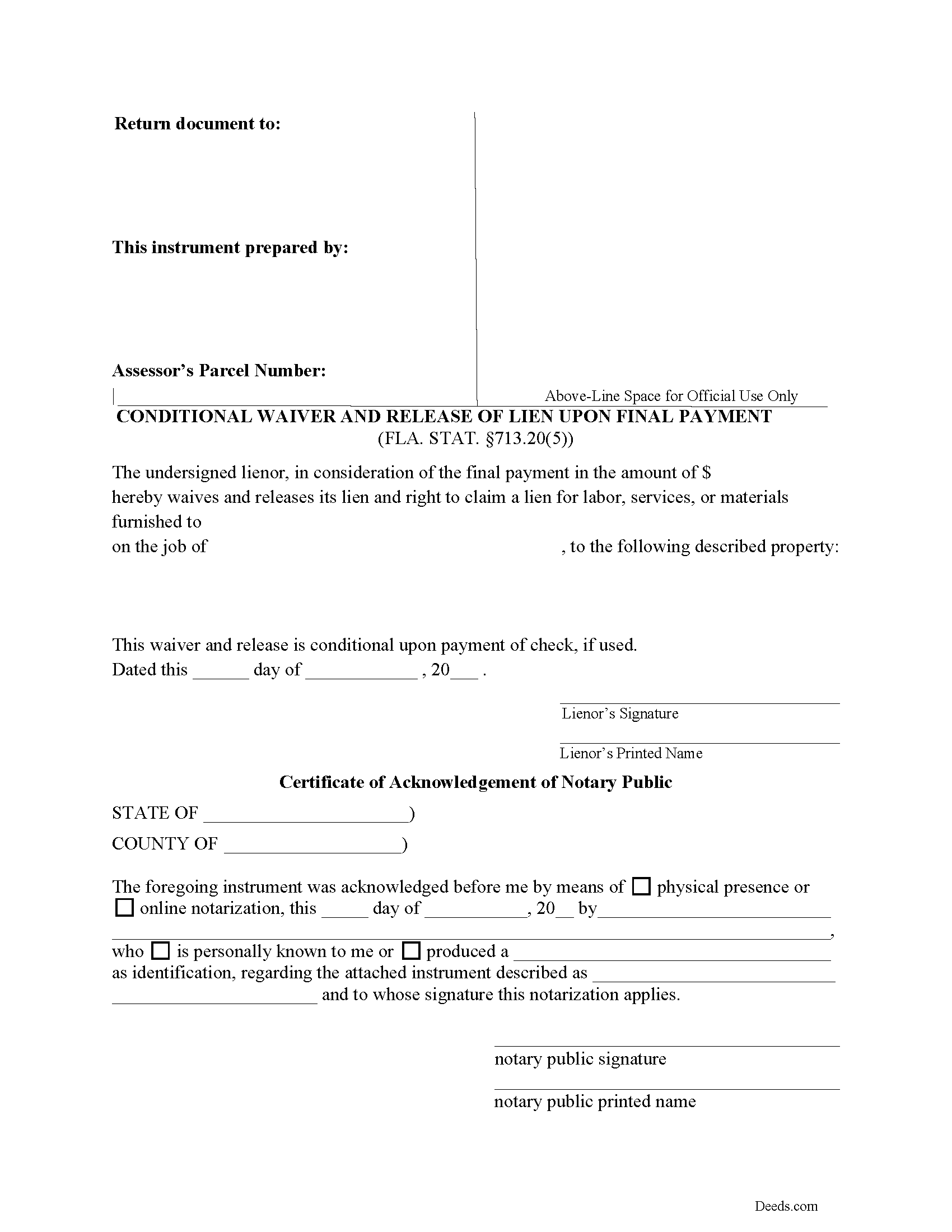
Gadsden County Conditional Waiver and Release of Lien upon Final Payment Form
Fill in the blank form formatted to comply with all recording and content requirements.
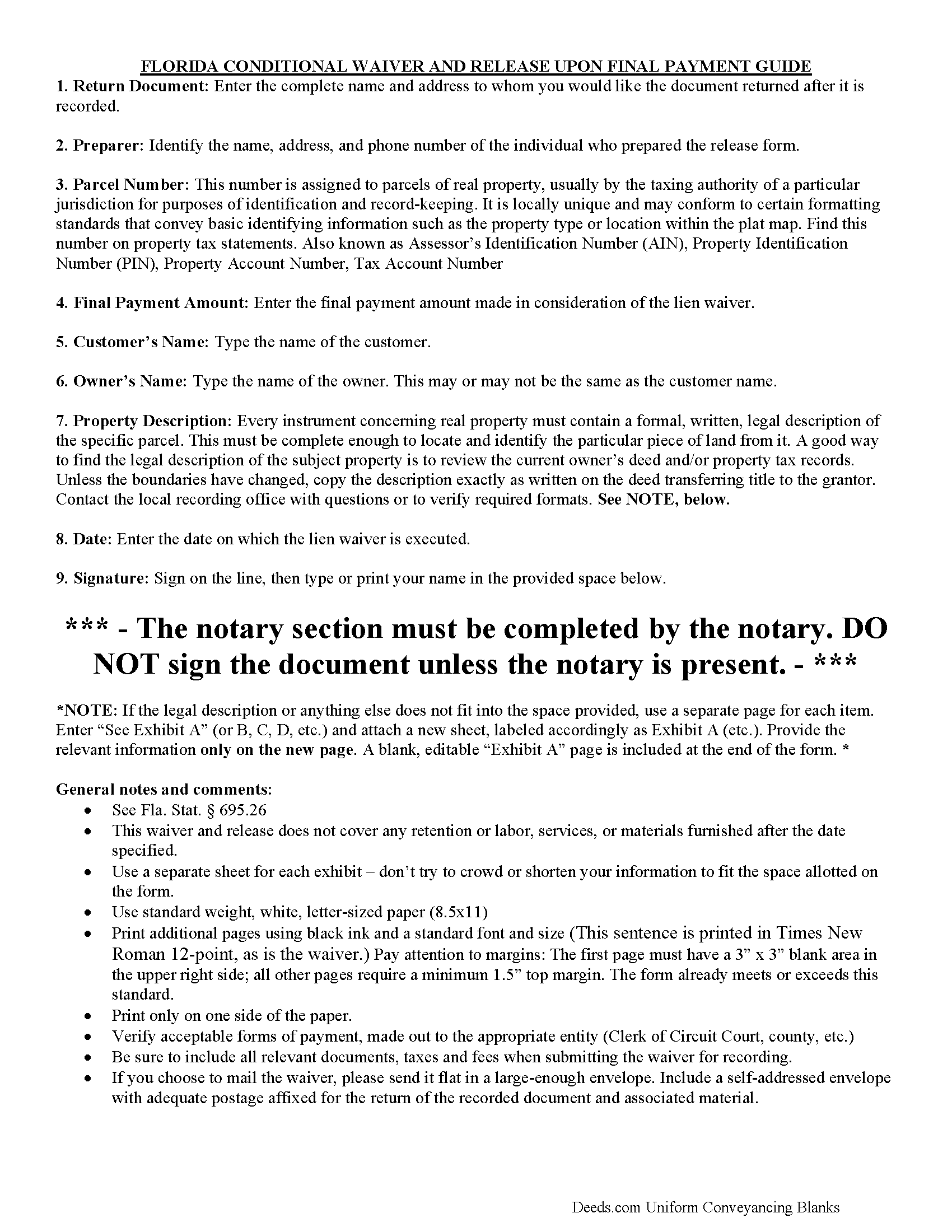
Gadsden County Conditional Waiver and Release of Lien upon Final Payment Guide
Line by line guide explaining every blank on the form.
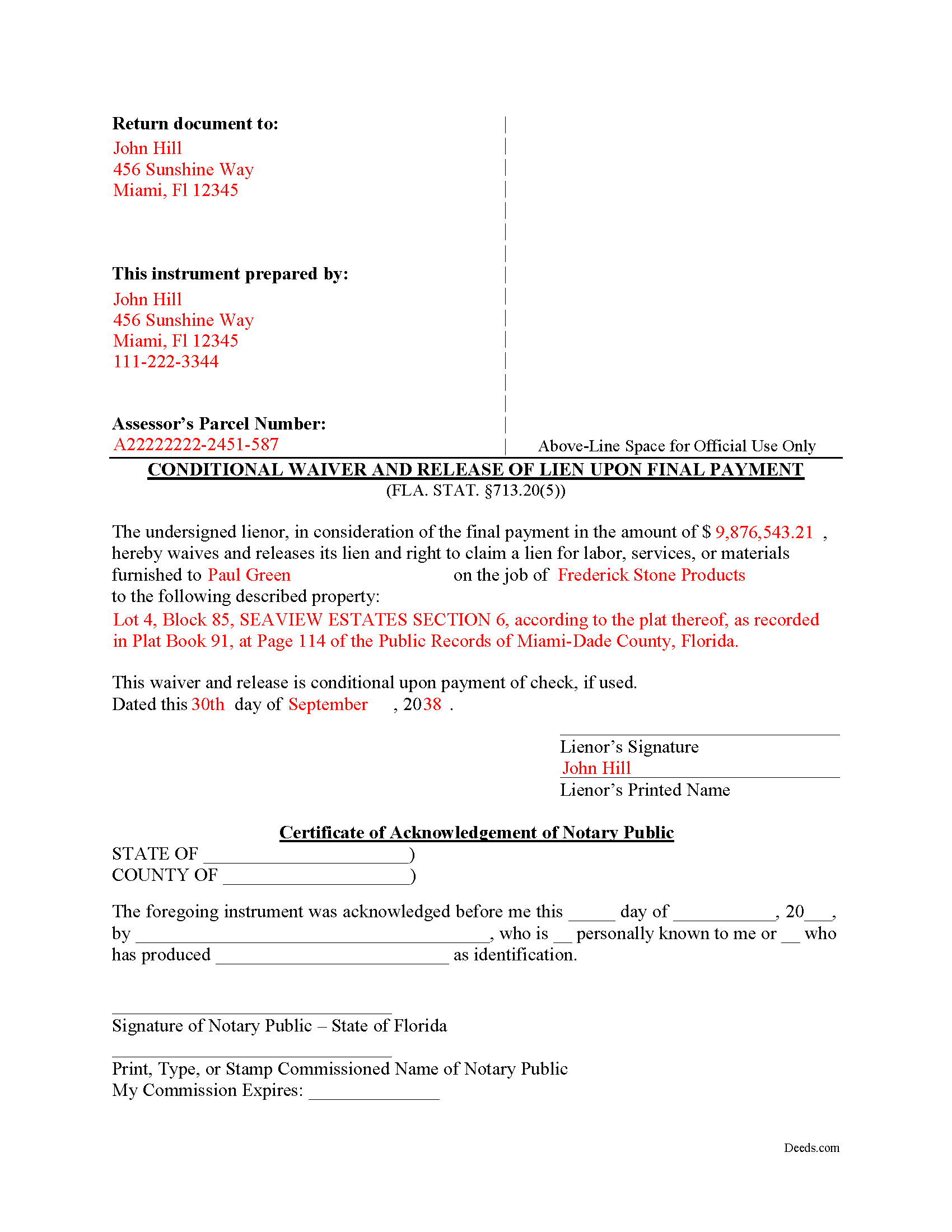
Gadsden County Completed Example of the Conditional Waiver and Release of Lien upon Final Payment Document
Example of a properly completed form for reference.
All 3 documents above included • One-time purchase • No recurring fees
Immediate Download • Secure Checkout
Additional Florida and Gadsden County documents included at no extra charge:
Where to Record Your Documents
Clerk of the Circuit Court - County Courthouse
Quincy, Florida 32351
Hours: 8:30am - 5:00pm M-F
Phone: (850) 875-8601
Recording Tips for Gadsden County:
- Bring your driver's license or state-issued photo ID
- Ensure all signatures are in blue or black ink
- Ask about their eRecording option for future transactions
- Avoid the last business day of the month when possible
- Both spouses typically need to sign if property is jointly owned
Cities and Jurisdictions in Gadsden County
Properties in any of these areas use Gadsden County forms:
- Chattahoochee
- Greensboro
- Gretna
- Havana
- Midway
- Quincy
Hours, fees, requirements, and more for Gadsden County
How do I get my forms?
Forms are available for immediate download after payment. The Gadsden County forms will be in your account ready to download to your computer. An account is created for you during checkout if you don't have one. Forms are NOT emailed.
Are these forms guaranteed to be recordable in Gadsden County?
Yes. Our form blanks are guaranteed to meet or exceed the applicable formatting requirements used for recording in Gadsden County, including margin requirements, font requirements, and other layout standards. This guarantee applies to formatting, not to the legal sufficiency of information entered by the user or the suitability of a form for a particular transaction.
Can I reuse these forms?
Yes. You can reuse the forms for your personal use. For example, if you have multiple properties in Gadsden County you only need to order once.
What do I need to use these forms?
The forms are PDFs that you fill out on your computer. The free Adobe Acrobat Reader is recommended, and most PDF apps also work. You do NOT enter your property information online - you download the blank forms and complete them privately on your own computer.
Are there any recurring fees?
No. This is a one-time purchase. Nothing to cancel, no memberships, no recurring fees.
How much does it cost to record in Gadsden County?
Recording fees in Gadsden County vary. Contact the recorder's office at (850) 875-8601 for current fees.
Questions answered? Let's get started!
Lien waivers or releases are used to surrender the right to a lien, either in full or in part depending on the type of lien release form selected. Florida's Construction Lien Law authorizes statutory waivers at 713.20 Fla. Stat. (2016).
Under 713.20(5), lienors may waive, on condition
The Florida Conditional Waiver and Release of Lien upon Final Payment is the closeout counterpart to the conditional progress waiver in section 713.20 of the Florida Statutes — total in scope, but conditioned on the final payment actually clearing. Where the unconditional final waiver releases all remaining lien rights immediately on signing regardless of whether the lienor is paid, the conditional final version keeps the lienor protected until the funds are actually in the account. Florida is one of the few states to legislate this kind of scenario-specific waiver wording, and the conditional final waiver exists for the closeout situation that comes up on most jobs: the lienor needs to deliver a final release in exchange for the final draw, but the check is being handed over at settlement rather than after the funds clear.
What the Florida Conditional Waiver and Release of Lien upon Final Payment Does
This form is signed by a lienor at project close to release all remaining lien rights against the property, with the release becoming effective only when the final payment is actually received and clears. "Conditional" assigns the credit risk of the payment to the customer or owner; "final" makes the waiver total in scope rather than tied to a single progress billing. The most common use is at the closing of a final draw or settlement disbursement — the lienor signs the conditional final waiver to provide closing parties with documentation of intent to release, while preserving lien rights as a backstop until the wire or check actually settles.
Florida Statutory Requirements Under Section 713.20
Florida codifies four statutory lien waiver forms in section 713.20 — conditional or unconditional, paired with progress or final payment — and requires that any waiver "substantially follow" the statutory wording for the matching scenario. The statute supplies the conditional language that makes the release contingent on payment, and the final language that makes the release total. Mixing scenarios, deleting required fields, or rewriting the conditional clause can convert the document into something other than a section 713.20 conditional final waiver. Title companies, construction lenders, and counsel reviewing closeout files typically check the wording against the statute precisely because the four forms are not interchangeable.
The form must identify the lienor, the customer, the property owner, the amount of the conditional final payment, and the property — typically by parcel identifier and legal description (§ 713.20).
Execution: No Witnesses, No Notary Required
Section 713.20 statutory waivers do not require witnesses or notarization to be effective. The lienor signs and dates the form. As with the unconditional final waiver, construction lenders and title insurers handling closing on a completed project may insist on notarized closeout waivers as a matter of internal underwriting policy. Notarization is not a statutory prerequisite, but it is often a practical one when the document is being delivered into a closing.
Florida-Specific Traps
The conditional final waiver shares some traps with the conditional progress waiver and others with the unconditional final waiver, and adds a few of its own:
- Advance waivers are void. Lien rights for labor, services, or materials not yet furnished cannot be released in advance under Florida law (§ 713.20).
- The condition is automatic and absolute. Until the final payment is actually received and clears, no lien rights are released. If the wire fails or the check is dishonored, the lienor's chapter 713 rights remain intact.
- Banks and title companies often will not rely on it. Because the release is contingent on payment clearance, a conditional final waiver does not give the closing parties documented proof that lien rights have been extinguished. Title underwriters issuing policies free of construction lien exceptions, and lenders authorizing final disbursement on the construction loan, frequently require the unconditional version and treat the conditional final waiver as a placeholder until the payment clears.
- Retainage and final draw mismatches. The "final payment" recited on the form should be the actual final payment, including any retainage being released. A waiver that recites the wrong amount, or that is signed against a payment that does not include retainage everyone assumes is being closed out, can leave a portion of the lienor's exposure outside the scope of the release.
- Punch list and warranty work. Once payment clears, the conditional final waiver releases all remaining lien rights — including for any unbilled corrective work the lienor has performed. As with the unconditional version, the lienor should make sure that all extras, change orders, and stored materials are billed and accounted for in the final payment amount before signing.
- "Substantially follow" still applies. A non-conforming conditional final waiver may not be enforceable as a section 713.20 waiver, which is the worst possible outcome at closeout — the lienor may have given up nothing, and the closing parties may have received a document that does not deliver what they thought it did.
- Notice of Commencement and Notice of Termination alignment. The property described in the waiver should match the property described in the Notice of Commencement (§ 713.13), and lienors closing out near the recording of a Notice of Termination (§ 713.132) should confirm their post-termination work is fully billed before signing.
- Two-step closings. On many Florida projects, a conditional final waiver is delivered into closing to provide intent-to-release documentation, and the lienor then issues an unconditional final waiver after the funds clear. Lienors should understand whether they are delivering only the conditional waiver, only the unconditional version, or both — and at what stage — so that the correct document carries the correct risk allocation.
How the Waiver Is Used
The conditional final waiver is not recorded in the county's official records. It is delivered to the owner, general contractor, construction lender, or title company at the final draw or settlement, and is retained with the closing file. Closing parties typically pair it with bank confirmation that the underlying payment has cleared, at which point the conditional final waiver functions as the lienor's complete release. On jobs where the closing parties require an unconditional final waiver to issue title insurance or fund the final disbursement, the conditional version is often delivered first as evidence of intent and then replaced with the unconditional form once the payment is settled.
Download Package
The download package includes the Florida Conditional Waiver and Release of Lien upon Final Payment, drafted to follow the statutory wording at section 713.20, a completed example showing how each field is filled in, and a guide explaining the form's role at closeout, the conditional structure, and how it fits with the other three section 713.20 waiver scenarios. The forms are prepared by Deeds.com's forms development team and are delivered as instant downloads.
of payment, a lien they already filed against the owner's interest in the improved property. The release contains information about the lienor, the customer, the property owner, the property description, the payment amount, and a date to finalize the work covered by the waiver.
Each case is unique, so contact an attorney with specific questions on lien waivers or any other issues related to Florida Construction Liens.
Important: Your property must be located in Gadsden County to use these forms. Documents should be recorded at the county recording office listed above.
This Conditional Waiver and Release of Lien upon Final Payment meets all recording requirements specific to Gadsden County.
Our Promise
The documents you receive here are guaranteed to meet or exceed the applicable Gadsden County recording format requirements. If there is a rejection caused by our formatting, we will correct the issue or refund your payment. This guarantee applies to document formatting only and does not extend to information entered by the user, the selection of the form, or the legal effect of the completed document.
Save Time and Money
Get your Gadsden County Conditional Waiver and Release of Lien upon Final Payment form done right the first time with Deeds.com Uniform Conveyancing Blanks. At Deeds.com, we understand that your time and money are valuable resources, and we don't want you to face a penalty fee or rejection imposed by a county recorder for submitting nonstandard documents. We constantly review and update our forms to meet rapidly changing state and county recording requirements for roughly 3,500 counties and local jurisdictions.
4.8 out of 5 - ( 4,828 Reviews )
Vince D. 5 out of 5 stars
Great product and service, really makes me rethink the value I provide to my customers.
Thank you!
Shari N. 5 out of 5 stars
Deeds.com provides a valuable resource to efficiently file documents for recordation.
We are grateful for your feedback and looking forward to serving you again. Thank you!
Justin F. 5 out of 5 stars
Provided the template and guide I was looking for. Reasonable pricing,
Thank you!
JoAnn S. 5 out of 5 stars
Easy to process orders.
Thank you!
Lora N. 5 out of 5 stars
Excellent, easy to use! Awesome system. Loved it.
Thank you!
Maxine P. 5 out of 5 stars
This is so amazing and I truly thank you for what I needed for my documents. This is a great company and will take care of what you needs.
Thank you for your feedback. We really appreciate it. Have a great day!
Pam G. 5 out of 5 stars
Loved the ease of use, the very helpful instructions, and samples to go along with the documents I needed to create.
Your feedback is valuable to us and helps us improve. Thank you for sharing your thoughts!
Bruce L. 5 out of 5 stars
Fantastic. The forms were easy to read and complete. Came with a guide and examples of how it looked completed Thanks!
We appreciate your business and value your feedback. Thank you. Have a wonderful day!
Patrick S. 5 out of 5 stars
Excellent!
Thank you!
Scott D. 5 out of 5 stars
I am very satisfied with the quality of the product I ordered. I have done similar property transfers/recording in the past on my own but paying for the forms and guidance is well worth it. The AI question area is extremely helpful. The example for the forms is perfect (as it has to be). I will absolutely use Deeds.com in the future for any related property needs. A+
We appreciate your business and value your feedback. Thank you. Have a wonderful day!
Scott A. 2 out of 5 stars
The information and instructions provided is thorough and great. But, the fill-in-the-blanks form does not work well and is very frustrating. The font size of the information I was adding on each individual line varies and is determined by the number of characters entered on that individual line. So the font size is different on each line. And the number of lines is fixed making it impossible to fill in the full legal name of the trust I needed to fill out the form for. My needs are somewhat unusual, but the form should have been designed to be flexible enough to handle it. A blank paper form would have been more useful.
Thank you for your feedback. We really appreciate it. Have a great day!
A Rod P. 5 out of 5 stars
The website was short and to the point. And I receive three responses quite quickly.
We appreciate your business and value your feedback. Thank you. Have a wonderful day!
John H. 5 out of 5 stars
I haven't begun yet, but this looks like what I need.
Thank you!
Jackson J. 5 out of 5 stars
Thank you very much for all your help its always a pleasure to continue working with you thanks again.
Thank you for your feedback. We really appreciate it. Have a great day!
Louise J. 5 out of 5 stars
I found your service to be very helpful. The documents were correct and comprehensive as well as easy to access. The cost is so reasonable. I think it's a great service and was impressed with it.
We appreciate your business and value your feedback. Thank you. Have a wonderful day!