Florida Disclaimer of Interest
County Specific Legal Forms Validated as recently as October 15, 2026 by our Forms Development Team
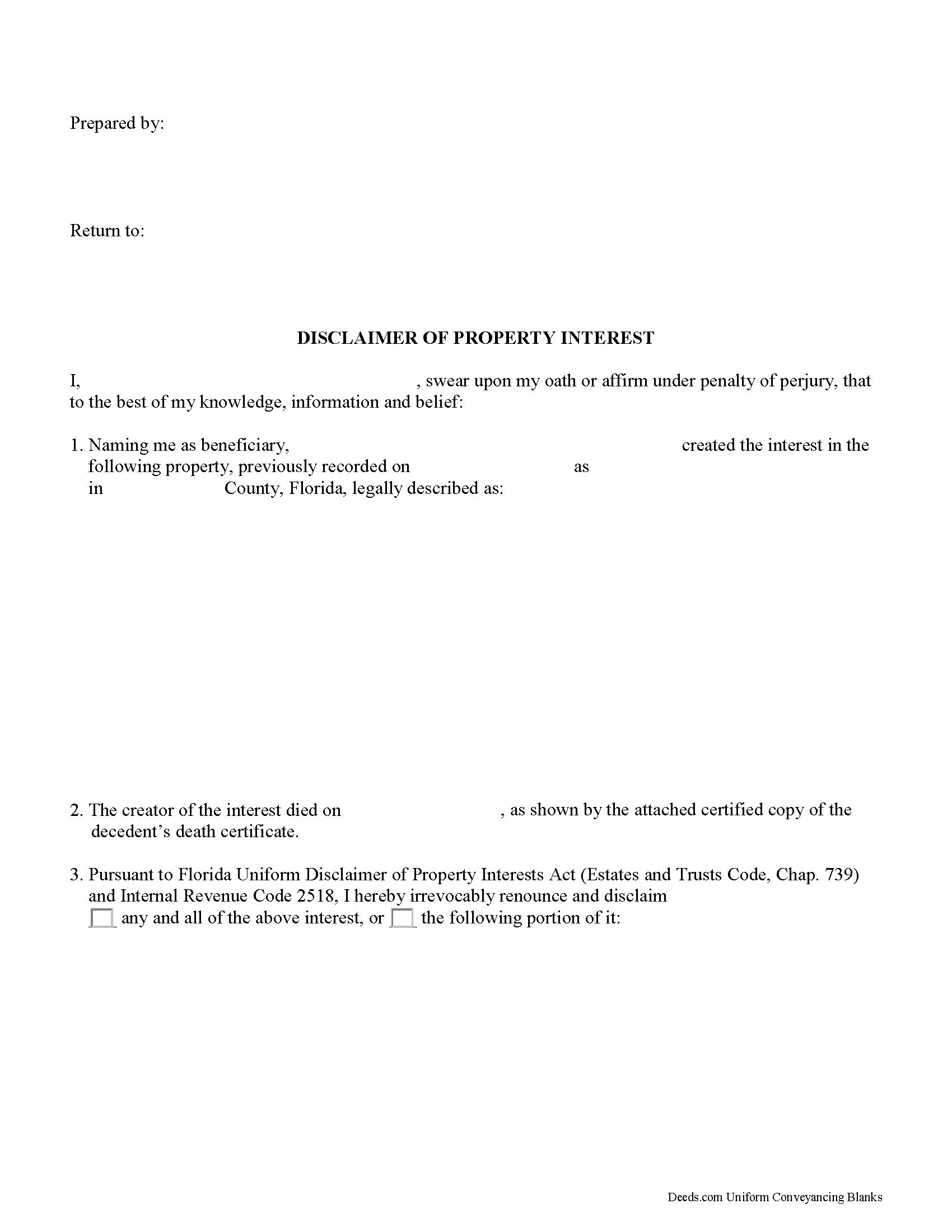
About the Florida Disclaimer of Interest
How to Use This Form
- Select your county from the list
- Download the county-specific form
- Fill in the required information
- Have the document notarized if required
- Record with your county recorder's office
What Others Like You Are Saying
"L-o-v-e your site. Great over-all usable docs. thanks"
"While I was initially disappointed I could not go to the local County to file my paperwork due to Co…"
"was fairly easy to work through the forms but needed better information on what goes on a few of the…"
"They didn't have what I was looking for so they refunded my money immediately. Very easy to work wit…"
"I was extremely pleased with this experience, which literally took a minimum amount of time. One rec…"
4.8/5 from 4,829 reviews. Read all
A Florida Disclaimer of Interest is the written refusal to accept an interest in real property that would otherwise pass to the person signing it under a will, by intestate succession, under a trust, by survivorship, or under a deed or beneficiary designation. This form prepares that refusal under the Florida Uniform Disclaimer of Property Interests Act, Chapter 739, Florida Statutes, for one disclaimant and one parcel of Florida real property, signed with the formalities of a Florida deed and ready for delivery and recording.
A refusal, not a transfer
Section 739.104(6) shapes the instrument: a disclaimer under Chapter 739 is not a transfer, assignment, or release, so nothing passes from the disclaimant to anyone. Under Section 739.201 the disclaimed interest passes as the creating instrument explicitly provides for a disclaimed interest or, absent such a provision, as if the disclaimant had died immediately before the interest was created. The form's disclaimer paragraph says so: the interest passes without direction by the disclaimant, as Chapter 739 and the creating instrument or law provide.
Whole or part, described in the writing
Section 739.104(3) requires the writing to declare itself a disclaimer and to describe the interest disclaimed, and Section 739.104(4) allows a partial disclaimer expressed as a fraction, percentage, monetary amount, term of years, or any other interest or estate in the property. The form carries that description in its own section, tied to the source recited above it: the decedent or transferor, the date of death, the instrument or law under which the interest arose, and any pending court proceeding. The completed example disclaims the whole of a devised one-third interest; the guide shows how a fractional disclaimer reads. The disclaimer the form states is unconditional, the rule under Section 739.104(1) unless the disclaimant explicitly provides otherwise.
Signed like a Florida deed
Chapter 739 borrows its formalities from deed law: the disclaimer is witnessed and acknowledged in the manner provided for deeds of real estate to be recorded in Florida. The form carries one DISCLAIMANT signature block, two subscribing witness blocks with the printed name and post-office address of each witness that Section 695.26(1)(c) has required since 2024, and an acknowledgment certificate in the statutory short form of Section 695.25(1), with a reserved area for the rubber-stamp seal Section 117.05 requires on every notarized paper document.
Delivery makes it effective; recording gives notice
Under Section 739.104(3) an original of the disclaimer is delivered or filed as Section 739.301 directs, to the personal representative for an interest passing under a will or by intestacy, to the trustee for a trust interest, or to the clerk of the court where no fiduciary is serving, and it becomes irrevocable under Section 739.104(5) once delivered or filed and effective. Recording is the separate step that protects the title: Section 739.601 gives a recorded disclaimer constructive notice to all persons only when it contains a legal description and is recorded in the county where the property is located, and Section 739.301(12) presumes delivery upon that recording. The guide walks through the recipient Section 739.301 names for each kind of interest, the clerk's page-space and fee rules, and the Section 739.402 events that bar a disclaimer.
One disclaimant, one parcel
The form identifies a single natural person refusing an interest in his or her own right and a single property described by county, legal description, parcel number, and address. An heir declining a devised share, a surviving joint owner refusing the survivorship interest in a co-owned lot, and a trust beneficiary refusing a distribution of a house present the pattern the form recites. The form is not set up as a fiduciary's disclaimer for an estate, trust, or ward, as a disclaimer of a power of appointment, as a conditional disclaimer, or as a joint instrument for two disclaimants; a second person refusing an interest in the same property is the disclaimant of a separate instrument. Section 739.501 treats a disclaimer that qualifies under Section 2518 of the Internal Revenue Code as effective under Chapter 739; the federal nine-month and no-acceptance conditions are rules the guide describes, not terms the form supplies.
The package includes the fillable Disclaimer of Interest form, a completed example filled in for an Orange County fact pattern, and the guide that explains each section, the signing and witnessing requirements, delivery under Section 739.301, and recording under Section 739.601. This description and the guide describe the form and the governing statutes in general terms; they are not legal advice.
Important: County-Specific Forms
Our disclaimer of interest forms are specifically formatted for each of the 67 counties in Florida.
After selecting your county, you'll receive forms that meet all local recording requirements, ensuring your documents will be accepted without delays or rejection fees.