Florida Life Estate Deed Without Warranties (Two Married Co-Owners Holding by the Entirety)
County Specific Legal Forms Validated as recently as October 15, 2026 by our Forms Development Team
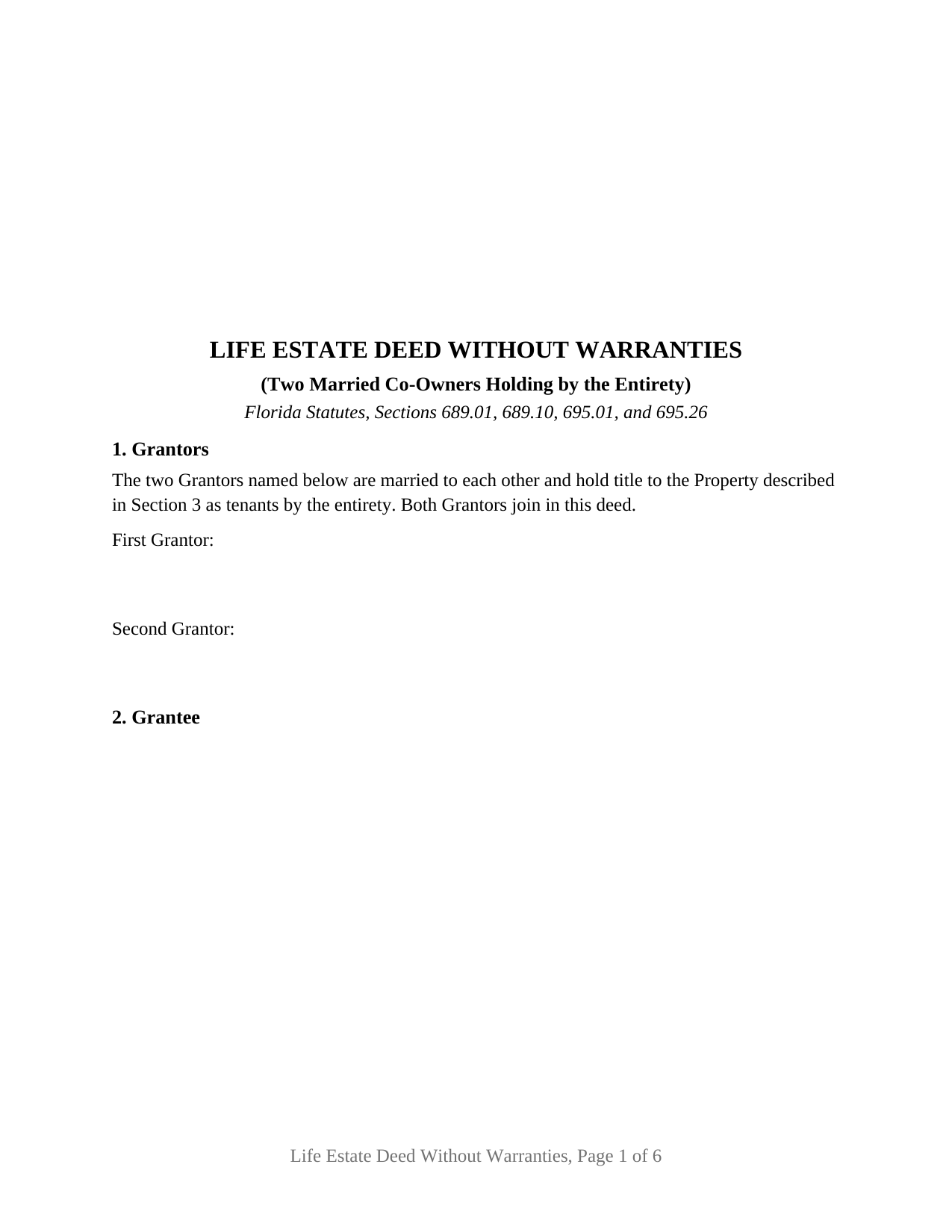
About the Florida Life Estate Deed Without Warranties (Two Married Co-Owners Holding by the Entirety)
How to Use This Form
- Select your county from the list
- Download the county-specific form
- Fill in the required information
- Have the document notarized if required
- Record with your county recorder's office
What Others Like You Are Saying
"Easy process. Thanks for making this resource available."
"Received exactly what you said I would get. Good Quick Service"
"It's going well so far!"
"I am extremely impressed with the quality of this service. They are a pleasure to work with and I kn…"
"Easiest and most efficient process awesome online communication"
4.8/5 from 4,828 reviews. Read all
Two Florida spouses who own their home as tenants by the entirety can keep the right to live in it for both of their lifetimes and still pass the remainder now, by one recorded deed that both of them sign. This form prepares that deed: a Florida life estate deed without warranties for exactly two married co-owners holding by the entirety, reserving a life estate to the couple and the survivor of them and conveying the remainder to one or two grantees without warranty.
A life estate that outlives the first spouse
The grantors keep a life estate for their joint lives, and when the first spouse dies it continues in the survivor for life. Nothing changes hands at the first death; the survivor keeps the same right to possess, rent, and collect income from the property. The remainder vests in the grantees on delivery, but possession waits for the second death, when the life estate ends and the grantees take possession on the recorded deed and the fact of death rather than through probate.
The deed reserves no power to sell, mortgage, or revoke the remainder, and says so in its own text; that sentence separates it from the enhanced life estate deed, often searched as a lady bird deed. It also states that it is not in the statutory warranty deed form of section 689.02 and names the covenants the grantors do not make, while conveying the remainder with present words of grant, bargain, sale, and conveyance.
Two owners, two signatures, one entireties title
Florida presumes real property titled in both spouses' names to be held by the entirety when the unities are present and the instrument shows no contrary intent, the rule of Beal Bank v. Almand & Associates. Section 1 recites that title as fixed text: the two grantors are married to each other, hold the property as tenants by the entirety, and both join in the deed, and Section 4 identifies the recorded vesting instrument behind that title.
Because both spouses are grantors, the spousal joinder article X, section 4(c) of the Florida Constitution describes for an alienation of homestead appears on the face of the deed. The form carries a signature block for each spouse, two subscribing witness blocks after each signature under section 689.01 with the witness post-office addresses section 695.26 has required since 2024, and a separate acknowledgment certificate for each spouse in the section 695.25 short form with a reserved seal area, so the spouses may acknowledge on different days or before different officers.
What this configuration recites
The deed prints one ownership pattern instead of leaving a blank: two natural persons, married to each other, holding by the entirety, signing in their own right. The grantee side stays open: one grantee takes the remainder alone, and two take it in the co-ownership form that follows their names, as tenants in common, as joint tenants with right of survivorship, or, if spouses, by the entirety. Spouses in their later years passing the remainder in the house they bought together to one grandchild, and a couple who hold a rental duplex by the entirety and convey its remainder to a nephew while keeping the rents, present the pattern this deed recites. A sole owner, co-owners who are not married to each other, and entity, trustee, or attorney-in-fact grantors follow different patterns, and the recital does not describe former spouses, whose entireties title became a tenancy in common on dissolution under section 689.15.
What the clerk collects
The clerk of the circuit court in the county where the land lies records the deed and collects documentary stamp tax under section 201.02 at 70 cents per 100 dollars of consideration, counting any unpaid mortgage balance; under Department of Revenue rule 12B-4.014, a gift of unencumbered property is not taxable, while a deed reciting love and affection and a nominal sum carries at least the minimum tax. A spouse who keeps living on the property holds a beneficial interest for life that section 196.041(2) treats as equitable title for the homestead tax exemption, and section 738.508 allocates recurring taxes, insurance, and ordinary repairs to the life tenants and principal and extraordinary repairs to the remainder holders.
The package consists of the fillable deed form, a completed example for a Seminole County fact pattern, and the guide that describes each numbered section, the signing formalities, and recording. The article and the guide describe the form and Florida law in general terms and are not legal advice.
Important: County-Specific Forms
Our life estate deed without warranties (two married co-owners holding by the entirety) forms are specifically formatted for each of the 67 counties in Florida.
After selecting your county, you'll receive forms that meet all local recording requirements, ensuring your documents will be accepted without delays or rejection fees.