Florida Life Estate Deed Without Warranties
County Specific Legal Forms Validated as recently as October 14, 2026 by our Forms Development Team
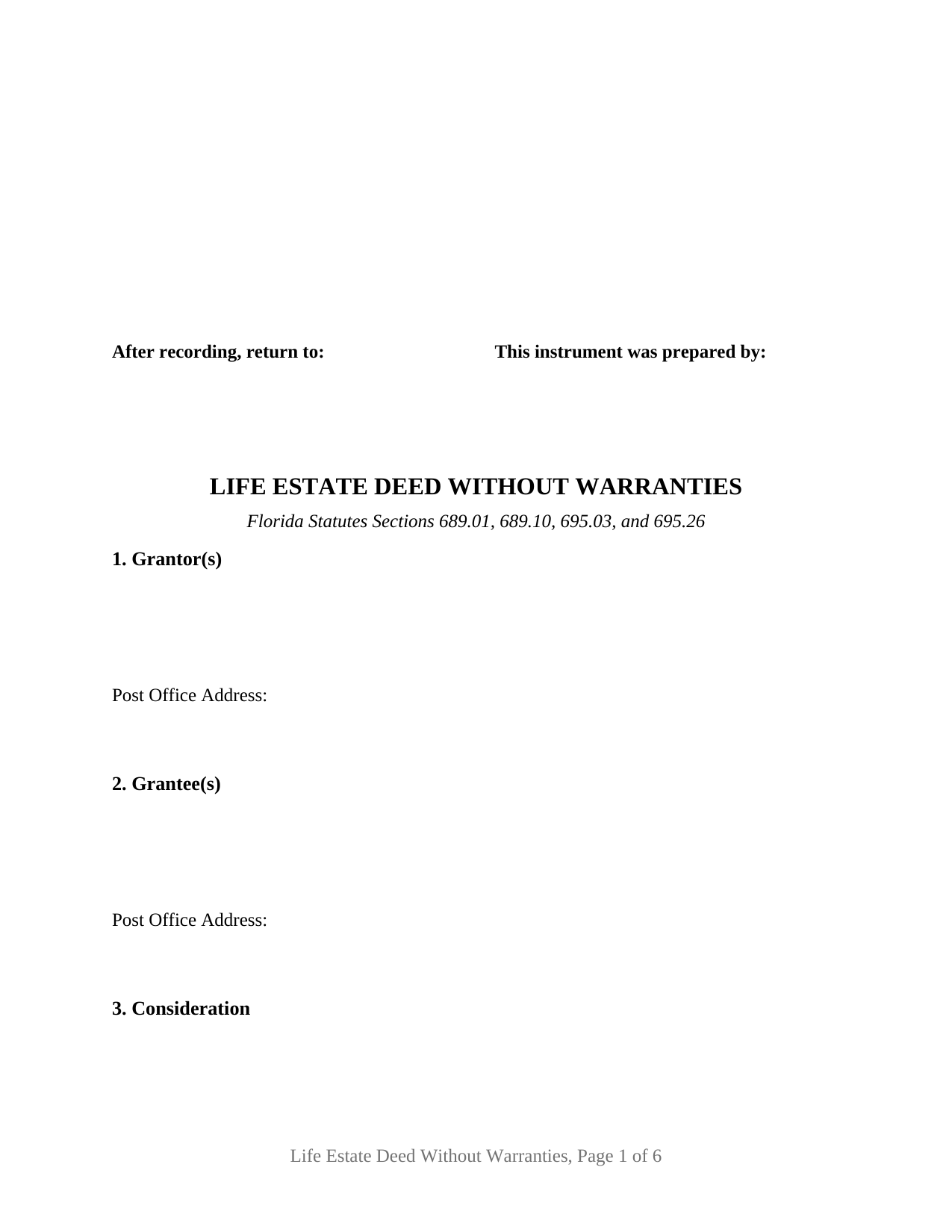
About the Florida Life Estate Deed Without Warranties
How to Use This Form
- Select your county from the list
- Download the county-specific form
- Fill in the required information
- Have the document notarized if required
- Record with your county recorder's office
What Others Like You Are Saying
"IT WAS SO VERY HELPFUL AND EASY TO DO WILL RETUN TO THE SITE AGAIN."
"Thank you everything was as expected very good service"
"First time user and the service was great.. I typically go to recording kiosk at the libraries. This…"
"I am a litigator based in Lee County that rarely needs to record deeds or mortgages. However, at tim…"
"Absolutely wonderful customer service. I am very pleased with the service I received and highly reco…"
4.8/5 from 4,825 reviews. Read all
A Florida life estate deed without warranties splits ownership of real property in two the moment it is delivered: the grantor keeps a life estate, the right to live in, use, and collect the income from the property for life, and the grantee receives the remainder, a vested interest that ripens into full possession when the life tenant dies. This form prepares that deed for Florida real property, with one or two grantors conveying to one or two grantees and no warranty of title.
A present conveyance that waits to take possession
The deed is not a will and not a transfer on death designation. It conveys the remainder now, on delivery, and the grantor cannot later revoke it or sell the whole property alone. The deed states on its face that the grantor reserves no power to sell, convey, mortgage, or otherwise dispose of the remainder, which is the line between this conventional life estate deed and the enhanced life estate deed, often called a lady bird deed, that reserves those lifetime powers. When the life tenant dies, nothing is left in the life tenant to pass through probate under this deed; the remainderman's possession rests on the recorded deed and the fact of death.
Why the deed says no warranty, and why Florida lets it
Florida gives statutory warranty effect only to a conveyance executed substantially in the warranty deed form of Section 689.02; Section 689.03 then reads the full common-law covenants into that form. A deed that departs from the form, and says so, carries no such covenants. This deed uses present words of grant, bargain, sale, and conveyance aimed at the property itself, not the remise, release, and quitclaim wording of the Section 689.025 quitclaim form, and it states that the grantor makes no covenant of seisin, right to convey, freedom from encumbrances, quiet enjoyment, or further assurances, and no warranty of title.
What the general configuration carries
This is the base configuration of the deed, built for natural persons signing in their own right. The grantor and grantee blocks are free-form: each takes one or two names with whatever status words the entries supply, and the grantee block takes any designation two grantees use to hold the remainder together, as tenants in common, as joint tenants with right of survivorship, or as spouses by the entirety. Nothing about marital status, existing ownership, or vesting is preprinted. The form carries two grantor signature blocks, each followed by two subscribing witness blocks with the witness addresses Section 695.26 has required since 2024, and a separate acknowledgment certificate for each grantor in the Section 695.25 short form, with a reserved area for the notary's rubber-stamp seal. On a single-grantor deed the second signature block, its witness blocks, and its certificate stay blank. A parent conveying the remainder in the family home to an adult child, and a married couple conveying it to their two children with survivorship between them, present the one-grantor and two-grantor patterns this deed recites; a corporate, trustee, or attorney-in-fact grantor follows a different pattern.
Homestead joinder and the married grantor
Article X, section 4(c) of the Florida Constitution provides that the owner of homestead real estate, joined by the spouse if married, may alienate it by mortgage, sale, or gift. A married grantor conveying the remainder in homestead therefore conveys with the spouse's joinder, and the second signature block, its witnesses, and its certificate are where a joining spouse signs.
Taxes, expenses, and the record
A life estate deed conveys a present interest, so documentary stamp tax under Section 201.02 applies at 70 cents per 100 dollars of consideration, and the Department of Revenue counts the balance of any mortgage on the property as consideration whether or not the grantee assumes it. A life tenant living on the property holds equitable title for the homestead tax exemption under Section 196.041(2), and Section 738.508 allocates the ongoing costs: the life tenant pays recurring taxes, insurance, interest, and ordinary repairs, and the remainderman pays principal and extraordinary repairs. The deed is recorded with the clerk of the circuit court in the county where the property lies.
The package includes the fillable deed form, a completed example filled in for a realistic Volusia County fact pattern, and the guide that walks through every numbered section, the signing formalities, and the documentary stamp tax. This description and the guide describe the form and the governing Florida statutes in general terms; they are not legal advice.
Important: County-Specific Forms
Our life estate deed without warranties forms are specifically formatted for each of the 67 counties in Florida.
After selecting your county, you'll receive forms that meet all local recording requirements, ensuring your documents will be accepted without delays or rejection fees.