Florida Life Estate Quitclaim Deed (Two Married Co-Owners Holding by the Entirety)
County Specific Legal Forms Validated as recently as October 14, 2026 by our Forms Development Team
About the Florida Life Estate Quitclaim Deed (Two Married Co-Owners Holding by the Entirety)
How to Use This Form
- Select your county from the list
- Download the county-specific form
- Fill in the required information
- Have the document notarized if required
- Record with your county recorder's office
What Others Like You Are Saying
"The process worked great! It's a great solution for recording documents at the county during the pan…"
"Very fast and easy to use."
"Using www.deeds.com was super ez even for a non-technical person like me, it saved me lots of time a…"
"Wow, this was a breeze!! Best experience and fast. Great way to record documents in a matter of minu…"
"I wish that I had known about Deed.com years ago! Very easy and time saving!"
4.8/5 from 4,828 reviews. Read all
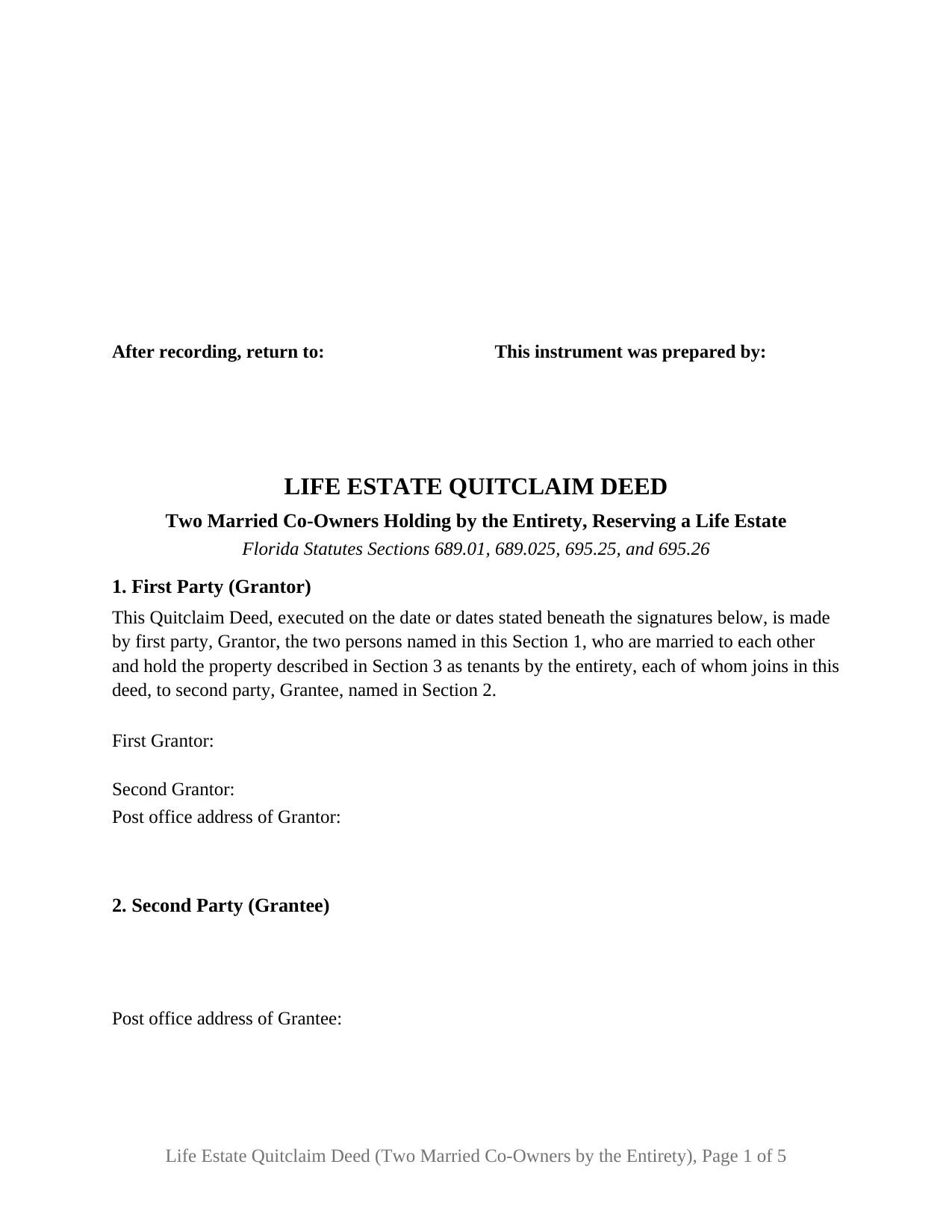
A married couple holding a Florida home as tenants by the entirety can convey the remainder now and keep the home for both of their lives in one recorded deed: both spouses convey together, and both keep a life estate that lasts until the second of them dies. This fillable form prepares that deed under Section 689.025, Florida Statutes, for exactly two grantors who are married to each other and hold the property by the entirety.
Both spouses convey, and the life estate runs to the survivor
The deed recites its configuration as fixed text: the first party is two persons married to each other who hold the property as tenants by the entirety, each of whom joins in the deed. Because both spouses sign, the deed carries on its face the joinder article X, section 4(c) of the Florida Constitution calls for when homestead is alienated by sale or gift. The reservation keeps a life estate for the grantors' joint lives and for the life of the survivor of them, with the right to possess and occupy the property and to take its rents and income. At the first death the survivor holds the life estate alone; at the second death it ends, and the grantee's recorded remainder becomes an estate in possession without probate.
A remainder the grantors cannot take back alone
Section 689.10 passes the grantor's whole estate unless the deed shows a contrary intention, and Section 4 of this deed states that intention: a life estate is reserved, the conveyance is subject to it, and the reservation includes no power to sell, mortgage, or otherwise divest the remainder without the joinder of the grantee. That sentence separates the instrument from the enhanced life estate, the lady bird deed, whose grantor keeps the power to undo the remainder alone; here a sale or mortgage of the whole property takes the life tenants and the remainder holder together.
The entireties recital, as the record shows it
Florida presumes that real property titled in both spouses' names is held by the entirety when the six unities, including marriage, are present and the deed shows no contrary intent, the rule of Beal Bank, SSB v. Almand and Associates, 780 So. 2d 45 (Fla. 2001). The recital in Section 1 states that status as the grantors assert it from their vesting deed. The guide covers the Section 689.15 rule that dissolution of marriage converts an entireties estate into a tenancy in common; the reservation measures the life estate by both lives and the survivor's life, not by the marriage.
The grantee side stays open
The grantee entry is free-form: one or two natural persons, with the post office address Section 695.26(1)(f) requires, and any designation of how they hold the remainder written after their names. The completed example, set in Brevard County, shows a couple conveying the remainder to their two children as tenants in common in equal undivided shares. Spouses who hold as tenants in common or as joint tenants, a single grantor, a trustee or entity grantor, and three or more owners are configurations this deed is not set up to recite.
Two signatures, four witnesses, two certificates
Section 689.01 requires each grantor to sign before two subscribing witnesses, and the deed draws a witness block for each, naming the grantor whose signature it attests, with the printed name and post office address Section 695.26(1)(c) has made recording data since January 1, 2024. Two acknowledgment certificates follow in the Section 695.25(1) short form, one per grantor, so a couple can acknowledge together or separately before different notaries, and each reserves an area for the rubber stamp seal Section 117.05(3)(a) requires on paper.
Recording in the county where the land lies
The clerk of the circuit court records the deed at the Section 28.24 charges, with the three-inch clerk space clear at the top right of the first page. Documentary stamp tax under Section 201.02 is computed on the consideration, and the statute counts the unpaid balance of any mortgage as consideration whether or not the grantee takes it over. After recording, Section 196.041 treats the grantors' retained life interest as equitable title for homestead tax exemption purposes.
The package contains the fillable deed, a completed example for the Brevard County couple above, and a guide that walks through each entry, the witness and notary ceremony, and recording. The description and the guide explain the form and the Florida statutes behind it in general terms and are not legal advice.
Important: County-Specific Forms
Our life estate quitclaim deed (two married co-owners holding by the entirety) forms are specifically formatted for each of the 67 counties in Florida.
After selecting your county, you'll receive forms that meet all local recording requirements, ensuring your documents will be accepted without delays or rejection fees.