Florida Life Estate Quitclaim Deed (Unmarried Sole Owner)
County Specific Legal Forms Validated as recently as October 14, 2026 by our Forms Development Team
About the Florida Life Estate Quitclaim Deed (Unmarried Sole Owner)
How to Use This Form
- Select your county from the list
- Download the county-specific form
- Fill in the required information
- Have the document notarized if required
- Record with your county recorder's office
What Others Like You Are Saying
"This service was a godsend since I am currently disabled."
"Excellent service. Pay your fee, download the form and fill out according to specific instructions. …"
"The e-recording service was invaluable. This was my first experience recording a document in any cap…"
"Very fast and professionally handled."
"Easy to use Example provided Clear instructions"
4.8/5 from 4,828 reviews. Read all
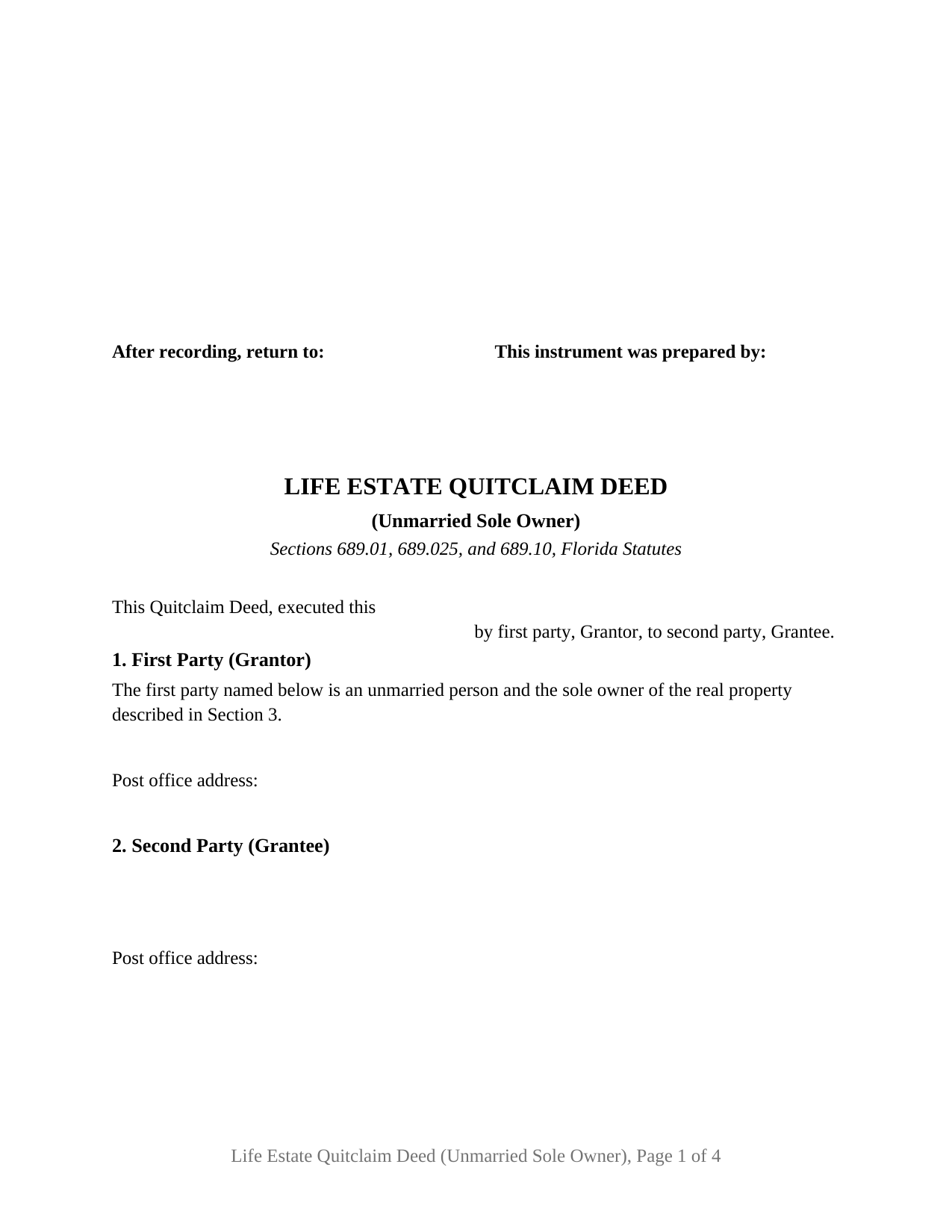
One owner, unmarried, holding the whole title, who keeps the home for life and passes the rest of the ownership now: that is the configuration this Florida life estate quitclaim deed fixes in its own text. The deed names one first party, prints the words identifying that person as an unmarried person and the sole owner of the parcel, conveys the remainder by the statutory quitclaim words of Section 689.025, Florida Statutes, and reserves an ordinary life estate to the grantor under the contrary-intention clause of Section 689.10.
A status written into the deed, not left to a blank
Section 1 opens with a fixed sentence that the first party named below is an unmarried person and the sole owner of the real property described in Section 3, and the only entries under it are the grantor's name and post office address. The recital is the grantor's own statement of status and ownership, carried as deed text rather than typed after a name. The signature section follows the same discipline: one grantor block, two subscribing witness blocks beneath it, and one acknowledgment certificate.
Why an unmarried owner signs alone
Article X, section 4(c) of the Florida Constitution lets the owner of homestead real estate alienate it by sale or gift, joined by the spouse if married. That joinder clause is what puts a spouse's signature on a married owner's deed of the home, and it has no work to do when the owner has no spouse, so this deed draws no joinder line and asks no question about marriage.
What the life estate keeps and what it gives up
Section 5 carries the quitclaim sentence in the statute's words and then states the reservation: a life estate for the grantor's natural life, with the exclusive right to possess, occupy, and use the property and to take its rents and income. The same paragraph says what the reservation is not. The grantor keeps no power to sell, mortgage, or otherwise divest the remainder without the grantee's joinder, and the life estate is stated to be an ordinary one rather than an enhanced one. From delivery the grantee owns the remainder; at the grantor's death it becomes possession under the deed already of record, outside probate. Section 196.041, Florida Statutes, treats a person who resides on the property under an estate limited in time by deed as holding title for the property tax homestead exemption, so the grantor's exemption claim does not depend on keeping the fee.
A gift deed and the minimum stamp
A parent deeding the remainder to an adult child for no money is the common fact pattern. Florida Administrative Code rule 12B-4.014(2) provides that a conveyance of unencumbered realty as a gift is not taxable, but that a deed reciting a consideration such as a dollar and other valuable consideration requires at least the minimum tax. Because the statutory form recites a sum paid, Section 4 of this deed carries that sum, and a gift of unencumbered property on this form ordinarily records with the minimum stamp. Where a mortgage remains on the property, Section 201.02 counts its balance as consideration whether or not the grantee assumes it.
What the form recites and what it is not set up as
The deed recites exactly one record owner, unmarried, holding the whole title and signing in that person's own right, and one or two natural persons taking the remainder, with any survivorship or entireties words written after their names in Section 2. A widowed parent conveying the family home to one child, and a divorced owner passing a condominium to two children as tenants in common, present the single unmarried owner pattern this deed recites. A married owner, two co-owners, an owner conveying a fractional interest, a trustee or attorney in fact signing for someone else, and a trust or company taking the remainder each follow a different pattern, and the form prints nothing that would accommodate them. The guide walks through each entry, the Section 695.26 recording data, and the signing ceremony in order.
The package holds the fillable life estate quitclaim deed, a completed example worked through for a Pinellas County parcel, and the guide. Neither this description nor the guide applies the law to a particular owner or parcel, and neither is legal advice.
Important: County-Specific Forms
Our life estate quitclaim deed (unmarried sole owner) forms are specifically formatted for each of the 67 counties in Florida.
After selecting your county, you'll receive forms that meet all local recording requirements, ensuring your documents will be accepted without delays or rejection fees.