Liberty County Notice of Commencement Form
Last validated September 22, 2026 by our Forms Development TeamFormatted for recording in Liberty County, for property anywhere in the county: rural and unincorporated areas as well as Bristol, Hosford, Sumatra, Telogia.
- 3 documents included
- Immediate PDF download
- Formatting guarantee
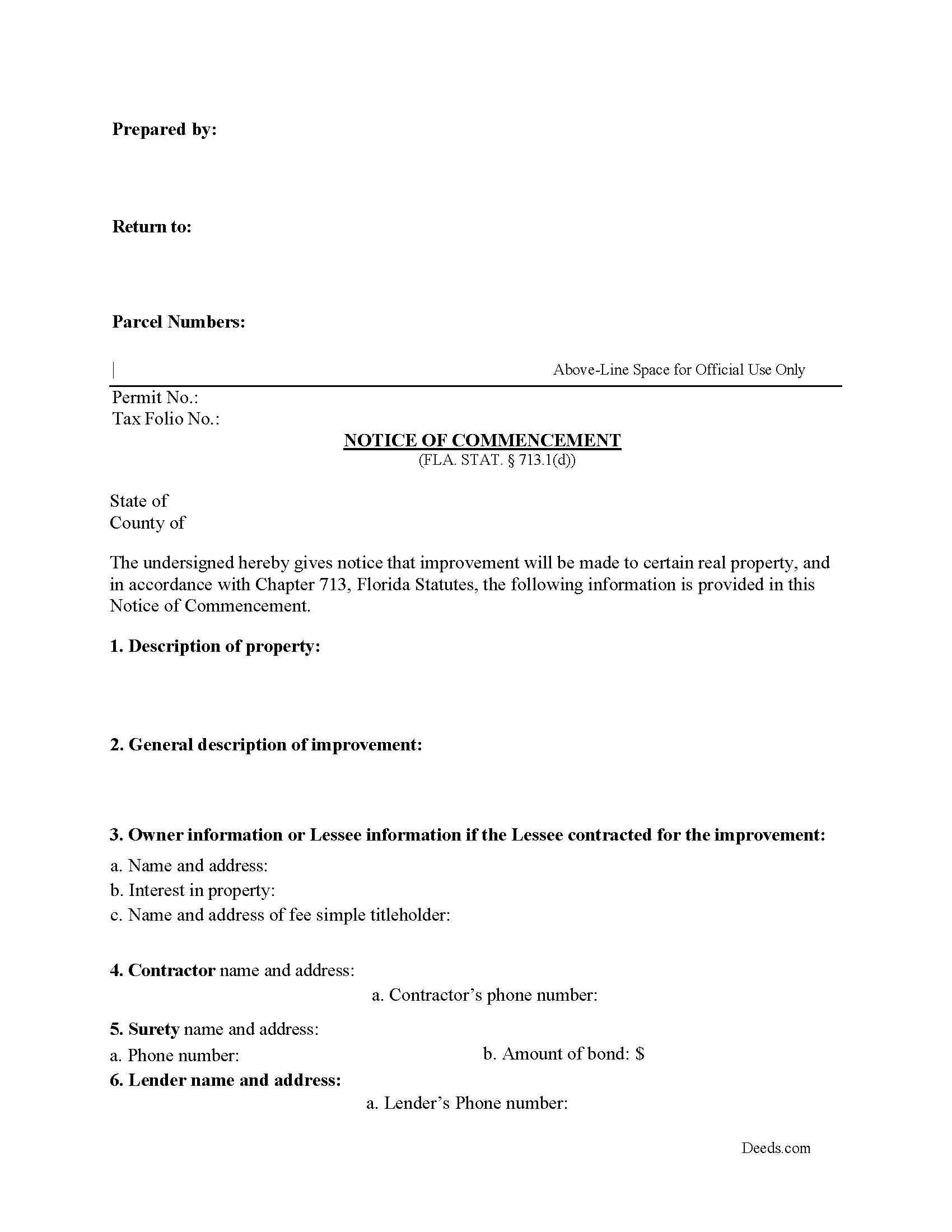
Liberty County Notice of Commencement Form
Fill in the blank Notice of Commencement form formatted to comply with all Florida recording and content requirements.
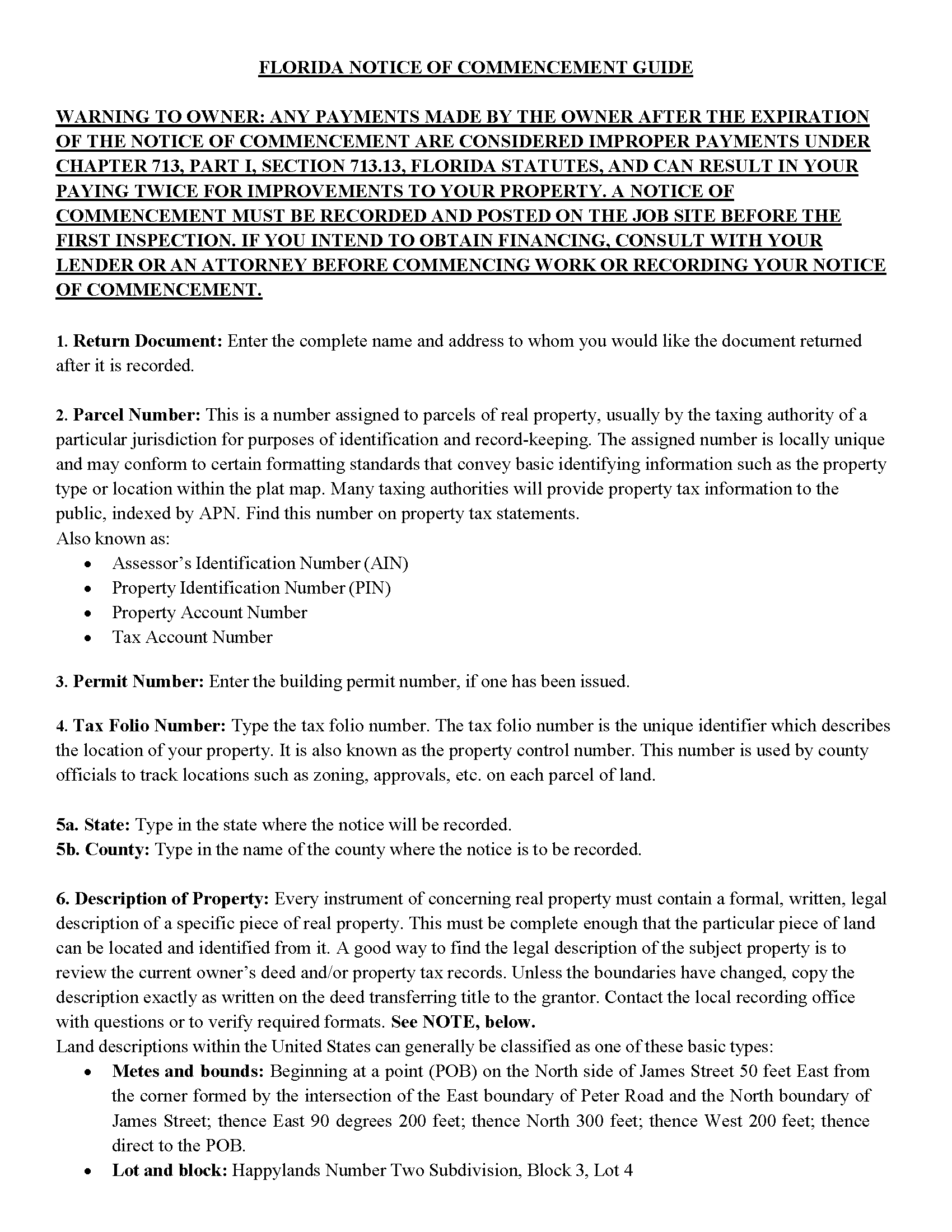
Liberty County Notice of Commencement Guide
Line by line guide explaining every blank on the Notice of Commencement form.
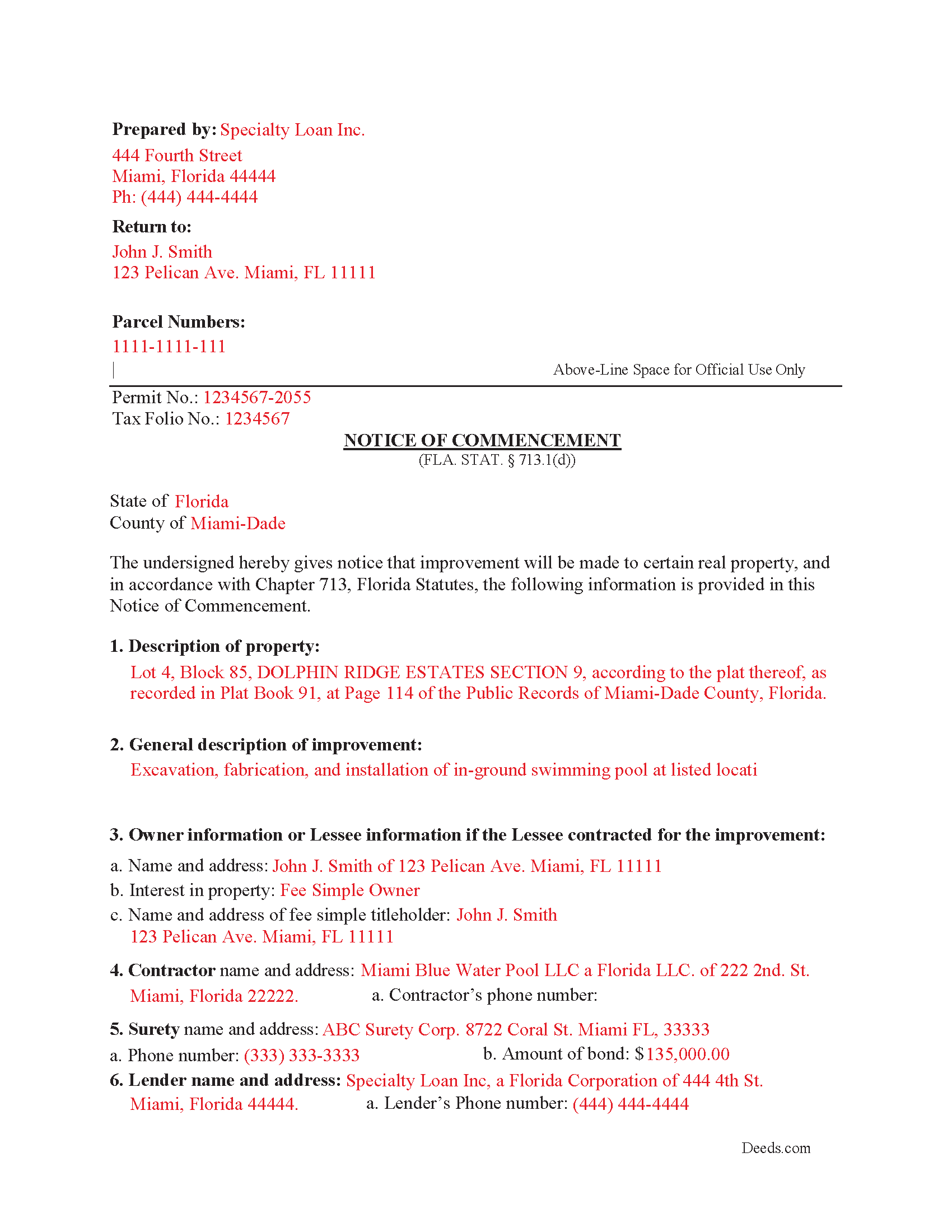
Liberty County Completed Example of the Notice of Commencement Document
Example of a properly completed Florida Notice of Commencement document for reference.
All 3 documents above included • One-time purchase • No recurring fees
Immediate Download • Secure Checkout
Additional Florida and Liberty County documents included at no extra charge:
Where to Record Your Documents
Liberty County Clerk of Court
Bristol, Florida 32321
Hours: 8:00am - 5:00pm M-F
Phone: (850) 643-2215
Recording Tips for Liberty County:
- Bring your driver's license or state-issued photo ID
- Ensure all signatures are in blue or black ink
- Ask about their eRecording option for future transactions
- Avoid the last business day of the month when possible
- Both spouses typically need to sign if property is jointly owned
Cities and Jurisdictions in Liberty County
Properties in any of these areas use Liberty County forms:
- Bristol
- Hosford
- Sumatra
- Telogia
Hours, fees, requirements, and more for Liberty County
How do I get my forms?
Forms are available for immediate download after payment. The Liberty County forms will be in your account ready to download to your computer. An account is created for you during checkout if you don't have one. Forms are NOT emailed.
Are these forms guaranteed to be recordable in Liberty County?
Yes. Our form blanks are guaranteed to meet or exceed the applicable formatting requirements used for recording in Liberty County, including margin requirements, font requirements, and other layout standards. This guarantee applies to formatting, not to the legal sufficiency of information entered by the user or the suitability of a form for a particular transaction.
Can I reuse these forms?
Yes. You can reuse the forms for your personal use. For example, if you have multiple properties in Liberty County you only need to order once.
What do I need to use these forms?
The forms are PDFs that you fill out on your computer. The free Adobe Acrobat Reader is recommended, and most PDF apps also work. You do NOT enter your property information online - you download the blank forms and complete them privately on your own computer.
Are there any recurring fees?
No. This is a one-time purchase. Nothing to cancel, no memberships, no recurring fees.
How much does it cost to record in Liberty County?
Recording fees in Liberty County vary. Contact the recorder's office at (850) 643-2215 for current fees.
Questions answered? Let's get started!
Choose a Florida Notice of Commencement when a Florida construction project needs the Chapter 713 notice that ties lien rights to the county recording record. Florida’s version is unusually specific: it uses a statutory form, requires recording in the clerk’s office and job-site posting before the first inspection, separates the $2,500 construction-lien threshold from the $5,000 inspection-copy rule, and voids the notice if the improvement does not start within 90 days after recording.
What a Florida Notice of Commencement Does and When It Is Used
A Notice of Commencement identifies the property, the improvement, the owner or contracting lessee, the contractor, and any lender or payment bond so contractors, subcontractors, suppliers, and laborers know where lien-related notices should be sent. In Florida, it is commonly used for private construction, remodeling, additions, repairs, and other improvements to real property when the project is not exempt under the construction lien law. It does not transfer title, change ownership, create survivorship rights, or operate like a deed; it is a recorded construction-lien notice governed by Chapter 713.
Florida Statutory Requirements for the Notice
Except for an improvement exempt under the small-project rule, an owner or the owner’s authorized agent must record a notice of commencement in the clerk’s office before actually commencing an improvement to real property, or before recommencing completion after default or abandonment, even when the project has a payment bond (Fla. Stat. § 713.13(1)(a)). An improvement for which the direct contract price is $2,500 or less is exempt from most provisions of Part I of Chapter 713 except the contractor’s lien provision (Fla. Stat. § 713.02(5)).
The Florida notice must be in substantially the statutory form and must include:
- A legal description sufficient to identify the property, plus the street address and tax folio number if available, or other information describing the physical location when no street address is available (Fla. Stat. § 713.13(1)(a)1.).
- A general description of the improvement (Fla. Stat. § 713.13(1)(a)2.).
- The owner’s name and address, the owner’s interest in the site, and the fee simple titleholder’s name and address if different from the owner. A lessee who contracts for the improvement must be listed as the owner with a statement that the interest is a leasehold interest (Fla. Stat. § 713.13(1)(a)3.).
- The contractor’s name and address (Fla. Stat. § 713.13(1)(a)4.).
- The surety’s name and address, if a payment bond exists, and the bond amount (Fla. Stat. § 713.13(1)(a)5.).
- The name and address of any lender making a construction loan for the improvements (Fla. Stat. § 713.13(1)(a)6.).
- The name and Florida address of any person designated by the owner to receive notices or other documents, if the owner designates someone for that purpose (Fla. Stat. § 713.13(1)(a)7.).
- The name and address of any additional person designated to receive a copy of a lienor’s notice, if the owner makes that optional designation (Fla. Stat. § 713.13(1)(b)).
- An expiration date. If no different date is stated, the notice expires one year after recording (Fla. Stat. § 713.13(1)(d)).
If the contract with the contractor named in the notice states a completion period longer than one year, the notice must state that it is effective for one year plus the additional time, and payments made after expiration are treated as improper payments under Chapter 713 (Fla. Stat. § 713.13(1)(c)).
Signing, Notarization, and Job-Site Posting in Florida
The statutory form is signed by the owner or lessee, or by the owner’s or lessee’s authorized officer, director, partner, or manager when an entity is involved, and the form includes a notary acknowledgment for physical presence or online notarization (Fla. Stat. § 713.13(1)(d)). Florida’s notice of commencement is not executed like a deed: the statutory form does not include two witness lines, but the owner-signature rule is strict because the statute states that the owner must sign the notice and no one else may be permitted to sign in the owner’s stead (Fla. Stat. § 713.13(1)(g)).
After recording, the owner must post either a certified copy of the recorded notice or a notarized statement that the notice has been filed for recording, together with a copy of the notice, at the improvement site (Fla. Stat. § 713.13(1)(a)). When the direct contract is greater than $5,000, the building permit applicant must file a copy of the notice with the issuing authority before the first inspection; the copy may be a certified copy of the recorded notice, a notarized filing statement with a copy, or the clerk’s official records information such as the instrument number or book and page (Fla. Stat. § 713.135(1)(e)).
Recording, Priority, and County Filing
The notice is recorded in the clerk’s office for the county where the Florida property is located. For Chapter 713, the clerk’s office means the clerk of the circuit court or other county recorder serving the county where the real property is located (Fla. Stat. § 713.01(4)). The notice is effective upon filing in the clerk’s office (Fla. Stat. § 713.13(1)(f)).
Prompt recording matters because Florida lien priority is tied to the notice. Liens under the contractor and subcontractor lien statutes attach and take priority as of the time the notice of commencement is recorded; if no notice is filed, those liens attach and take priority as of the time the claim of lien is recorded (Fla. Stat. § 713.07(2)). Recording the notice does not itself create a lien, cloud, or encumbrance on the real property, but it gives constructive notice that Chapter 713 claims of lien may be recorded and may take priority under Florida’s priority statute (Fla. Stat. § 713.13(3)).
Florida-Specific Issues That Commonly Cause Problems
- Recording too early: If the improvement described in the notice is not actually commenced within 90 days after the notice is recorded, the notice is void and has no further effect (Fla. Stat. § 713.13(2)).
- Confusing the two dollar thresholds: The $2,500 rule relates to the small-improvement exemption in Chapter 713, while the $5,000 rule relates to filing a copy of the notice with the permitting authority before the first inspection (Fla. Stat. §§ 713.02(5), 713.135(1)(e)).
- Weak legal description: Florida requires a legal description, and a street address alone is not a substitute when a legal description is available. An incorrect property description in the notice can make payments on the direct contract improper as to a lienor adversely affected by the error (Fla. Stat. § 713.06(3)(a)).
- Payment bond not attached: If a payment bond exists, a copy must be attached when the notice is recorded. Failure to attach it negates the exemption that would otherwise apply to the bonded direct contract (Fla. Stat. § 713.13(1)(e)).
- Leasehold improvements: When a lessee contracts for the work, the lessee is treated as the owner for notice purposes and must be listed with a leasehold-interest statement, while the fee simple titleholder must also be identified if different (Fla. Stat. § 713.13(1)(a)3.).
- Spousal lien exposure: Florida’s construction lien law contains a spouse-agency rule. When a husband or wife contracts for an improvement on property owned by the other spouse or by both spouses, and the spouses are not separated and living apart, the contracting spouse is deemed the other spouse’s agent for lien purposes unless the other spouse gives the contractor and records a notice of objection within 10 days after learning of the contract (Fla. Stat. § 713.12).
- Deed-style information: A Notice of Commencement is not a deed, so it does not use vesting language, survivorship wording, marital status recitals, or deed documentary stamp tax calculations. The required information is the construction-lien information listed in Chapter 713.
- Recording-format details: Florida recording offices may screen instruments for printed names and addresses of signers, a preparer’s name and address, the notary’s printed or stamped name, and the required recording space at the top right of the page (Fla. Stat. § 695.26).
Amending or Terminating a Florida Notice of Commencement
A notice recorded within its effective period may be amended to extend the effective period, correct erroneous information, or add omitted information. The amended notice must identify the official records book and page of the original notice, and the owner must serve a copy on the contractor and each lienor who serves notice before or within 30 days after the amendment is recorded. Changing contractors requires a new notice of commencement or a notice of recommencement rather than an amendment (Fla. Stat. § 713.13(5)).
An owner may terminate the effective period by recording a Notice of Termination that includes the same information as the notice of commencement, the recording reference and recording date of the original notice, a termination date that is not earlier than 30 days after recording, a statement describing whether the termination applies to all or part of the property, a statement that all lienors have been paid, and the required service statements. When properly served before recording, the termination is generally effective 30 days after recording or on a later date stated in the notice (Fla. Stat. § 713.132).
What You Receive With This Florida Notice of Commencement
- A county-specific Florida Notice of Commencement form developed by Deeds.com’s forms development team for the selected Florida county.
- Step-by-step completion instructions explaining the property description, owner or lessee information, contractor information, lender and surety fields, notice-recipient fields, expiration date, signature, notarization, recording, and posting steps.
- A completed example showing how the Florida Notice of Commencement can be filled out for a typical county recording.
- County recording information to help prepare the notice for filing with the correct Florida clerk or county recorder.
- Downloadable materials available immediately after purchase for use with the selected Florida county.
Important: Your property must be located in Liberty County to use these forms. Documents should be recorded at the county recording office listed above.
This Notice of Commencement meets all recording requirements specific to Liberty County.
Our Promise
The documents you receive here are guaranteed to meet or exceed the applicable Liberty County recording format requirements. If there is a rejection caused by our formatting, we will correct the issue or refund your payment. This guarantee applies to document formatting only and does not extend to information entered by the user, the selection of the form, or the legal effect of the completed document.
Save Time and Money
Get your Liberty County Notice of Commencement form done right the first time with Deeds.com Uniform Conveyancing Blanks. At Deeds.com, we understand that your time and money are valuable resources, and we don't want you to face a penalty fee or rejection imposed by a county recorder for submitting nonstandard documents. We constantly review and update our forms to meet rapidly changing state and county recording requirements for roughly 3,500 counties and local jurisdictions.
4.8 out of 5 - ( 4,828 Reviews )
Pedro M. 5 out of 5 stars
Very good service......
Your feedback is greatly appreciated. Thank you for taking the time to share your experience!
Robert H. 5 out of 5 stars
I am very pleased with your service.
Thank you!
NormaJean Q. 5 out of 5 stars
Thank you, thie was very helpful. I did find the forms I needed.Very easy to use.,
We appreciate your business and value your feedback. Thank you. Have a wonderful day!
Michael L. 5 out of 5 stars
Professional, simple. Very good.
We appreciate your business and value your feedback. Thank you. Have a wonderful day!
Noble Mikhail F. 5 out of 5 stars
The system is wonderful, and makes recording and searching simple, thanks a lot
Thank you!
John M. 5 out of 5 stars
Easy to use site with a good selection of documents
Thank you!
Anna L W. 5 out of 5 stars
Was insecure about being able to access the information but pleasantly found that the site was easy to use. Seems that I can use it repeatedly to go back and reprint the forms once I paid.
We appreciate your business and value your feedback. Thank you. Have a wonderful day!
Sam A. 5 out of 5 stars
User friendly website and deeds are very easy to maneuver. I'm very happy with everything Deeds.com has to offer. It truly helped me with the business that I had to take care of.
Thank you!
JAN F. 5 out of 5 stars
One day start to finish and so easy to complete.
Happy we could assist. Thank you for sharing your experience.
Brenda K R. 5 out of 5 stars
Hello, I like how easy the form is to follow. I'm unsure however of how to proceed as what I am trying to do is have my name added to the deed so in event of death I have ownership.
Thank you for your feedback. We really appreciate it. Have a great day!
Margaret C. 4 out of 5 stars
I recieved my document in a reasonable amount of time. I thought being a member i would be able to look up more than 1 document but it keeps asking me for more money. I requested help, asking if I need to pay for each document but have not yet been answered. I appreciate the fact I got 1 document I needed quickly.
Thank you!
Joseph W. 5 out of 5 stars
good place to get documents and it seems like a sound place to get forms. Self explainitory and helpful
Thank you!
Peggy D. 5 out of 5 stars
Very helpful in finding the information for me. Quick response. Very easy to use the forms.
Thank you for your feedback. We really appreciate it. Have a great day!
Michael M. 5 out of 5 stars
I downloaded the gift deed and I can not type my info onto it what am I doing wrong. Please advise
Sounds like you may be trying to complete the form in your browser. The document needs to be downloaded and saved to you computer, then opened in Adobe.
ANGELIA E. 5 out of 5 stars
Thanks for your expedite process
We appreciate your business and value your feedback. Thank you. Have a wonderful day!