Okaloosa County Personal Representative Deed (Intestate) Form
Last validated September 30, 2026 by our Forms Development TeamFormatted for recording in Okaloosa County, for property anywhere in the county: rural and unincorporated areas as well as Baker, Crestview, Destin, Eglin Afb, Fort Walton Beach, Holt, Hurlburt Field, Laurel Hill and 5 more.
- 3 documents included
- Immediate PDF download
- Formatting guarantee
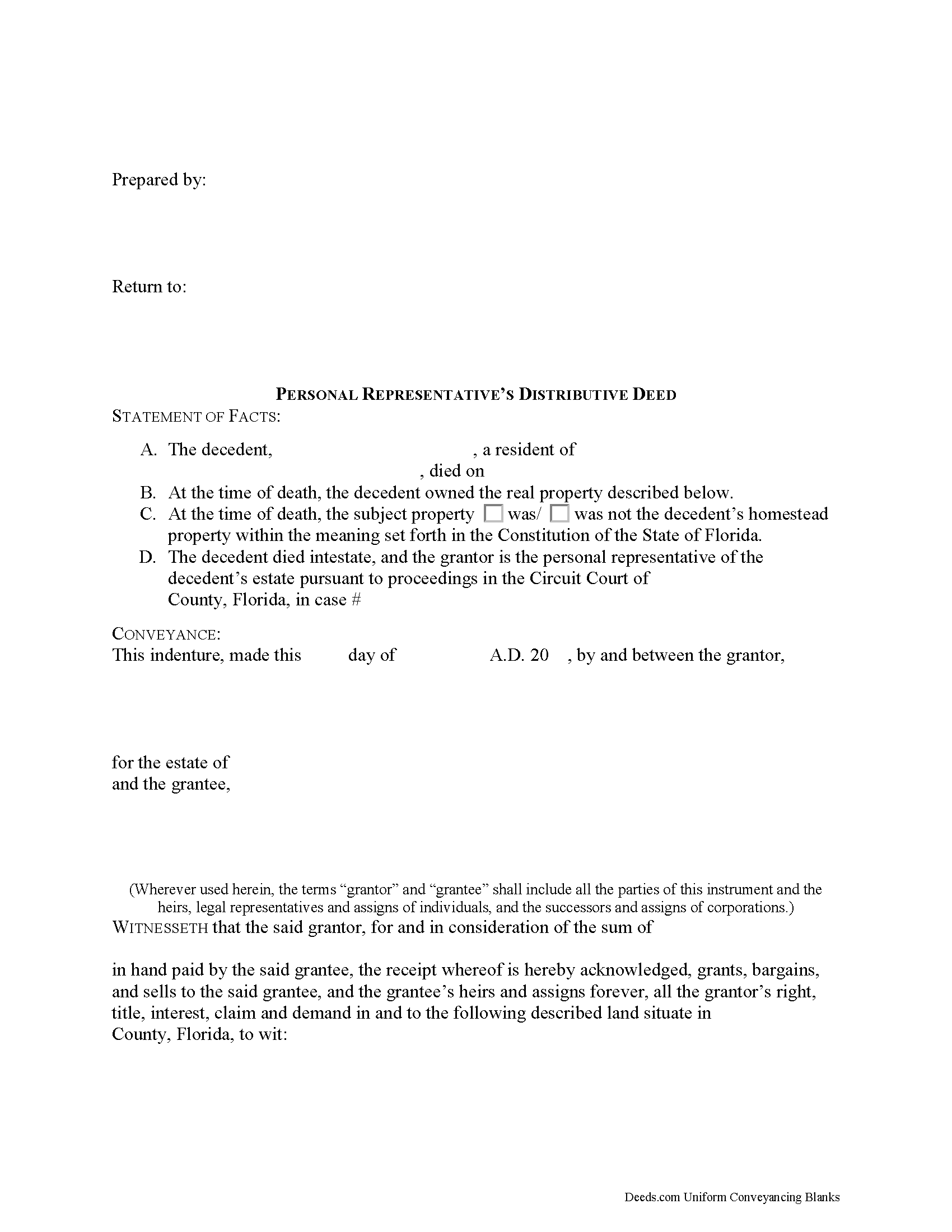
Okaloosa County Personal Representative Deed (Intestate) Form
Fill in the blank Personal Representative Deed (Intestate) form formatted to comply with all Florida recording and content requirements.
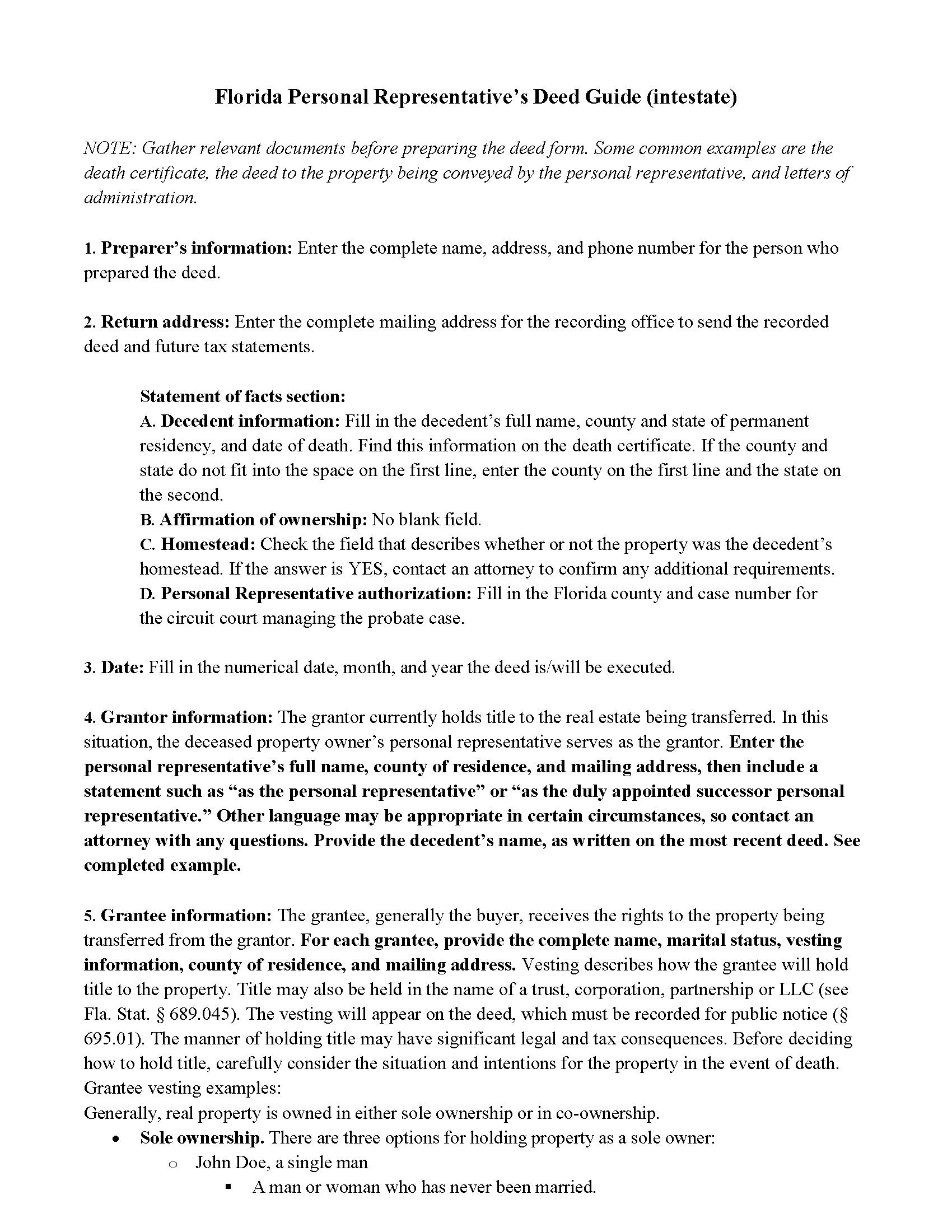
Okaloosa County Personal Representative Deed (Intestate) Guide
Line by line guide explaining every blank on the Personal Representative Deed (Intestate) form.
Okaloosa County Completed Example of the Personal Representative Deed (Intestate) Document
Example of a properly completed Florida Personal Representative Deed (Intestate) document for reference.
All 3 documents above included • One-time purchase • No recurring fees
Immediate Download • Secure Checkout
Additional Florida and Okaloosa County documents included at no extra charge:
Where to Record Your Documents
Okaloosa County Clerk of Circuit Court
Crestview, Florida 32536
Hours: 8:00am - 5:00pm M-F
Phone: (850) 689-5000
Recording Tips for Okaloosa County:
- Bring your driver's license or state-issued photo ID
- Ensure all signatures are in blue or black ink
- Check that your notary's commission hasn't expired
- Documents must be on 8.5 x 11 inch white paper
- Double-check legal descriptions match your existing deed
Cities and Jurisdictions in Okaloosa County
Properties in any of these areas use Okaloosa County forms:
- Baker
- Crestview
- Destin
- Eglin Afb
- Fort Walton Beach
- Holt
- Hurlburt Field
- Laurel Hill
- Mary Esther
- Milligan
- Niceville
- Shalimar
- Valparaiso
Hours, fees, requirements, and more for Okaloosa County
How do I get my forms?
Forms are available for immediate download after payment. The Okaloosa County forms will be in your account ready to download to your computer. An account is created for you during checkout if you don't have one. Forms are NOT emailed.
Are these forms guaranteed to be recordable in Okaloosa County?
Yes. Our form blanks are guaranteed to meet or exceed the applicable formatting requirements used for recording in Okaloosa County, including margin requirements, font requirements, and other layout standards. This guarantee applies to formatting, not to the legal sufficiency of information entered by the user or the suitability of a form for a particular transaction.
Can I reuse these forms?
Yes. You can reuse the forms for your personal use. For example, if you have multiple properties in Okaloosa County you only need to order once.
What do I need to use these forms?
The forms are PDFs that you fill out on your computer. The free Adobe Acrobat Reader is recommended, and most PDF apps also work. You do NOT enter your property information online - you download the blank forms and complete them privately on your own computer.
Are there any recurring fees?
No. This is a one-time purchase. Nothing to cancel, no memberships, no recurring fees.
How much does it cost to record in Okaloosa County?
Recording fees in Okaloosa County vary. Contact the recorder's office at (850) 689-5000 for current fees.
Questions answered? Let's get started!
A Florida Personal Representative Deed (Intestate) is used when Florida real property is being transferred from an estate where the owner died without a will and the probate court has appointed a personal representative. Florida is different from many states because an intestate personal representative does not rely on a will-based power of sale: for an intestate estate, Florida law allows the personal representative to sell estate real property, but no title passes until the circuit court authorizes or confirms the sale (Fla. Stat. § 733.613(1)). Florida also removes protected homestead from the ordinary assets in the personal representative’s hands, so the deed must fit the probate authority and the property’s homestead status rather than simply name the estate as grantor (Fla. Stat. § 733.608(1)).
When a Florida Personal Representative Deed (Intestate) Is Used
This deed is commonly used in a Florida probate administration when a decedent left no valid will, the circuit court has issued letters of administration, and the personal representative needs to document a transfer of Florida real estate from the intestate estate to a buyer, heir, or other grantee. The deed connects the recorded land records to the probate case by identifying the decedent, the personal representative’s fiduciary capacity, the court authority for the transfer, the grantee, the consideration, and the Florida legal description.
Florida Probate Authority for an Intestate Transfer
In a Florida intestate estate, property not effectively disposed of by will passes to the decedent’s heirs under Florida’s intestacy statutes, and the heirs’ rights vest at death (Fla. Stat. § 732.101). The personal representative still has statutory authority over non-homestead estate property for administration, claims, expenses, and distribution (Fla. Stat. § 733.608(1)).
Florida gives priority for appointment in an intestate estate first to the surviving spouse, then to the person selected by a majority in interest of the heirs, and then to the heir nearest in degree, subject to the court’s selection among qualified applicants (Fla. Stat. § 733.301(1)(b)). The deed should therefore identify the grantor as the appointed personal representative, not as an individual owner acting personally.
For an intestate sale of estate real property, Florida’s key rule is that the personal representative may sell at public or private sale when the sale is considered in the estate’s and interested persons’ best interest, but title does not pass until the court authorizes or confirms the sale (Fla. Stat. § 733.613(1)). A purchaser or lender taking under a court order authorizing or confirming the act takes free of estate creditor claims and beneficiary entitlements, subject to existing mortgages and other liens against the real property (Fla. Stat. § 733.613(3)).
Execution Requirements for Florida Deeds
Florida requires a deed conveying an interest in real property to be signed in the presence of two subscribing witnesses (Fla. Stat. § 689.01(1)). This witness requirement is a Florida-specific detail that differs from many states, where notarization alone may be enough for a deed. For recording, the deed must also be acknowledged by the person executing it, proved by a subscribing witness, or otherwise authenticated under Florida’s recording statute (Fla. Stat. § 695.03).
The personal representative signs the deed in a representative capacity, using the name and title that match the probate appointment. Florida recording rules also require the printed, typewritten, or stamped name and post-office address of each person who signs, the name and post-office address of the natural person who prepared the instrument or supervised its preparation, the printed name and post-office address of each witness, the notary’s printed name, required clerk recording space, and the grantee’s name and post-office address (Fla. Stat. § 695.26(1)).
Florida Recording Traps for Intestate Estate Deeds
- Protected homestead: Florida protected homestead is excluded from the personal representative’s ordinary estate assets, although the personal representative may take limited possession to preserve, insure, and protect apparently protected homestead while status is pending (Fla. Stat. § 733.608(1)-(2)). If the decedent is survived by a spouse and descendants, Florida homestead may descend as a life estate to the surviving spouse with a vested remainder to descendants, unless the spouse makes the statutory election for an undivided one-half tenant-in-common interest within the required time (Fla. Stat. § 732.401(1)-(2)).
- Homestead spousal rules: Florida’s constitution restricts homestead devise and provides that an owner of homestead real estate, if married, alienates the homestead by mortgage, sale, or gift with the spouse joined (Fla. Const. art. X, § 4(c)). Because an intestate estate often requires title review of marital status, surviving spouse rights, and minor child issues, deed recitals and probate orders are closely reviewed when homestead could be involved.
- Marital status recitals: Florida clerks record many deeds based on statutory formatting, but title problems can arise when the deed or probate record does not make clear whether the decedent was married at death or whether homestead rights were implicated. In an intestate deed, marital-status information is tied to heirship and homestead review rather than ordinary seller identity.
- Court order alignment: For an intestate sale, the deed should be consistent with the Florida probate order authorizing or confirming the sale, because section 733.613 provides that title does not pass before that court action. Mismatched names, legal descriptions, prices, or probate case references can create questions in the county land records.
- Preparer identification: Florida requires the deed to show the name and post-office address of the natural person who prepared the instrument or under whose supervision it was prepared (Fla. Stat. § 695.26(1)(b)).
- Witness names and addresses: Florida recording requirements include the printed name and post-office address of each witness, not just witness signatures (Fla. Stat. § 695.26(1)(c)).
- Legal description and plat references: The deed should use the full Florida legal description from the prior recorded deed or other title source. For platted property, that typically means the lot, block, subdivision name, plat book, page, and county records reference. A street address or property appraiser parcel number is not a substitute for the legal description.
- Parcel identification number: Florida deed statutes for common deed forms make clear that the property appraiser’s parcel identification number, when included, is not part of and cannot replace the legal description (Fla. Stat. §§ 689.02(2), 689.025(3)).
- Documentary stamp tax: Florida imposes documentary stamp tax on deeds and other instruments transferring an interest in Florida real property based on consideration, including money, discharge of obligations, and mortgage or lien amounts (Fla. Stat. § 201.02(1)(a)). The general rate is 70 cents per $100 or fraction of consideration, while Miami-Dade County uses a different structure with a discretionary surtax that does not apply to a document transferring only a single-family residence (Fla. Stat. §§ 201.02(1)(a), 201.031).
- Ancillary probate: If the decedent was not a Florida resident but owned Florida real property, Florida ancillary administration may be involved. An ancillary personal representative has the same rights, powers, and authority as other Florida personal representatives to manage, sell, lease, or mortgage local property, subject to Florida probate limits (Fla. Stat. § 734.102(7)).
Recording the Deed in Florida County Records
A Florida personal representative deed is recorded with the clerk of the circuit court in the county where the real property is located. Recording places the transfer in the county’s official records and helps connect the probate authority to the public chain of title. Florida’s recording statute provides that a conveyance, transfer, or mortgage of real property is not effective against creditors or subsequent purchasers for value without notice unless it is recorded according to law (Fla. Stat. § 695.01(1)).
Prompt recording matters because the recorded deed gives public notice of the transfer and supports the grantee’s record title. The clerk will review formatting requirements such as signature blocks, witness information, notary information, grantee address, preparer information, recording space, fees, and documentary stamp tax. Some probate transfers also record or reference the order authorizing or confirming the sale so the county land records show the source of the personal representative’s authority.
Vesting Options and Survivorship Language in Florida
The grantee section of a Florida intestate personal representative deed should state how the new owner will hold title. Florida does not presume survivorship merely because two or more people receive title together. Except for estates by the entirety, a transfer to two or more persons creates a tenancy in common unless the instrument expressly provides for a right of survivorship (Fla. Stat. § 689.15).
Florida recognizes tenancy by the entirety for married spouses, and section 689.15 treats estates by the entirety differently from ordinary joint ownership. For unmarried co-owners, survivorship must be stated clearly in the deed to avoid default tenancy-in-common treatment. This vesting language is separate from the personal representative’s authority; it describes the grantee’s title after the estate transfer is recorded.
What the Florida Personal Representative Deed (Intestate) Download Includes
- A county-specific Florida Personal Representative Deed (Intestate) form prepared by Deeds.com’s forms development team
- Step-by-step guidelines for completing and recording the deed in Florida
- A completed example showing how the form may be filled out
- Florida-focused prompts for the decedent, personal representative, probate case, court authority, grantee, consideration, legal description, witnesses, notary acknowledgment, and recording information
Important: Your property must be located in Okaloosa County to use these forms. Documents should be recorded at the county recording office listed above.
This Personal Representative Deed (Intestate) meets all recording requirements specific to Okaloosa County.
Our Promise
The documents you receive here are guaranteed to meet or exceed the applicable Okaloosa County recording format requirements. If there is a rejection caused by our formatting, we will correct the issue or refund your payment. This guarantee applies to document formatting only and does not extend to information entered by the user, the selection of the form, or the legal effect of the completed document.
Save Time and Money
Get your Okaloosa County Personal Representative Deed (Intestate) form done right the first time with Deeds.com Uniform Conveyancing Blanks. At Deeds.com, we understand that your time and money are valuable resources, and we don't want you to face a penalty fee or rejection imposed by a county recorder for submitting nonstandard documents. We constantly review and update our forms to meet rapidly changing state and county recording requirements for roughly 3,500 counties and local jurisdictions.
4.8 out of 5 - ( 4,815 Reviews )
Brenda S. 5 out of 5 stars
Awesome forms, filled them out on my computer, printed them out complete, notarized, recorded, wonderful process. THANKS
Thank you for the kind words Brenda. Have a great day!
Barbara G. 5 out of 5 stars
Easy to use. I especially am thankful for the guide.
Your feedback is greatly appreciated. Thank you for taking the time to share your experience!
Janet M. 5 out of 5 stars
Deed.com is an amazing site. After calling many places and going on many websites to figure out what I needed to submit (most counties cannot help with questions and the place I needed to turn the documents into could not help either, they are not allowed to give legal advice) I came across Deeds.com. It has been so helpful and I was able to research what documents I needed. I purchased one document and after more research I realized I needed a different document. Deed.com refunded my first purchase. I then purchased an Affidavit of Death and a Deed for the county and state I needed them for. Both the example and guide were very helpful and I will be submitting my documents after I have them notarized. I give five stars
Your feedback is greatly appreciated. Thank you for taking the time to share your experience!
Theresa J. 5 out of 5 stars
The beginning of the process was very simple. In the middle now waiting for the invoice to move forward.
Thank you for your feedback. We really appreciate it. Have a great day!
JENNIE W. 5 out of 5 stars
This is so much easier than going downtown to file paperwork! Thanks deeds.com!
Thank you!
Jennifer J. 5 out of 5 stars
I have to admit this process was a scary one but you have made it very clear and simple to follow along with. I felt their virtual hand holding, that is how user friendly it is. Thank you for being top notch.
Thank you!
Ann E Grace S. 5 out of 5 stars
Forms and instructions are very easy to access. Thank you!
Thank you for your feedback. We really appreciate it. Have a great day!
David L. 3 out of 5 stars
You did refund my payment, but were unable to provide the deed i needed.
Thank you!
Barbara Y. 5 out of 5 stars
I found your instructions and sample for completing a quit-claim deed in Arizona to be simple and easy to follow with one exception. The website to use in order to determine the code for the reason for exemption of fees was incorrect, as a result of which I had to contact the County Recorder to obtain that information.
Thank you for your feedback. We really appreciate it. Have a great day!
Kim C. 5 out of 5 stars
Very user-friendly and easy to obtain exactly what I needed. I am impressed by the sample forms as well. I will definitely be using Deeds.com again!!
Thank you for your feedback. We really appreciate it. Have a great day!
James B. 5 out of 5 stars
This was very easy to do. Great experience. These are the forms I needed. I would recommend these to anyone.
Thank you!
Cheryl S. 5 out of 5 stars
quick response
Thank you!
james b. 5 out of 5 stars
worked great
Thank you!
Arthur M. 5 out of 5 stars
A good service that saves a lot of time and precludes making a trip to the County Assessors Office. Valuable service.
Thank you!
Greg R. 5 out of 5 stars
Great service especially living out of state for the documents in the state I required. Easy to use, understand forms with instructions and examples.
Thank you for your feedback. We really appreciate it. Have a great day!