Lafayette County Special Warranty Deed (Individual) Form
Last validated November 20, 2026 by our Forms Development TeamFormatted for recording in Lafayette County, for property anywhere in the county: rural and unincorporated areas as well as Day, Mayo.
- 3 documents included
- Immediate PDF download
- Formatting guarantee
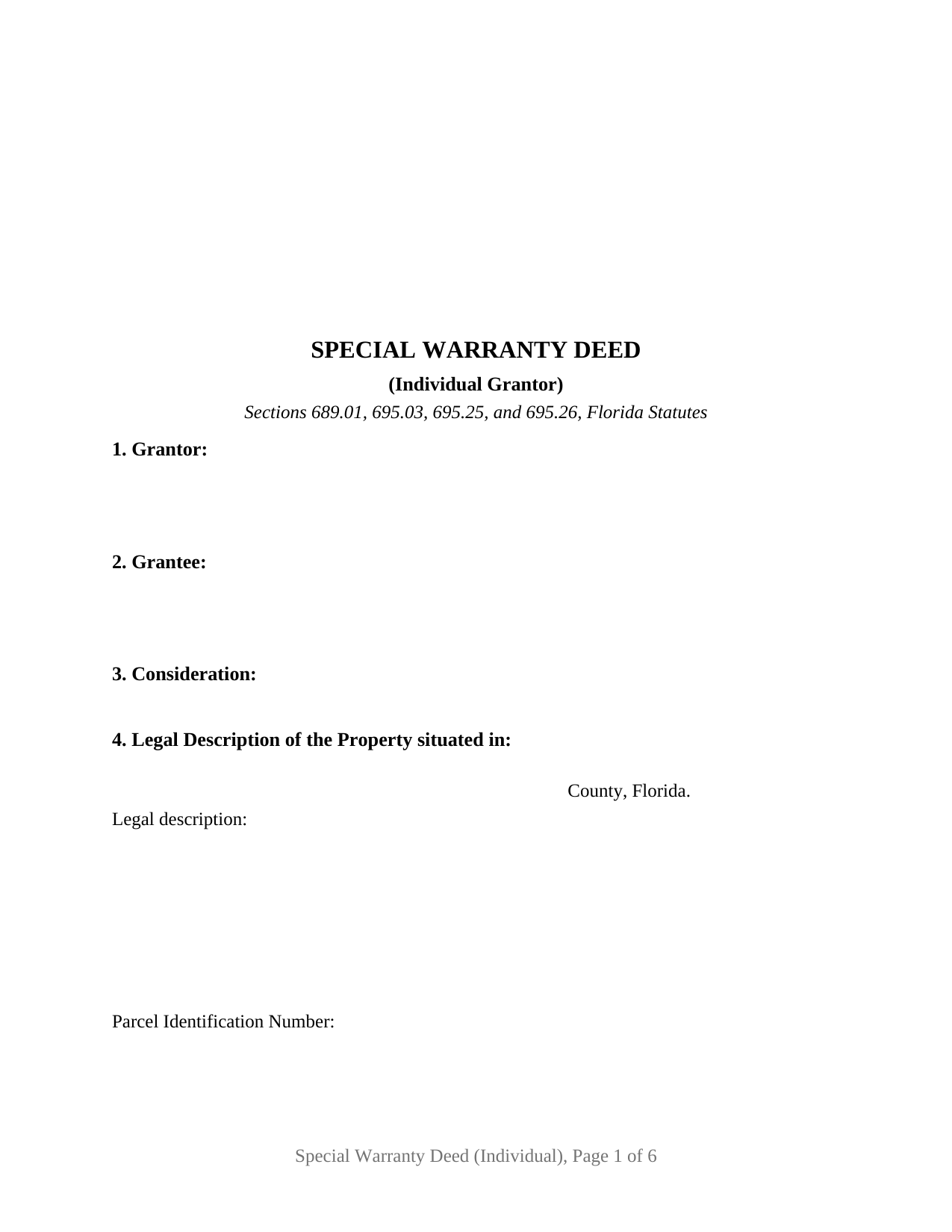
Lafayette County Special Warranty Deed (Individual) Form
Fill in the blank Special Warranty Deed (Individual) form formatted to comply with all Florida recording and content requirements.
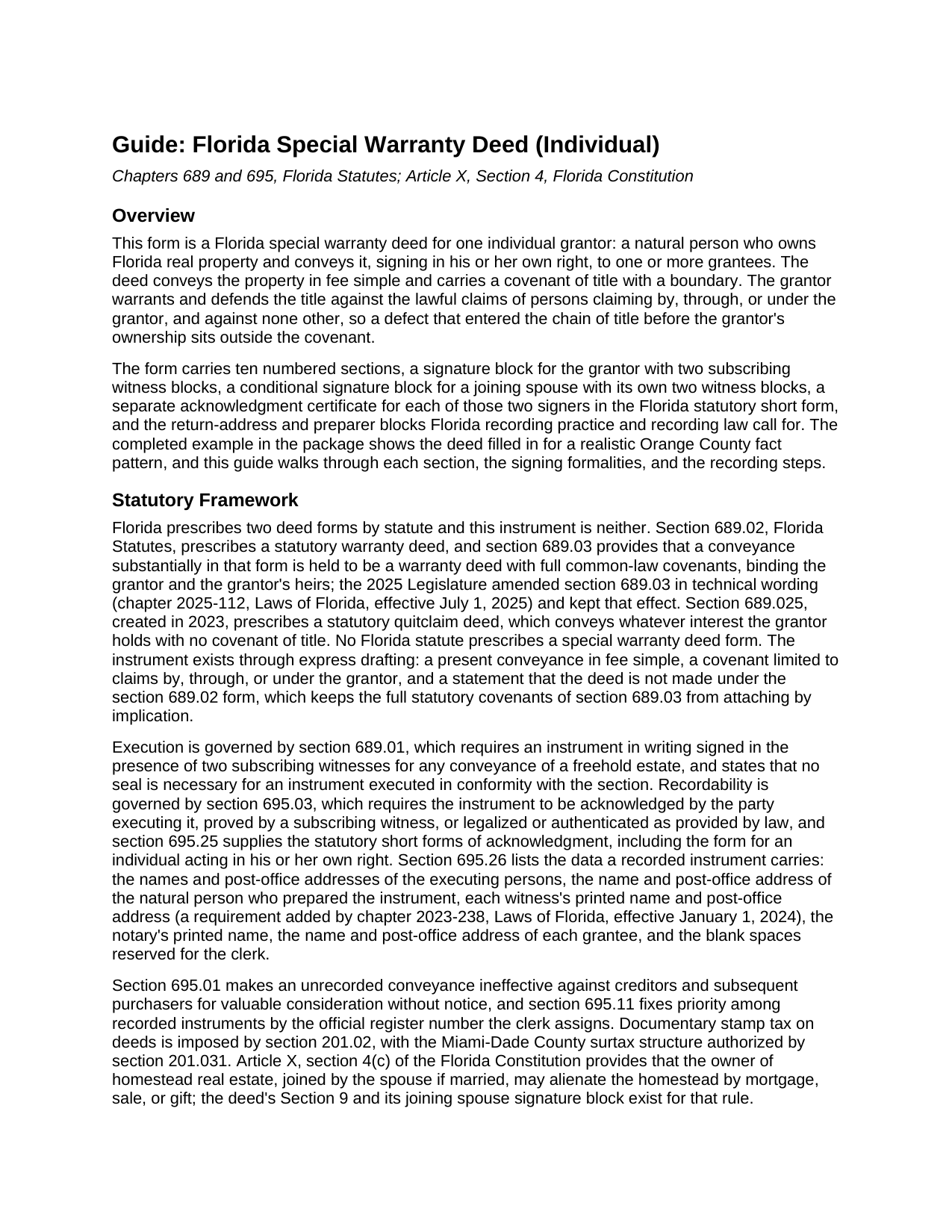
Lafayette County Special Warranty Deed (Individual) Guide
Line by line guide explaining every blank on the Special Warranty Deed (Individual) form.
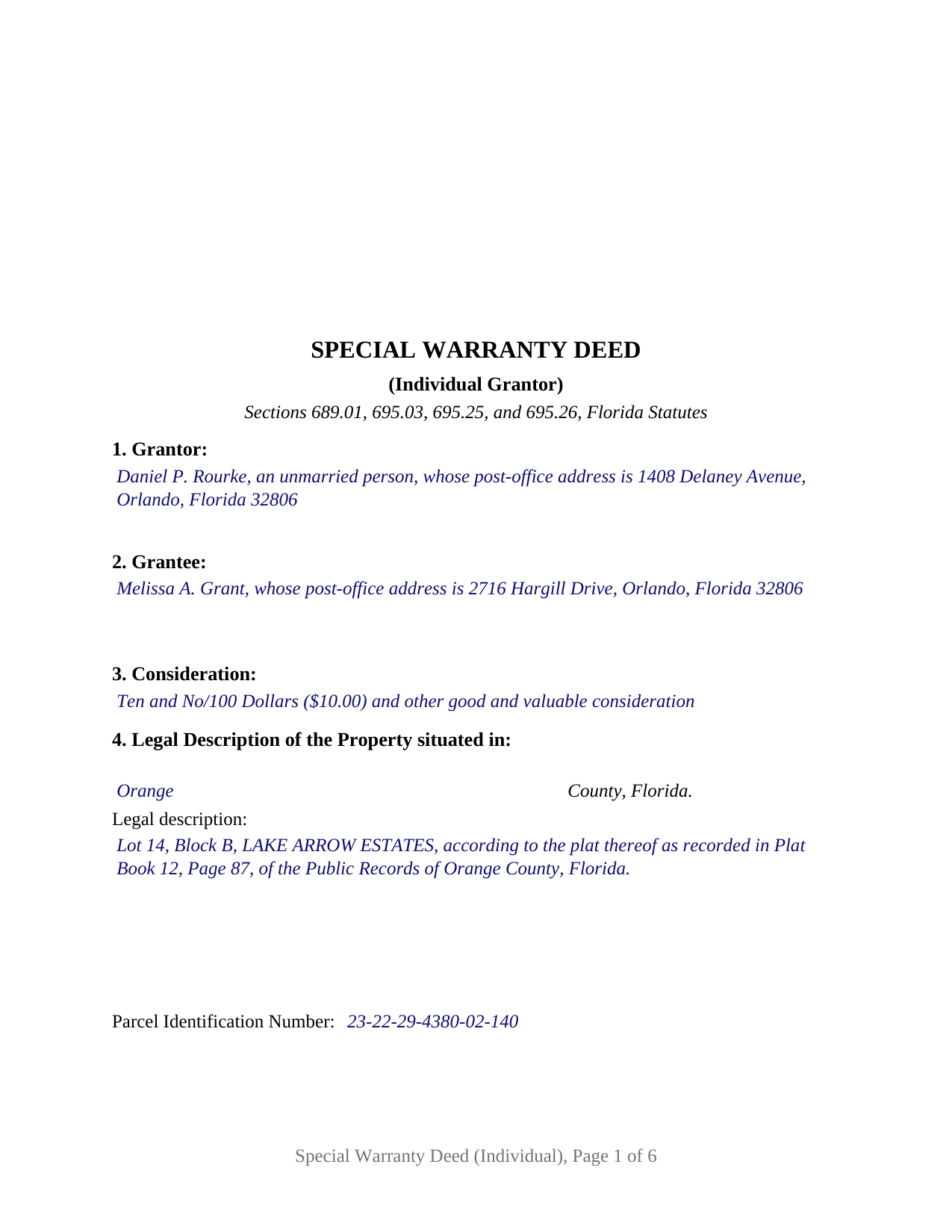
Lafayette County Completed Example of the Special Warranty Deed (Individual) Document
Example of a properly completed Florida Special Warranty Deed (Individual) document for reference.
All 3 documents above included • One-time purchase • No recurring fees
Immediate Download • Secure Checkout
Additional Florida and Lafayette County documents included at no extra charge:
Where to Record Your Documents
Clerk of Court - Lafayette County Courthouse
Mayo, Florida 32066
Hours: 8:00am to 5:00pm M-F
Phone: (386) 294-1600
Recording Tips for Lafayette County:
- Bring your driver's license or state-issued photo ID
- Ensure all signatures are in blue or black ink
- Both spouses typically need to sign if property is jointly owned
- Bring extra funds - fees can vary by document type and page count
- Check margin requirements - usually 1-2 inches at top
Cities and Jurisdictions in Lafayette County
Properties in any of these areas use Lafayette County forms:
- Day
- Mayo
Hours, fees, requirements, and more for Lafayette County
How do I get my forms?
Forms are available for immediate download after payment. The Lafayette County forms will be in your account ready to download to your computer. An account is created for you during checkout if you don't have one. Forms are NOT emailed.
Are these forms guaranteed to be recordable in Lafayette County?
Yes. Our form blanks are guaranteed to meet or exceed the applicable formatting requirements used for recording in Lafayette County, including margin requirements, font requirements, and other layout standards. This guarantee applies to formatting, not to the legal sufficiency of information entered by the user or the suitability of a form for a particular transaction.
Can I reuse these forms?
Yes. You can reuse the forms for your personal use. For example, if you have multiple properties in Lafayette County you only need to order once.
What do I need to use these forms?
The forms are PDFs that you fill out on your computer. The free Adobe Acrobat Reader is recommended, and most PDF apps also work. You do NOT enter your property information online - you download the blank forms and complete them privately on your own computer.
Are there any recurring fees?
No. This is a one-time purchase. Nothing to cancel, no memberships, no recurring fees.
How much does it cost to record in Lafayette County?
Recording fees in Lafayette County vary. Contact the recorder's office at (386) 294-1600 for current fees.
Questions answered? Let's get started!
A sole owner of Florida real estate, holding title as an individual, can give a deed whose title covenant is measured by that owner's own years on the title and by nothing earlier. This Florida special warranty deed is prepared for exactly that seller: a single individual, signing personally rather than for a company or a trust, with a joinder section that brings a spouse onto the deed only when the Florida Constitution calls for it.
A covenant that starts when the grantor's ownership started
Section 689.03 attaches full common-law covenants to a deed substantially in the statutory warranty form of section 689.02, and the statutory quitclaim deed of section 689.025 carries none. Nothing in the statutes describes the deed in between, so this instrument builds it in its own words: the grantor warrants and defends the title against the lawful claims of all persons claiming by, through, or under the grantor, but against none other, and the deed states that it is not made, and is not to be construed, as a statutory warranty deed. Section 6, the source of title, marks where the promise begins. A lien that attached during the grantor's ownership sits inside the covenant unless Section 7 lists it as a matter the conveyance remains subject to.
One signature, and a second one only for homestead
The spouse who may not be on the title at all is what sets an individual grantor apart. Article X, Section 4 of the Florida Constitution lets the owner of homestead real estate alienate it by sale or gift only when joined by the spouse, if married; dower and curtesy are abolished, so no other doctrine puts a spouse's signature on a Florida deed. The form answers that one rule with Section 9, Joinder of Spouse (Homestead), and a JOINING SPOUSE signature block with its own two witness blocks and its own acknowledgment certificate. Where the grantor is married and the property is the grantor's homestead, the spouse signs there and, by that joinder, conveys, releases, and relinquishes the spouse's interest without any warranty. Where the grantor is unmarried, or the property is not the grantor's homestead, those blocks stay blank and the deed states that no spouse joins.
The seller this deed recites
The form recites exactly one grantor, an individual signing in the grantor's own right and not in any representative capacity, conveying the whole of the grantor's interest. Two histories that present the pattern in the Florida record are a buyer at a foreclosure or tax deed sale who later resells without warranting the title the sale cut off, and a landlord who has owned a rental for years and stands behind that period alone. A grantor that is a corporation, a limited liability company, a partnership, or a trustee signs under different statutes and uses a different statutory acknowledgment, and two co-owners present two signatures and two certificates; the form is not set up as any of those.
Two witnesses, the statutory certificate, and a place for the seal
Section 689.01 requires the grantor to sign in the presence of two subscribing witnesses, and since January 1, 2024, section 695.26 has required each witness's printed name beneath the signature and a post-office address on the instrument; the form carries two witness blocks for each signature. The acknowledgment certificate reproduces the section 695.25(1) short form for an individual acting in his or her own right, with the two boxes the officer marks for physical presence or online notarization, and it reserves a labeled area for the rubber-stamp seal section 117.05 places beside or below the notary's signature.
At the recording counter
The clerk of the circuit court records the deed in the county where the land lies, and the first page keeps the top-right 3 inch by 3 inch space section 695.26 reserves for the clerk. Documentary stamp tax under section 201.02 is paid at recording, 70 cents per $100 of consideration in every county except Miami-Dade, which follows its own rate and surtax structure. Under section 695.01 an unrecorded deed binds the parties but gives way to creditors and later purchasers for value without notice.
The download includes the deed as a fillable PDF, a completed example worked through an Orange County conveyance by an unmarried grantor, and a plain-language guide that treats every numbered section, the witness and notary blocks, the homestead joinder, and the recording steps. The materials describe Florida law in general terms and are not legal advice.
Important: Your property must be located in Lafayette County to use these forms. Documents should be recorded at the county recording office listed above.
This Special Warranty Deed (Individual) meets all recording requirements specific to Lafayette County.
Our Promise
The documents you receive here are guaranteed to meet or exceed the applicable Lafayette County recording format requirements. If there is a rejection caused by our formatting, we will correct the issue or refund your payment. This guarantee applies to document formatting only and does not extend to information entered by the user, the selection of the form, or the legal effect of the completed document.
Save Time and Money
Get your Lafayette County Special Warranty Deed (Individual) form done right the first time with Deeds.com Uniform Conveyancing Blanks. At Deeds.com, we understand that your time and money are valuable resources, and we don't want you to face a penalty fee or rejection imposed by a county recorder for submitting nonstandard documents. We constantly review and update our forms to meet rapidly changing state and county recording requirements for roughly 3,500 counties and local jurisdictions.
4.8 out of 5 - ( 4,867 Reviews )
Judy F. 5 out of 5 stars
The site was easy to use, I just wasn't sure which of all these documents I needed.
Thank you!
Sherry F. 5 out of 5 stars
Good product and service.
Thank you!
Hanna M. 5 out of 5 stars
Very helpful information! Thank you for your service!
Thank you!
Fernando V. 5 out of 5 stars
Excellent!
Thank you!
Kimberly G. 3 out of 5 stars
It would be helpful if there were a specific example of putting a deed into a trust. Also, the limitation of characters on the description of the property was not enough.
Thank you for your feedback. We really appreciate it. Have a great day!
Deborah P. 5 out of 5 stars
Very helpful! Easy and clear guidance. Good examples on sample forms.
We appreciate your business and value your feedback. Thank you. Have a wonderful day!
Shari S. 5 out of 5 stars
Deeds.com is a wonderful resource providing helpful information, forms, examples, and instructions. Thank you for your service.
We appreciate your business and value your feedback. Thank you. Have a wonderful day!
Larry P. 5 out of 5 stars
Love your site. I found just what I needed and it was so easy. Saved me countless time and effort. Worth every penny.
We appreciate your business and value your feedback. Thank you. Have a wonderful day!
Sandra B. 5 out of 5 stars
Easy to navigate through. Documents were in orderly fashion. Highly recommend. Step by step instructions
We appreciate your business and value your feedback. Thank you. Have a wonderful day!
Diane C. 5 out of 5 stars
This was just the info I needed
Thank you!
Samantha S. 5 out of 5 stars
I really appreciated Deeds.com. It was quick and easy to use. Saved me substantial time completing my deed recording.
Thank you for your feedback. We really appreciate it. Have a great day!
A. S. 3 out of 5 stars
First, I am glad that you gave a blank copy, an example copy, and a 'guide'. It made it much easier to do. Overall I was very happy with your products and organization... however, things got pretty confusing and I have a pretty 'serious' law background in Real Estate and Civil law. With that said, I spent about 10+ hours getting my work done, using the Deed of Trust and Promissory note from you and there were a few problems: First, it would be FANTASTIC if you actually aligned your guide to actually match the Deed or Promissory Note. What I mean is that if the Deed says 'section (E)' then your guide shouldn't be 'randomly' numbered as 1,2,3, for advice/instructions, but should EXACTLY match 'section (E)'. Some places you have to 'hunt' for what you are looking for, and if you did it based on my suggestion, you wouldn't need to 'hunt' and it would avoid confusion. 2nd: This one really 'hurt'... you had something called the 'Deed of Trust Master Form' yet you had basically no information on what it was or how to use it. The only information you had was a small section at the top of the 'Short Form Deed of Trust Guide'. Holy Cow, was that 'section' super confusing. I still don't know if I did it correctly, but your guide says only put a return address on it and leave the rest of the 16 or so page Deed of Trust beneath it blank... and then include your 'Deed of Trust' (I had to assume the short form deed that I had just created) as part of it. I had to assume that I had to print off the entire 17 page or so title page and blank deed. I also had to assume that the promissory note was supposed to be EXHIBIT A or B on the Short Form Deed. It would be great if someone would take a serious look at that short section in your 'Short Form Deed of Trust Guide' and realize that those of us using your products are seriously turning this into a county clerk to file and that most of us, probably already have a property that has an existing Deed... or at least can find one in the county records if necessary... and make sure that you make a distinction between the Deed for the property that already exists, versus the Deed of Trust and Promissory note that we are trying to file. Thanks.
Thank you for your feedback. We'll have staff review the document for clarity. Have a great day!
Ann E Grace S. 5 out of 5 stars
Forms and instructions are very easy to access. Thank you!
Thank you for your feedback. We really appreciate it. Have a great day!
Ann W. 5 out of 5 stars
GREAT forms, easy to use and most importantly... compliant. Worth it and then some!
Thank you!
Alberta P. 5 out of 5 stars
form was east to use...instructions came in handy.
Thank you for your feedback. We really appreciate it. Have a great day!