Florida Special Warranty Deed (Individual)
County Specific Legal Forms Validated as recently as October 10, 2026 by our Forms Development Team
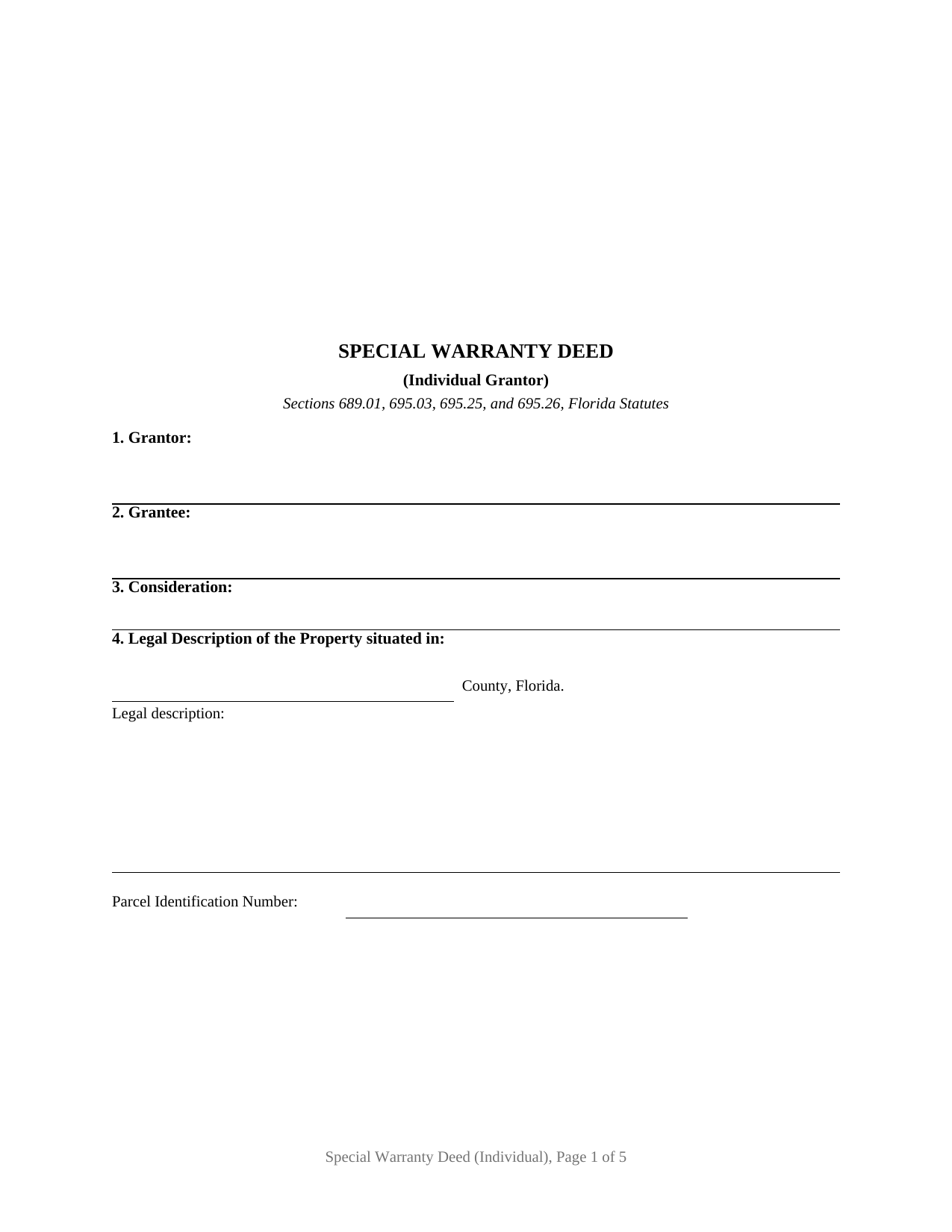
About the Florida Special Warranty Deed (Individual)
How to Use This Form
- Select your county from the list
- Download the county-specific form
- Fill in the required information
- Have the document notarized if required
- Record with your county recorder's office
What Others Like You Are Saying
"Very easy process and efficient. Made my job easier."
"I think Deeds is a great site for learning. On recording a document, I had trouble. It was me, becau…"
"Super easy and they filed my paperwork the same day"
"Good!!"
"This process is outstanding, and it saved the hassle of going downtown and dealing with traffic."
4.8/5 from 4,828 reviews. Read all
A sole owner of Florida real estate, holding title as an individual, can give a deed whose title covenant is measured by that owner's own years on the title and by nothing earlier. This Florida special warranty deed is prepared for exactly that seller: a single individual, signing personally rather than for a company or a trust, with a joinder section that brings a spouse onto the deed only when the Florida Constitution calls for it.
A covenant that starts when the grantor's ownership started
Section 689.03 attaches full common-law covenants to a deed substantially in the statutory warranty form of section 689.02, and the statutory quitclaim deed of section 689.025 carries none. Nothing in the statutes describes the deed in between, so this instrument builds it in its own words: the grantor warrants and defends the title against the lawful claims of all persons claiming by, through, or under the grantor, but against none other, and the deed states that it is not made, and is not to be construed, as a statutory warranty deed. Section 6, the source of title, marks where the promise begins. A lien that attached during the grantor's ownership sits inside the covenant unless Section 7 lists it as a matter the conveyance remains subject to.
One signature, and a second one only for homestead
The spouse who may not be on the title at all is what sets an individual grantor apart. Article X, Section 4 of the Florida Constitution lets the owner of homestead real estate alienate it by sale or gift only when joined by the spouse, if married; dower and curtesy are abolished, so no other doctrine puts a spouse's signature on a Florida deed. The form answers that one rule with Section 9, Joinder of Spouse (Homestead), and a JOINING SPOUSE signature block with its own two witness blocks and its own acknowledgment certificate. Where the grantor is married and the property is the grantor's homestead, the spouse signs there and, by that joinder, conveys, releases, and relinquishes the spouse's interest without any warranty. Where the grantor is unmarried, or the property is not the grantor's homestead, those blocks stay blank and the deed states that no spouse joins.
The seller this deed recites
The form recites exactly one grantor, an individual signing in the grantor's own right and not in any representative capacity, conveying the whole of the grantor's interest. Two histories that present the pattern in the Florida record are a buyer at a foreclosure or tax deed sale who later resells without warranting the title the sale cut off, and a landlord who has owned a rental for years and stands behind that period alone. A grantor that is a corporation, a limited liability company, a partnership, or a trustee signs under different statutes and uses a different statutory acknowledgment, and two co-owners present two signatures and two certificates; the form is not set up as any of those.
Two witnesses, the statutory certificate, and a place for the seal
Section 689.01 requires the grantor to sign in the presence of two subscribing witnesses, and since January 1, 2024, section 695.26 has required each witness's printed name beneath the signature and a post-office address on the instrument; the form carries two witness blocks for each signature. The acknowledgment certificate reproduces the section 695.25(1) short form for an individual acting in his or her own right, with the two boxes the officer marks for physical presence or online notarization, and it reserves a labeled area for the rubber-stamp seal section 117.05 places beside or below the notary's signature.
At the recording counter
The clerk of the circuit court records the deed in the county where the land lies, and the first page keeps the top-right 3 inch by 3 inch space section 695.26 reserves for the clerk. Documentary stamp tax under section 201.02 is paid at recording, 70 cents per $100 of consideration in every county except Miami-Dade, which follows its own rate and surtax structure. Under section 695.01 an unrecorded deed binds the parties but gives way to creditors and later purchasers for value without notice.
The download includes the deed as a fillable PDF, a completed example worked through an Orange County conveyance by an unmarried grantor, and a plain-language guide that treats every numbered section, the witness and notary blocks, the homestead joinder, and the recording steps. The materials describe Florida law in general terms and are not legal advice.
Important: County-Specific Forms
Our special warranty deed (individual) forms are specifically formatted for each of the 67 counties in Florida.
After selecting your county, you'll receive forms that meet all local recording requirements, ensuring your documents will be accepted without delays or rejection fees.