Georgia Transfer on Death Revocation
County Specific Legal Forms Validated as recently as October 21, 2026 by our Forms Development Team
About the Georgia Transfer on Death Revocation
How to Use This Form
- Select your county from the list
- Download the county-specific form
- Fill in the required information
- Have the document notarized if required
- Record with your county recorder's office
What Others Like You Are Saying
"Very helpful. The Register office is closed in Detroit due to covid, but after using it, I would do …"
"Good instructions and example"
"Very efficient and easy to use process"
"Easy to download, forms look to be pretty easy to use. Thank you!"
"Am very happy with the wealth of forms that were available with my purchase! This site is an awesome…"
4.8/5 from 4,829 reviews. Read all
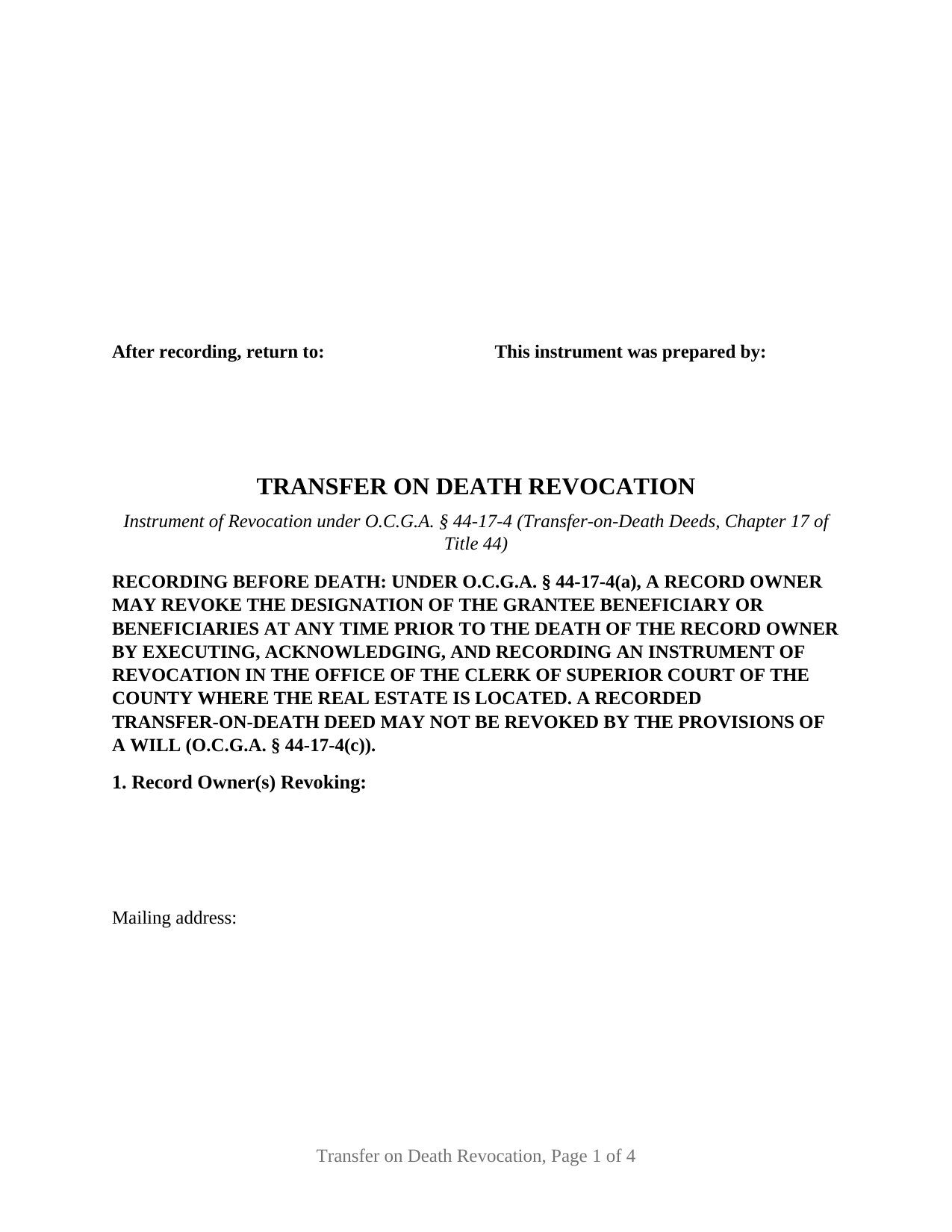
A Georgia transfer on death revocation cancels the beneficiary designation in a recorded transfer-on-death deed while the record owner is living, and it works only one way: executed, attested, and placed on record with the clerk of superior court before the owner dies. This form prepares that instrument under O.C.G.A. § 44-17-4(a) for one or two natural persons who are the record owners that made the designation.
What the 2026 amendment changed about revoking a Georgia TOD deed
Georgia created the transfer-on-death deed in 2024 and rewrote its revocation section in 2026 Act 379 (HB 413), effective April 22, 2026. Under the current O.C.G.A. § 44-17-4(a), the instrument of revocation refers to the initial transfer-on-death deed, is signed by the record owner, and carries a signature attested by an officer described in O.C.G.A. § 44-2-15 and by one other witness. The amendment dropped the earlier two-witness requirement, removed the clause admitting an attorney in fact's signature, and deleted the sentence that let a revocation ride inside another recorded conveyance. A recorded deed may not be revoked by the provisions of a will (O.C.G.A. § 44-17-4(c)), and the beneficiary's signature, consent, agreement, or notice is not required.
A reference the statute requires, and a recording that completes the act
The statute describes revocation as executing, acknowledging, and recording the instrument in the office of the clerk of superior court of the county where the real estate is located, at any time prior to the record owner's death, and the form prints that rule in capital letters under its title. Section 3 of the form is the reference the statute requires: the date of the deed, its recording date, the deed book and page, the county, and the grantee beneficiary or beneficiaries designated in it. The operative clause then revokes, as to each signing owner's interest, the designation made in that deed, and states that the instrument conveys no interest.
One or two record owners on one instrument
The form recites one or two record owners signing in their own capacity and preprints nothing about marital status, vesting, or capacity. Section 1 is a free-form block that receives a single owner revoking alone or two owners who titled their interest in one deed and revoke together. The signing section carries an OWNER block and a SECOND OWNER block, an UNOFFICIAL WITNESS block under each, and a separate attestation certificate for each signer; a sole owner leaves the second set empty. The form is not set up for an entity, a trustee, an attorney in fact, or three or more owners. Because O.C.G.A. § 44-17-6 lets a record joint owner use the chapter and states no separate rule for revocation by fewer than all owners, the operative clause speaks as to each signing owner's own interest.
Recording in the county of the real estate
The instrument is recorded with the clerk of superior court of the county where the real estate lies. O.C.G.A. § 15-6-61(a)(10) calls for letter or legal size paper with a three inch top margin on the first page for the clerk's notation, and O.C.G.A. § 44-2-14(b) places the return-to name and mailing address at the top of that page; the form reserves the three inches and prints the return block directly under them. The clerk's fee under O.C.G.A. § 15-6-77(f) is a flat 25 dollars per instrument. Since January 1, 2025, a self-filer under O.C.G.A. § 44-2-2 presents the instrument through the GSCCCA electronic filing portal. The instrument conveys nothing, so the transfer tax on conveyances does not apply.
Other ways the chapter ends a designation
Under O.C.G.A. § 44-17-4(b), a subsequent transfer-on-death deed, executed, acknowledged, and recorded, revokes all prior designations by that record owner for the interest; that deed is prepared and recorded separately and is not included in this package. Under subsection (d), added in 2026, the deed is rendered revoked by operation of law where the owner sells or conveys the interest before death, conveys it to the trustee of the owner's express trust, or where a sole designated grantee beneficiary dies before acceptance.
The download includes the fillable transfer on death revocation form, a completed example filled in for a Gwinnett County fact pattern with two record owners, and a guide that walks through each section, the officer and witness attestation, and recording with the clerk of superior court. This description and the guide describe the form and the governing Georgia statutes in general terms; they are not legal advice.
Important: County-Specific Forms
Our transfer on death revocation forms are specifically formatted for each of the 159 counties in Georgia.
After selecting your county, you'll receive forms that meet all local recording requirements, ensuring your documents will be accepted without delays or rejection fees.