Georgia Warranty Deed (Two Grantors)
County Specific Legal Forms Validated as recently as September 30, 2026 by our Forms Development Team
About the Georgia Warranty Deed (Two Grantors)
How to Use This Form
- Select your county from the list
- Download the county-specific form
- Fill in the required information
- Have the document notarized if required
- Record with your county recorder's office
What Others Like You Are Saying
"Love Deeds.com They have saved me so much time. Prompt responds to all my questions. Highly recommen…"
"Web site was clear to understand and easy to use. Found what I needed quickly and crossed it off my …"
"Program works well. Saves a lot of time trying to find out what you need to do."
"It was convenient to be able to download the deed template, instructions, and a completed sample dee…"
"Great to find this makes for easy work when you need to secure your ownership of a property!!Thanks …"
4.8/5 from 4,825 reviews. Read all
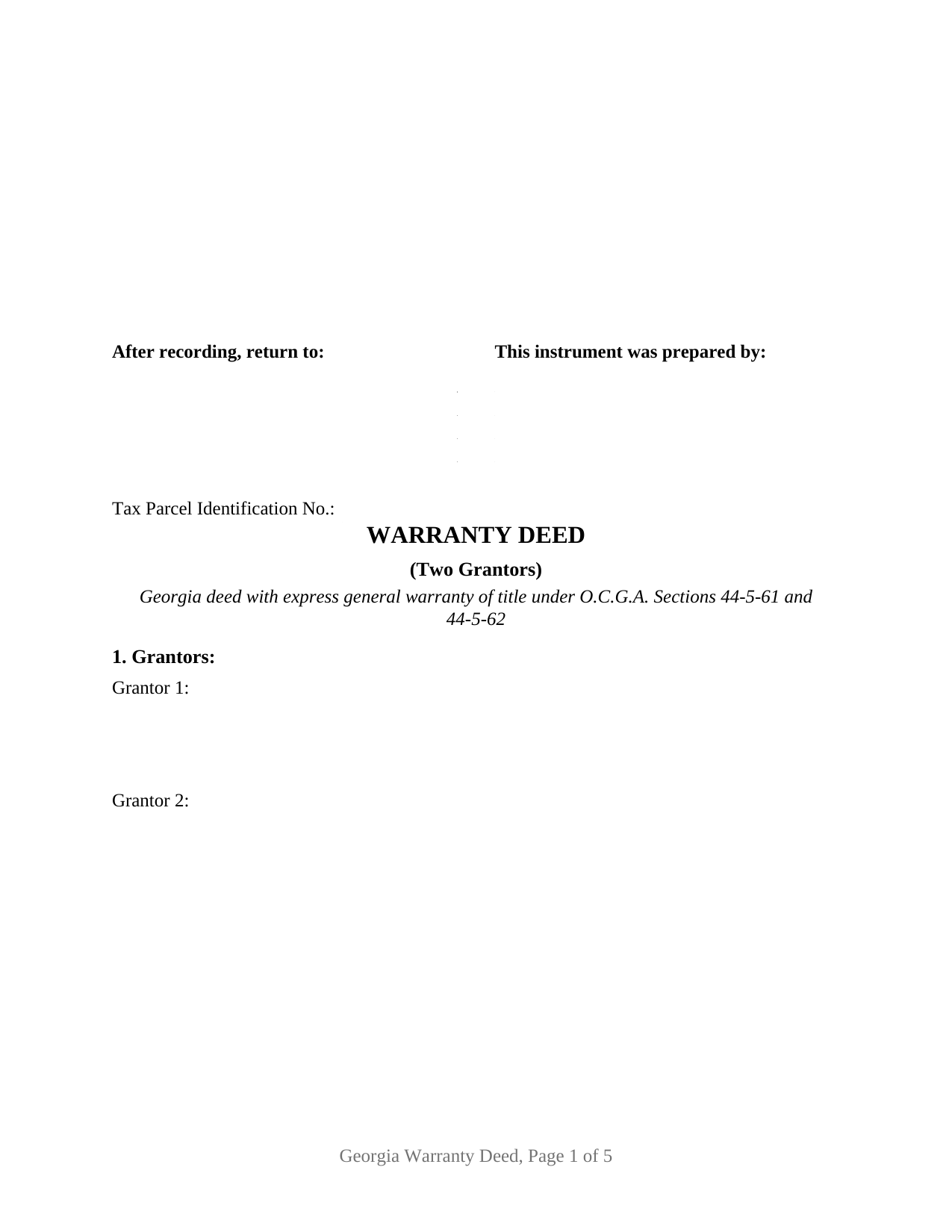
One Georgia deed can move both halves of a co-owned title at once. This Georgia Warranty Deed (Two Grantors) prepares a single conveyance in which two record owners join as grantors, transfer the property together, and stand behind one express general warranty of title given jointly and severally, so the grantee holds the whole covenant against either signer rather than two partial promises stitched together from separate instruments.
Two grantors, one covenant
The form recites exactly two grantors, each a natural person conveying personally, and its operative section states that the grants, covenants, and warranty run from both of them jointly and severally. The warranty itself is the strongest Georgia offers, the general warranty of title whose statutory scope comes from O.C.G.A. Section 44-5-62, and it is written out on the face of the deed because Georgia implies no title warranty a deed does not state. The patterns that present two grantors fill the county record rooms: siblings conveying an inherited parcel once the estate winds down, a jointly titled couple selling the family home, two investors closing out a co-owned rental, and joint tenants whose survivorship arrangement ends the ordinary way, with both names signing one deed to a buyer. A conveyance by a sole owner, by three or more co-owners, or by a trustee or entity presents recitals and signature architecture this form is not set up to carry.
A complete execution set for each signer
Georgia executes deeds by attestation: under O.C.G.A. Section 44-5-30, each grantor signs in the presence of an officer described in O.C.G.A. Section 44-2-15 and of one other witness, and both of those attesting signatures land on the deed itself. With two grantors that formality doubles, so the form carries it doubled: grantor one and grantor two each receive a personal signature block with a printed-name line, a dedicated unofficial witness block, and an officer attestation certificate reciting the signed, sealed, and delivered substance for that grantor alone. The paired certificates are the form's architecture rather than a statutory command, and the payoff is logistical: nothing in the layout assumes the two owners share a signing table. The included example runs on precisely that split, one grantor signing June 10 and the other June 12, before different notaries and different unofficial witnesses, with both executions converging on a single recordable instrument.
From closing table to the record room
The finished deed goes to the clerk of superior court in the county where the land sits, and Georgia keeps the arithmetic simple: O.C.G.A. Section 15-6-77(f) fixes a flat statutory recording fee for a deed regardless of length. A sale for value also generates Georgia's transfer tax, computed under O.C.G.A. Section 48-6-1 on the consideration and reported on the electronic PT-61 return filed through the GSCCCA system before the deed is presented; the guide walks through the tax computation, the gift and family exemptions, and the 2025 self-filer e-recording channel with its identity verification step. The first page of the form itself is built for the intake counter, holding the clerk's three inch stamp reserve, the recorded-deed return address block Georgia recording law expects, and a tax parcel identification line that satisfies DeKalb County's first-page parcel rule and speeds indexing everywhere else.
What arrives with the download
The purchase contains three pieces: the two-grantor warranty deed as a fillable PDF, a completed example built on a Gwinnett County sale by two co-owners, and a plain-language guide covering every numbered section, the doubled execution formalities, the ways Georgia law lets the grantees hold title, and the recording workflow from PT-61 to file stamp. The materials are informational and are not legal advice.
Important: County-Specific Forms
Our warranty deed (two grantors) forms are specifically formatted for each of the 159 counties in Georgia.
After selecting your county, you'll receive forms that meet all local recording requirements, ensuring your documents will be accepted without delays or rejection fees.