Clark County Quitclaim Deed (Individual Grantor) Form
Last validated October 8, 2026 by our Forms Development TeamFormatted for recording in Clark County, for property anywhere in the county: rural and unincorporated areas as well as Bethlehem, Borden, Charlestown, Clarksville, Henryville, Jeffersonville, Marysville, Memphis and 4 more.
- 3 documents included
- Immediate PDF download
- Formatting guarantee
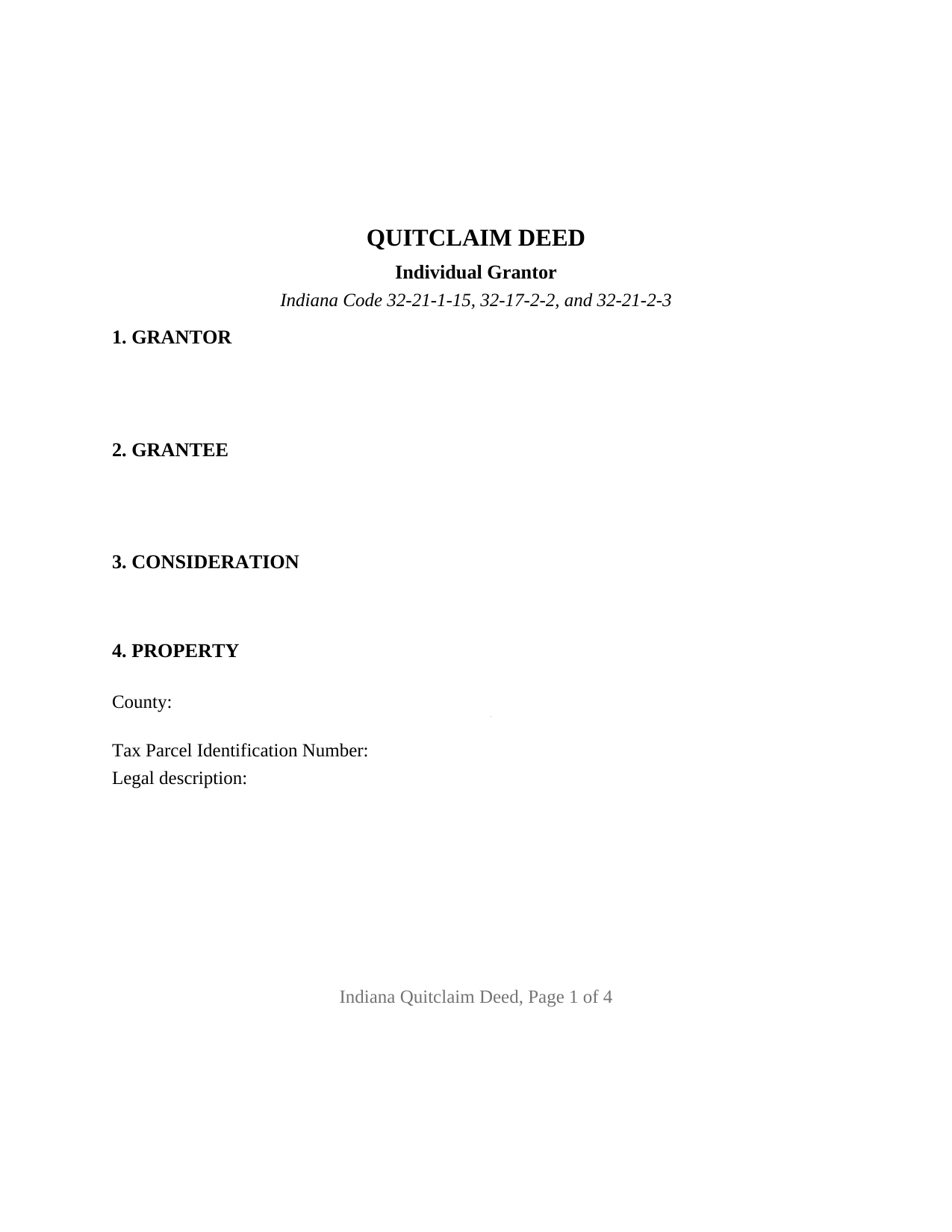
Clark County Quitclaim Deed (Individual Grantor) Form
Fill in the blank Quitclaim Deed (Individual Grantor) form formatted to comply with all Indiana recording and content requirements.
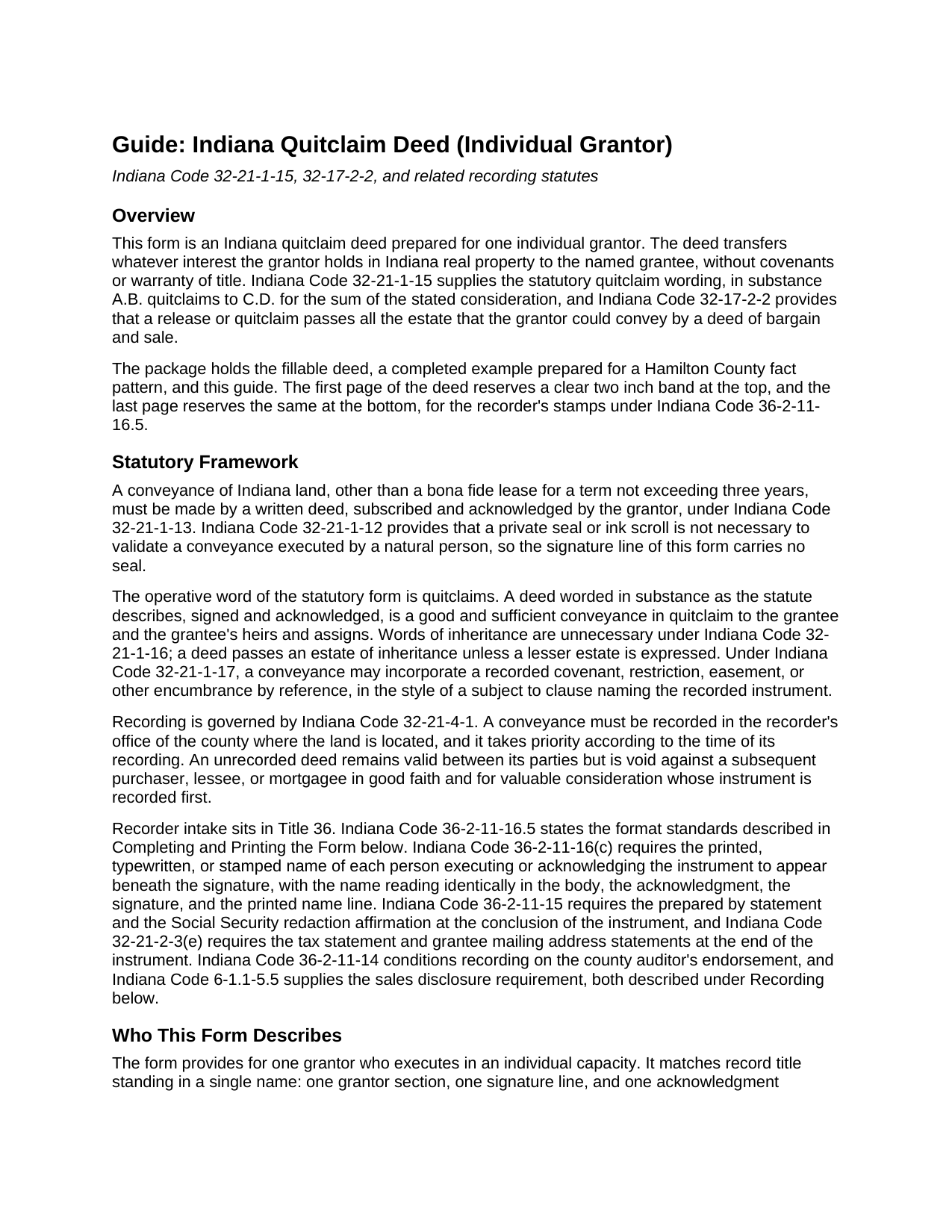
Clark County Quitclaim Deed (Individual Grantor) Guide
Line by line guide explaining every blank on the Quitclaim Deed (Individual Grantor) form.
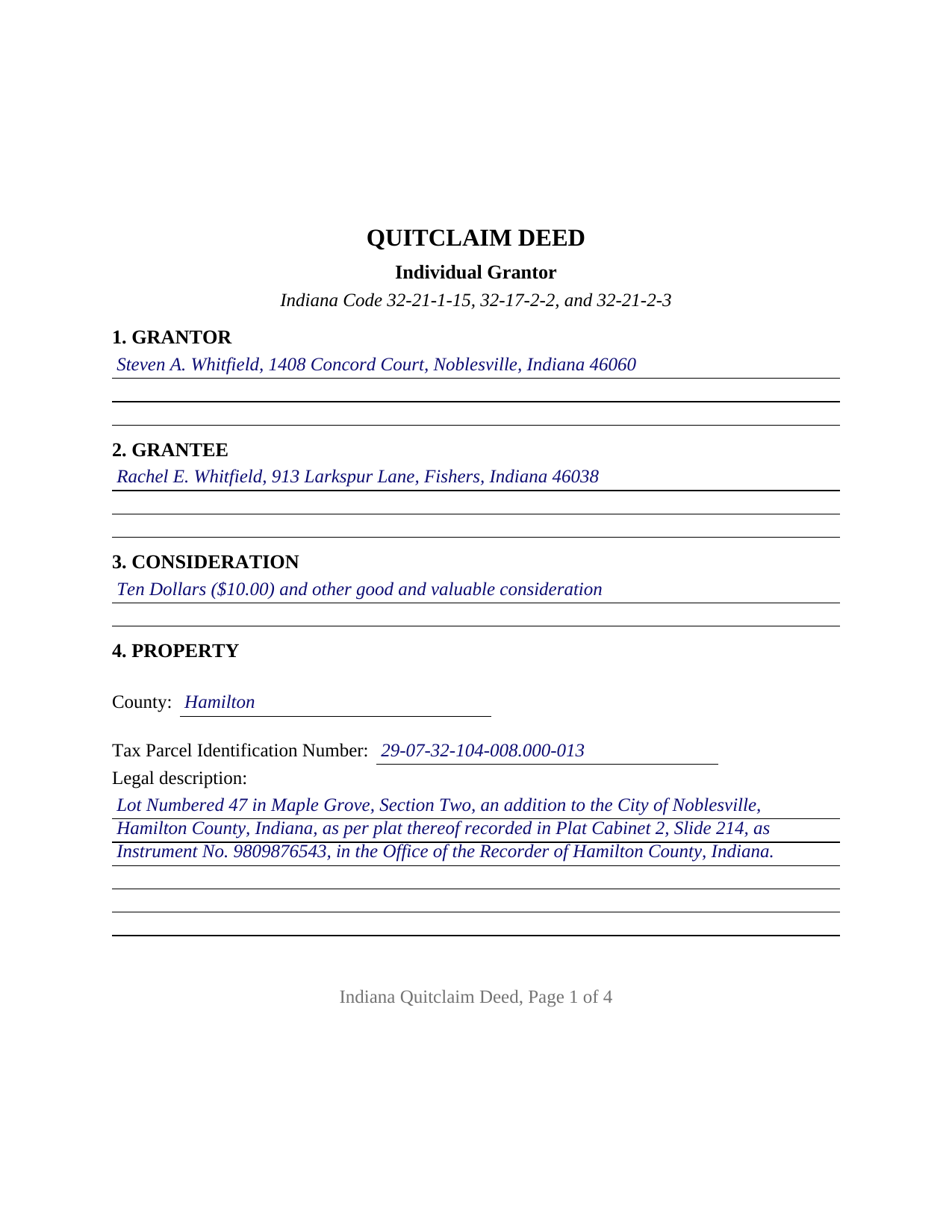
Clark County Completed Example of the Quitclaim Deed (Individual Grantor) Document
Example of a properly completed Indiana Quitclaim Deed (Individual Grantor) document for reference.
All 3 documents above included • One-time purchase • No recurring fees
Immediate Download • Secure Checkout
Additional Indiana and Clark County documents included at no extra charge:
Where to Record Your Documents
Clark County Recorder
Jeffersonville, Indiana 47130
Hours: 8:30am - 4:30pm M-F
Phone: (812) 285-6235
Recording Tips for Clark County:
- Bring your driver's license or state-issued photo ID
- Ensure all signatures are in blue or black ink
- Ask if they accept credit cards - many offices are cash/check only
- Check that your notary's commission hasn't expired
- Documents must be on 8.5 x 11 inch white paper
Cities and Jurisdictions in Clark County
Properties in any of these areas use Clark County forms:
- Bethlehem
- Borden
- Charlestown
- Clarksville
- Henryville
- Jeffersonville
- Marysville
- Memphis
- Nabb
- New Washington
- Otisco
- Sellersburg
Hours, fees, requirements, and more for Clark County
How do I get my forms?
Forms are available for immediate download after payment. The Clark County forms will be in your account ready to download to your computer. An account is created for you during checkout if you don't have one. Forms are NOT emailed.
Are these forms guaranteed to be recordable in Clark County?
Yes. Our form blanks are guaranteed to meet or exceed the applicable formatting requirements used for recording in Clark County, including margin requirements, font requirements, and other layout standards. This guarantee applies to formatting, not to the legal sufficiency of information entered by the user or the suitability of a form for a particular transaction.
Can I reuse these forms?
Yes. You can reuse the forms for your personal use. For example, if you have multiple properties in Clark County you only need to order once.
What do I need to use these forms?
The forms are PDFs that you fill out on your computer. The free Adobe Acrobat Reader is recommended, and most PDF apps also work. You do NOT enter your property information online - you download the blank forms and complete them privately on your own computer.
Are there any recurring fees?
No. This is a one-time purchase. Nothing to cancel, no memberships, no recurring fees.
How much does it cost to record in Clark County?
Recording fees in Clark County vary. Contact the recorder's office at (812) 285-6235 for current fees.
Questions answered? Let's get started!
This Indiana Quitclaim Deed is configured for a single individual grantor: one name in the grantor section, one signature line, and one acknowledgment certificate. The configuration matches record title standing in one person's name, with that owner passing whatever interest the record holds to the grantee named in the deed, without warranty of title.
A Deed Built Around One Name on the Title
The form recites exactly one grantor, executing in an individual capacity. Several record patterns present a lone grantor: a parcel that came to one person through a single prior deed, title that a survivorship form has already vested in the surviving owner alone, or a distribution that left one name on the county record. The form is not set up as a two grantor instrument, an entity or trustee conveyance, or a deed executed under a power of attorney; each of those patterns carries a different signature and acknowledgment architecture than this deed prints.
Marriage matters here only through title. Indiana abolished dower and curtesy (IC 29-1-2-11), and no current Indiana statute requires a spouse who is not on the title to join a sole owner's lifetime deed. Real estate titled in both spouses is presumptively held by the entireties (IC 32-17-3-1), and one spouse alone cannot effectively convey that estate, so jointly titled property calls for a deed both owners execute rather than this single signature layout.
The Measure of a Sole Grantor's Quitclaim
Indiana's statutory form, IC 32-21-1-15, works from the single operative word quitclaims, and IC 32-17-2-2 measures the effect: the deed passes all the estate the grantor could convey by a deed of bargain and sale. For a sole grantor, that measure is the grantor's own record interest at delivery, whether a full fee, a fractional share, or nothing at all. The deed in this package states that measure in its conveyance section, so the instrument reads as the quit claim deed Indiana practice expects rather than a warranty instrument with the covenants struck.
The Statements That Close an Indiana Deed
Indiana ends a recordable deed with a cluster of statutory statements, and this form prints all of them. IC 32-21-2-3(e) requires the deed to give the mailing address for property tax statements under IC 6-1.1-22-8.1 and the grantee's mailing address, and county recorder offices look for a street address or rural route rather than a post office box. IC 36-2-11-15 requires the prepared by statement and the affirmation that reads, "I affirm, under the penalties for perjury, that I have taken reasonable care to redact each Social Security number in this document, unless required by law." IC 36-2-11-16(c) adds the printed name beneath the signature, with the grantor's name reading identically in the body, the acknowledgment, and the signature block. A deed missing any of these closings is on the published rejection lists of Indiana recorder offices, so the form carries a labeled blank for each one.
From the Auditor's Stamp to the Record
An Indiana deed reaches the recorder by way of two other county offices. The sales disclosure form of IC 6-1.1-5.5 goes to the county assessor for review, with a twenty dollar auditor fee where one applies, and the county auditor then endorses the deed for taxation under IC 36-2-11-14 before the recorder may accept it. The recorder's fee for a deed is twenty five dollars statewide under IC 36-2-7-10, and Indiana imposes no state transfer tax on the recording. Recording in the county where the land lies protects the grantee's priority against later purchasers under IC 32-21-4-1.
What the Download Contains
The download delivers the fillable Indiana quitclaim deed formatted to the state recording standards, a completed example showing a single grantor conveyance recorded in Hamilton County, and a guide that walks through each section, the notarization, and the county assessor, auditor, and recorder steps. The materials describe Indiana law in general terms and are informational; they are not legal advice.
Important: Your property must be located in Clark County to use these forms. Documents should be recorded at the county recording office listed above.
This Quitclaim Deed (Individual Grantor) meets all recording requirements specific to Clark County.
Our Promise
The documents you receive here are guaranteed to meet or exceed the applicable Clark County recording format requirements. If there is a rejection caused by our formatting, we will correct the issue or refund your payment. This guarantee applies to document formatting only and does not extend to information entered by the user, the selection of the form, or the legal effect of the completed document.
Save Time and Money
Get your Clark County Quitclaim Deed (Individual Grantor) form done right the first time with Deeds.com Uniform Conveyancing Blanks. At Deeds.com, we understand that your time and money are valuable resources, and we don't want you to face a penalty fee or rejection imposed by a county recorder for submitting nonstandard documents. We constantly review and update our forms to meet rapidly changing state and county recording requirements for roughly 3,500 counties and local jurisdictions.
4.8 out of 5 - ( 4,839 Reviews )
Jane N. 5 out of 5 stars
This worked. Saved me a trip to get a copy of a deed. Cost less than the parking fee. Very convenient.
Thank you for your feedback. We really appreciate it. Have a great day!
Jason B. 3 out of 5 stars
Providing .doc versions would be much easier than trying to jam information into a non-editable PDF.
Thank you for your feedback. We really appreciate it. Have a great day!
Barbara S. 5 out of 5 stars
Thanks for this service. I believe it will be all I need. Will know for sure within a week
We appreciate your business and value your feedback. Thank you. Have a wonderful day!
Karen M. 5 out of 5 stars
Nicely Done - Blank Deeds, Guidelines, examples, etc. Thank you as a former paralegal, I am impressed.
We appreciate your business and value your feedback. Thank you. Have a wonderful day!
Alan C. 3 out of 5 stars
I thought the instructions could have been a little better. I didn't know how to do this if the spouses are married but living in separate residences. Also I didn't understand the "Prior Instrument Reference". That should be explained better. Very sketchy instructions.
Thank you for your feedback. We really appreciate it. Have a great day!
Kirstie W. 3 out of 5 stars
In California, the recorder charges a $75 fee for EVERY PAGE of any document related to real estate, with a $225 maximum. So the easement deed this company made is 3 pages, when it could easily have fit in 2 pages (including the notary page). So they just cost me an extra $75. Do better!
Thanks for the feedback. One correction, because it matters for anyone reading this: California's $75 fee (SB 2, Government Code 27388.1) is charged per document title, not per page, and the $225 cap applies to transactions with multiple documents or titles. Page count only affects the base recording fee, which is $3 per additional page. A three-page easement deed carries the same $75 as a two-page one would. Recording fees are set and collected by the county, not by Deeds.com, and the county recorder's published fee schedule is the place to confirm what you were charged.
Sherri S. 5 out of 5 stars
Easy to access forms, and reasonably priced. I'll definitely use again in the future.
We appreciate your business and value your feedback. Thank you. Have a wonderful day!
Judith A. 5 out of 5 stars
Excellent
Thank you!
William P. 5 out of 5 stars
Good timely service. Returned my fee on a document that could not be located.
Thank you!
Gail W. 5 out of 5 stars
Easy to use!!
Thank you!
VICKI R. 5 out of 5 stars
Thank you for your helpful information.
Thank you!
Monique C. 5 out of 5 stars
Very quick and efficient service! I will continue to use them for future reference.
Thank you!
Caroline K. 5 out of 5 stars
SIMPLE, THAT IS GOOD
Thank you for your feedback. We really appreciate it. Have a great day!
Marvin C. 5 out of 5 stars
My client needed to provide a statutory Oklahoma Memorandum of Trust. I was able to provide her with the form quickly and inexpensively.
We appreciate your business and value your feedback. Thank you. Have a wonderful day!
Stephen E. 5 out of 5 stars
Thank you for your great response on my needs. In less than 24 hours I had my documents in hand as needed. Looking forward to working with Deeds.com again. Steve Esler
Thank you for your feedback Steve, glad we could help.