Kansas Affidavit of Death (Transfer on Death Beneficiary)
County Specific Legal Forms Validated as recently as October 25, 2026 by our Forms Development Team
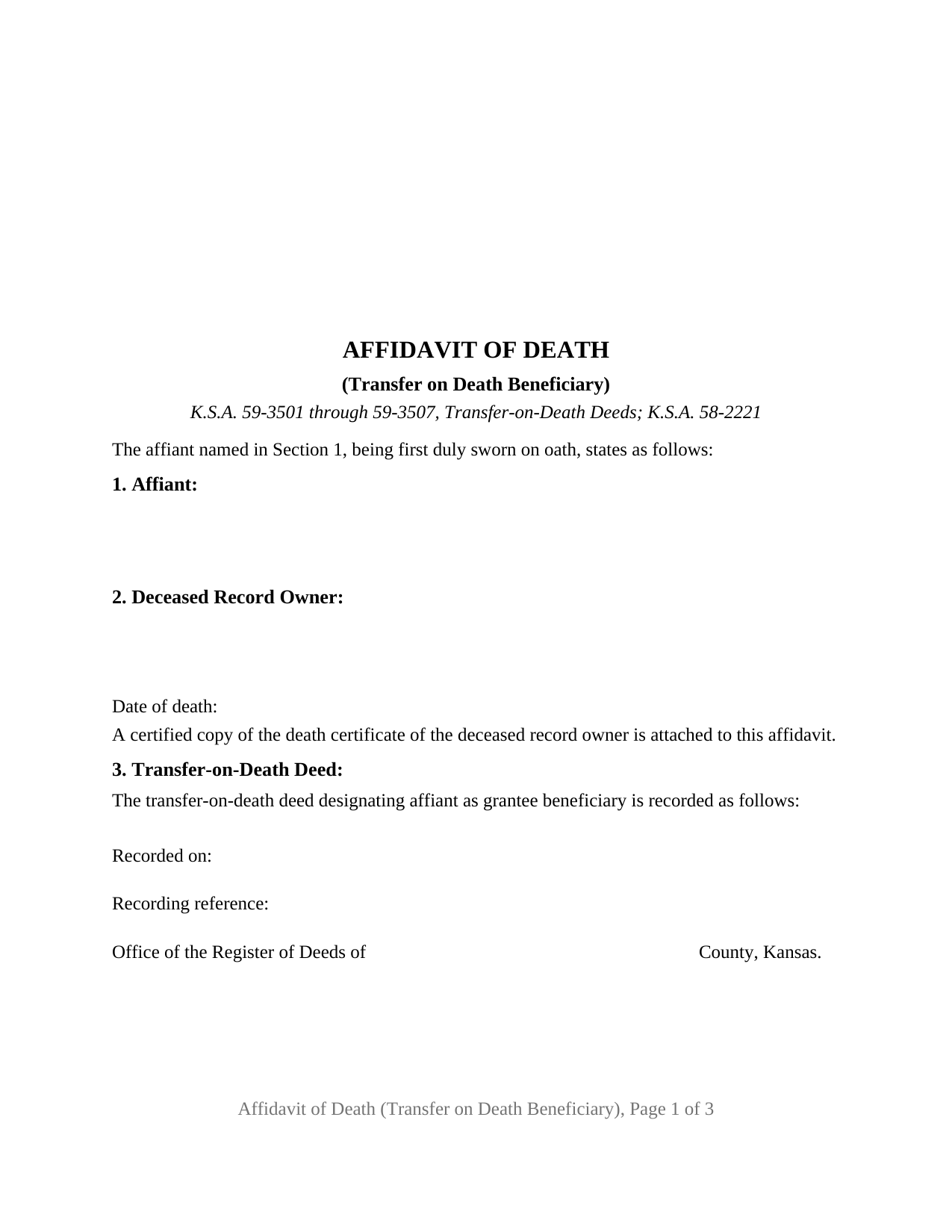
About the Kansas Affidavit of Death (Transfer on Death Beneficiary)
How to Use This Form
- Select your county from the list
- Download the county-specific form
- Fill in the required information
- Have the document notarized if required
- Record with your county recorder's office
What Others Like You Are Saying
"so far so good. was hoping to have the recorded document already. i need the recorded document by fr…"
"Thank you, Deed.com provided the needed forms to change county and state information after the passi…"
"I did a Beneficiary Deed, package came with all forms and instructions. Recorder accepted first time…"
"I was able to download the TOD deed form with no issues and it showed immediately. I appreciate that…"
"The process went smoothly and gave me what I needed. As an improvement, I would recommend that deeds…"
4.8/5 from 4,833 reviews. Read all
When the owner who recorded a Kansas transfer-on-death deed dies, the named grantee beneficiary already owns the property. K.S.A. 59-3504(a) vests title at the moment of death, with no probate and no new deed. What the county records do not yet show is that the death happened, that this beneficiary is the person the deed names, and that nothing revoked the designation. This form prepares the sworn affidavit a Kansas grantee beneficiary records, together with a certified copy of the death certificate, to put those facts into the chain of title.
A sworn statement, recorded where the deed was
Kansas transfer-on-death statutes, K.S.A. 59-3501 through 59-3507, prescribe no post-death filing. The affidavit is the documentary step Kansas title practice supplies, recorded with the same register of deeds that recorded the TOD deed. K.S.A. 58-2221(d) permits recording of any instrument whereby real estate may be affected, and K.S.A. 58-501 names an affidavit of death from a responsible person who knows the facts as prima facie evidence of a joint tenant's death, recorded in the county where the land lies. The certified death certificate copy is itself prima facie evidence of the fact, date, and time of death under K.S.A. 58-712(2), so the two documents travel together. Until they are of record, a title examiner, the county appraiser, and anyone else searching the records see only a deed waiting to operate.
What the beneficiary swears to
The affiant identifies the deceased record owner and the date of death, the recorded deed by its recording date, book and page or document number, and county, and the real estate by county and the legal description copied from the deed. The sworn statements then track what the statutes make relevant. The affiant is a grantee beneficiary designated in that deed. The affiant survived the record owner by more than 120 hours, the survival period K.S.A. 58-710 attaches to a donative provision of a deed. No instrument revoking the deed and no later transfer-on-death deed by the record owner appears of record, and the affiant knows of none, which matters because K.S.A. 59-3503 permits revocation only by a recorded instrument and never by will. And where the record owner held the interest as a joint tenant with right of survivorship, the record owner was the last joint owner to die, the death at which K.S.A. 59-3505 allows a joint owner's deed to operate.
One affiant, one jurat
This configuration recites exactly one affiant, a natural person who is a grantee beneficiary named in the deed, signing in that person's own name. The form carries one signature block and one notarial certificate, and the certificate is a verification on oath or affirmation, the Kansas jurat printed in K.A.R. 7-43-17(a)(3), rather than the acknowledgment a deed carries, because an affidavit is sworn. The certificate reserves an area for the official stamp K.S.A. 53-5a16(b) requires on a tangible record. A deed naming several beneficiaries presents this pattern once for each beneficiary who makes an affidavit. A successor grantee claiming a predeceased beneficiary's share per stirpes under K.S.A. 59-3504(c)(2), a personal representative, or an heir is not the person whose designation and survival the statements describe, and the form is not set up as that person's affidavit. The record owner's spouse, the other beneficiaries, and the heirs have no signature line.
Kansas recording details that matter here
Recording fees under K.S.A. 28-115 run by the page, and the death certificate copy behind the affidavit counts, so the instrument is kept to three pages at 12 point type with the top three inches of its first page left open for the register's recording label, the space K.S.A. 28-115(e) requires. The sales validation questionnaire of K.S.A. 79-1437c accompanies deeds and other instruments that provide for a transfer of title; the Department of Revenue directive registers follow states that a TOD deed needs none because it transfers nothing when filed, and it is silent on the post-death affidavit, so county intake practice on that point varies. Under K.S.A. 59-3504(b) the property passed subject to the record owner's mortgages, liens, contracts, and any Kansas medical assistance claim, and the affidavit leaves those where the statute put them.
The package includes the fillable affidavit of death, a completed example filled in for a realistic Johnson County fact pattern, and the guide that walks through every section, the notarial certificate, and the recording process. This description and the guide describe the form and the governing Kansas statutes in general terms; they are not legal advice.
Important: County-Specific Forms
Our affidavit of death (transfer on death beneficiary) forms are specifically formatted for each of the 105 counties in Kansas.
After selecting your county, you'll receive forms that meet all local recording requirements, ensuring your documents will be accepted without delays or rejection fees.