Kansas Transfer on Death Revocation
County Specific Legal Forms Validated as recently as October 25, 2026 by our Forms Development Team
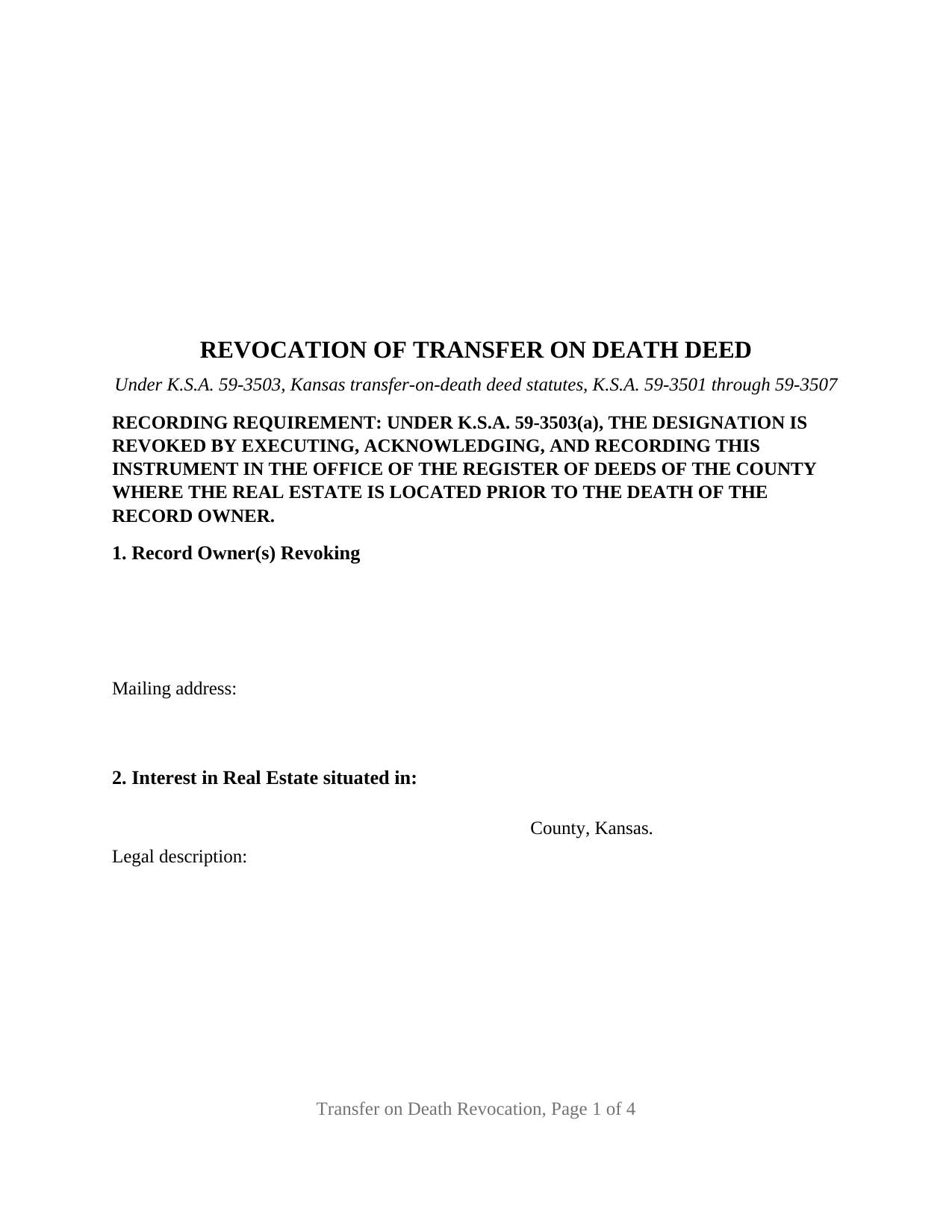
About the Kansas Transfer on Death Revocation
How to Use This Form
- Select your county from the list
- Download the county-specific form
- Fill in the required information
- Have the document notarized if required
- Record with your county recorder's office
What Others Like You Are Saying
"So far GOOD, just can't locate legal description. Will sign in later when have correct info. Thanx!!…"
"Found exactly what I was looking for in a matter of minutes at a very reasonable fee."
"in one of the reviews, the person said they wished that there was more room allowed for use in the g…"
"Excellent service! Easy to use, great communication, quick response time and very helpful with any q…"
"I tried 3 local attorneys and got no where , wrong information, to busy and another one was very rud…"
4.8/5 from 4,833 reviews. Read all
A Kansas transfer on death deed stays revocable for the whole of the owner's life, and K.S.A. 59-3503(a) names one way to revoke it: an instrument describing the interest in real estate, executed, acknowledged, and recorded in the office of the register of deeds of the county where the real estate is located, prior to the death of the record owner. This form prepares that instrument, a Kansas transfer on death revocation, for one or two record owners who signed the TOD deed being revoked.
Recorded before death, or it revokes nothing
Recording is the condition that gives the revocation effect. A revocation left unrecorded at the record owner's death revokes nothing; K.S.A. 59-3504(a) then vests title in whoever the recorded deed designates. A will does not do the work either: K.S.A. 59-3503(c) provides that a recorded transfer on death deed may not be revoked by the provisions of a will. The form prints the recording requirement in capital letters beneath its title.
An instrument the statute describes by its elements
Kansas prints a statutory form for the deed itself in K.S.A. 59-3502 and none for the revocation. Section 59-3503(a) describes the revocation by its elements, and the form carries each one. Section 1 identifies the record owner or owners. Section 2 describes the interest by county and legal description, copied from the recorded deed. Section 3 identifies the deed being revoked by its date, recording date, document number, book and page, and recording county. Section 4 performs the act in one sentence: the undersigned record owner or owners revoke the designation of grantee beneficiary or beneficiaries made in that deed as to that interest. The beneficiary does not sign and is not notified, as K.S.A. 59-3503(a) states, and the instrument transfers no interest in real estate.
One owner or two, each signing in their own name
The form recites one or two natural-person record owners signing as themselves. Nothing about marital status, how title is held, or signing capacity is preprinted; the owner block receives the names as they appear on the recorded deed, with whatever status recital the owners carry. Two signature blocks headed OWNER and SECOND OWNER (if applicable) follow, each with its own acknowledgment certificate, so two owners can acknowledge on different days or before different notaries. A sole owner uses the first block and leaves the second blank; two owners who together signed one deed, as joint tenants with right of survivorship or as tenants in common, both sign. The form is not set up as an instrument for an entity owner, a trustee, an attorney-in-fact, or three or more owners on one revocation.
Kansas recording details that matter here
Kansas takes the revocation on an acknowledgment, the formality K.S.A. 58-2211 applies to instruments affecting real estate, and the certificate on the form is the Kansas short form under K.A.R. 7-43-17; no witnesses sign. Recording fees are set statewide by K.S.A. 28-115 and charged by the page, and the register adds a sheet, counted as a page, when the first page leaves no room for the recording information; the form reserves the top three inches of its first page for it. The sales validation questionnaire of K.S.A. 79-1437c accompanies instruments providing for the transfer of title; the Department of Revenue's directive to registers treats a TOD deed as outside the questionnaire because nothing transfers at filing, and the revocation transfers even less, as Section 4 says on its face. Kansas has no deed or transfer tax.
Ending a designation versus changing one
This revocation ends the designation and puts nothing in its place; once recorded, the interest passes at the owner's death as it would with no transfer on death deed of record. A different beneficiary comes by the path K.S.A. 59-3503(b) describes, a subsequent transfer on death deed, prepared and recorded separately and not included in this package, which on its own revokes every prior designation by that owner for that interest.
The package includes the fillable revocation form, a completed example filled in for a realistic Shawnee County fact pattern, and a guide that walks through every section, the signing and notarization, and the recording requirements. This description and the guide describe the form and the governing Kansas statutes in general terms; they are not legal advice.
Important: County-Specific Forms
Our transfer on death revocation forms are specifically formatted for each of the 105 counties in Kansas.
After selecting your county, you'll receive forms that meet all local recording requirements, ensuring your documents will be accepted without delays or rejection fees.