Kansas Transfer on Death Deed Revocation
County Specific Legal Forms Validated as recently as September 25, 2026 by our Forms Development Team
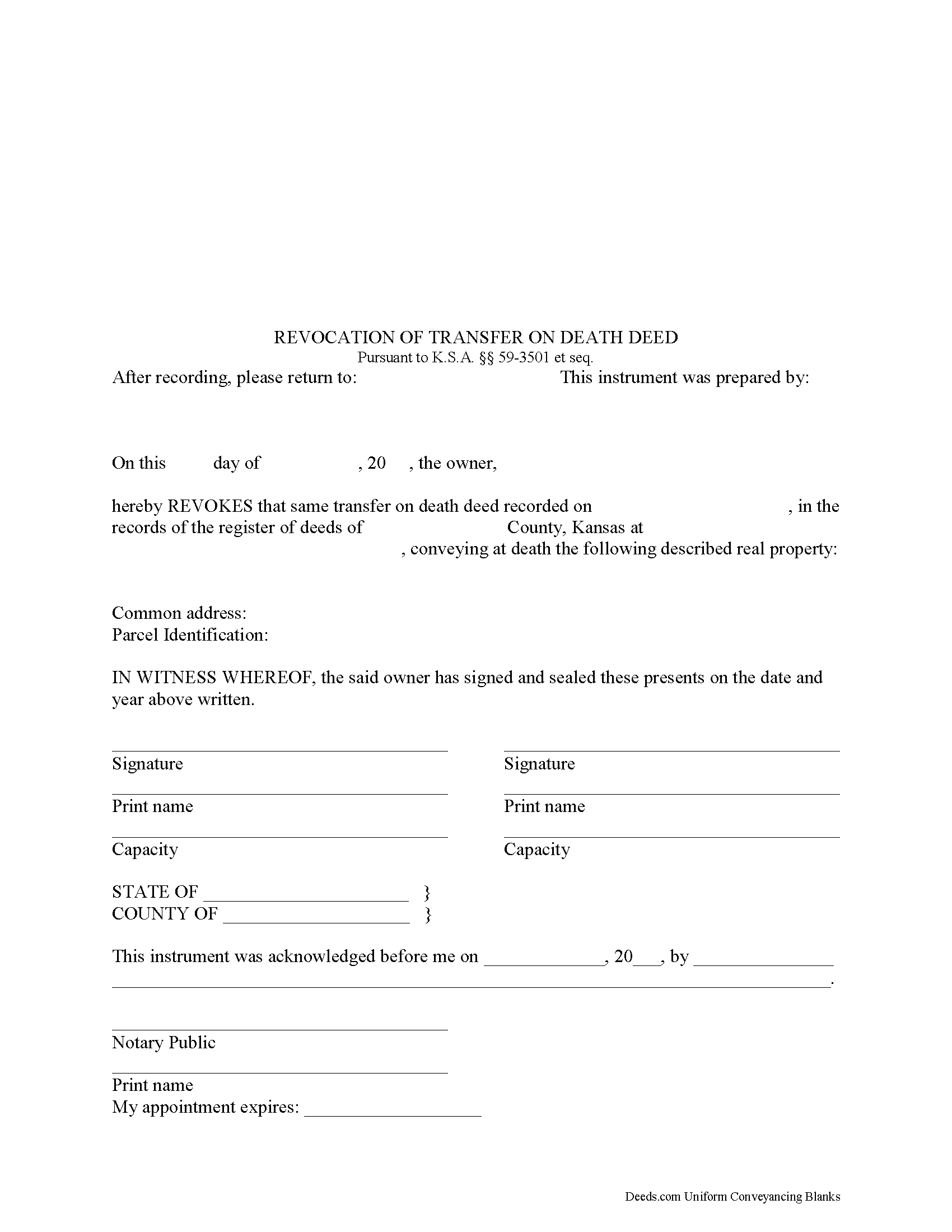
About the Kansas Transfer on Death Deed Revocation
How to Use This Form
- Select your county from the list
- Download the county-specific form
- Fill in the required information
- Have the document notarized if required
- Record with your county recorder's office
What Others Like You Are Saying
"Filling out forms was easy....so far, I am happy !"
"This was so easy and just what I needed."
"Excellent service. Easy to use, easy to upload, and very cost effective!"
"Exceptional Service all Year~ I wish Deeds.com A Happy Holidays & A Happy New Year."
"I am so very happy with the service provided by Deeds.com. The process was simple and saved me a lot…"
4.8/5 from 4,820 reviews. Read all
Kansas transfer on death deeds (TODDs) are governed by K.S.A. 59-3501 (2012) et seq. Revocation, specifically, is addressed in.
The transfer on death deed is a flexible estate planning tool which became available to Kansas land owners in 1997. Revocability, one of the many unique features of this deed, is based on the fact that the conveyance has no effect until after the owner dies.
Why might an owner wish to cancel, or revoke, a transfer on death? Sometimes there are changes in the owner or beneficiary's circumstances, unexpected family disputes, or one or more of numerous other reasons. In this regard, the reason does not matter -- the owner holds absolute title to and control over the property. The statute at 59-3503 provides two methods for exercising this option:
(a) A designation of the grantee beneficiary may be revoked at any time prior to the death of the record owner, by executing, acknowledging and recording in the office of the register of deeds in the county where the real estate is located an instrument describing the interest revoking the designation. The signature, consent or agreement of or notice to the grantee beneficiary or beneficiaries is not required.
(b) A designation of the grantee beneficiary may be changed at any time prior to the death of the record owner, by executing, acknowledging and recording a subsequent transfer-on-death deed in accordance with K.S.A. 59-3502. The signature, consent or agreement of or notice to the grantee beneficiary or beneficiaries is not required. A subsequent transfer-on-death beneficiary designation revokes all prior designations of grantee beneficiary or beneficiaries by such record owner for such interest in real estate.
Finally, part (c) explains that a transfer-on-death deed executed, acknowledged and recorded in accordance with this act may not be revoked by the provisions of a will.
Each situation is unique, so for specific questions or to review the options for more complex situations, contact a local attorney.
(Kansas Transfer on Death Deed Revocation Package includes form, guidelines, and completed example)
Important: County-Specific Forms
Our transfer on death deed revocation forms are specifically formatted for each of the 105 counties in Kansas.
After selecting your county, you'll receive forms that meet all local recording requirements, ensuring your documents will be accepted without delays or rejection fees.