Maine Notice of Death Affidavit (Transfer on Death Beneficiary)
County Specific Legal Forms Validated as recently as October 27, 2026 by our Forms Development Team
About the Maine Notice of Death Affidavit (Transfer on Death Beneficiary)
How to Use This Form
- Select your county from the list
- Download the county-specific form
- Fill in the required information
- Have the document notarized if required
- Record with your county recorder's office
What Others Like You Are Saying
"It was very easy to e-file. I liked it."
"There's nothing to say except it couldn't be easier."
"Very user friendly! Processing is very fast. I would highly recommend using Deed's."
"Easy to use, fast and reliable. love deeds.com"
"The included instructions and example made the document easy to complete. And the additional documen…"
4.8/5 from 4,836 reviews. Read all
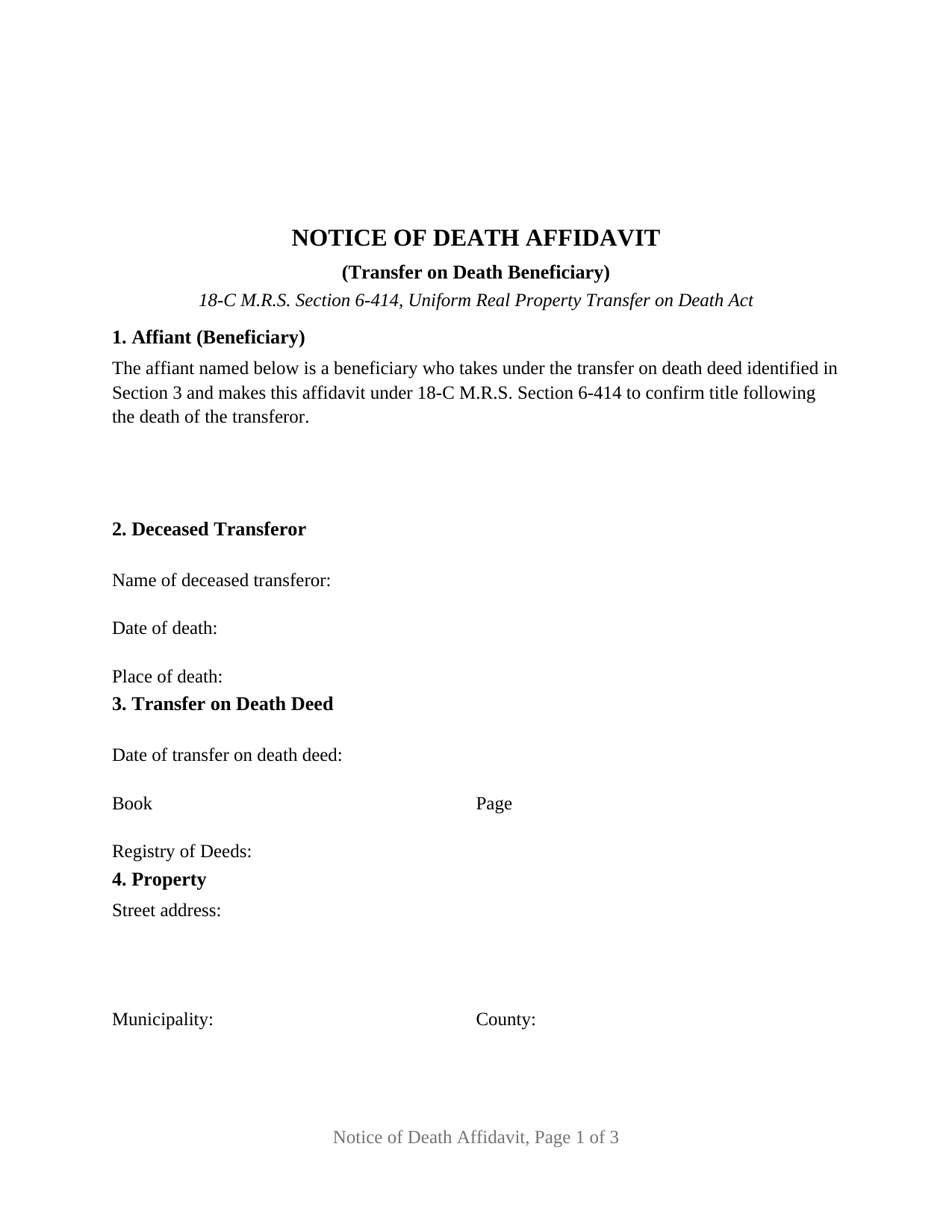
When the owner who recorded a Maine transfer on death deed dies, the property passes to the named beneficiary by the deed itself, with no probate and no new conveyance. This Maine Notice of Death Affidavit is the sworn statement 18-C M.R.S. Section 6-414 lets a beneficiary who takes under the deed record in the registry of deeds to confirm title following the transferor's death.
A filing that confirms title rather than transfers it
Section 6-414 closes with a sentence that shapes everything about this instrument: the filing of the notice of death affidavit is not a condition to the transfer of title. Under Section 6-413 the interest moved to the beneficiary at death, subject to the mortgages, liens, and other interests then affecting the property. The affidavit's work is to put that event into the chain of title, where a title examiner or a later buyer will look for it, and to tell the municipality where the tax bills now go: after recording, the register of deeds returns the original affidavit to the person who filed it and mails a copy to the tax assessor of the municipality where the property is located.
What the statute makes the affidavit say
Maine prescribes contents, not a form. The affidavit contains the name and address, if known, of each beneficiary taking under the deed; the street address of the property; the date of the transfer on death deed; the book and page at which the deed was recorded before the transferor's death; the name of the deceased transferor; the date and place of death; and the name and address to which future tax bills are to be mailed. Each item has its own section on this form, in the statute's order, with a further section for the legal description copied from the recorded deed. The sworn statements follow: that the affiant is a beneficiary who takes under the deed, that the transferor died on the date and at the place stated, that the deed was recorded before death at the book and page stated, and that the affiant knows of no recorded instrument revoking it.
One beneficiary, sworn and notarized
This version of the affidavit is set up for a transfer on death beneficiary: one natural person who takes under the deed, often called a TOD deed or beneficiary deed, signing in that person's own capacity. The form carries one signature block, for the affiant, and one notarial certificate. Because Section 6-414 requires the affidavit to be notarized and an affidavit is a sworn statement, the certificate is a verification on oath or affirmation under 4 M.R.S. Section 1917, subsection 3, Signed and sworn to (or affirmed) before me on, rather than an acknowledgment. The affiant may be the only beneficiary or one of several; the beneficiaries section lists everyone who takes, the affiant included. A trustee or entity beneficiary acting through a representative, an attorney-in-fact signing for a beneficiary, and an estate's personal representative present different patterns, and so does the death of a joint owner survived by another joint owner, where under Section 6-413 the property belongs to the survivor and the deed has not yet operated.
Recording in the Maine registry
The affidavit is recorded in the registry of deeds for the county where the property lies, the same registry that holds the deed, and the typed or printed name beneath each signature that 33 M.R.S. Section 651-A requires is built into the signature block and the certificate. Maine's registries publish a shared format standard, a 1 3/4 inch clear top margin on the first page, 3/4 inch sides, a 1 1/2 inch clear bottom on the last page, and 10 point type at minimum; the form reserves two inches at the top of page one and an inch and a half at the bottom of the last page. Since January 1, 2026 the statutory recording fee for a nongovernment submitter is a flat 40 dollars per instrument, whatever the page count. No transfer tax declaration accompanies the filing: the affidavit conveys nothing, and the transfer the deed made is exempt from the tax and the declaration under 36 M.R.S. Sections 4641-C and 4641-D.
The package includes the fillable notice of death affidavit, a completed example filled in for a Cumberland County fact pattern, and the guide that walks through every numbered section and the recording steps. This description and the guide describe the form and the governing Maine statutes in general terms; they are not legal advice.
Important: County-Specific Forms
Our notice of death affidavit (transfer on death beneficiary) forms are specifically formatted for each of the 16 counties in Maine.
After selecting your county, you'll receive forms that meet all local recording requirements, ensuring your documents will be accepted without delays or rejection fees.