Maine Transfer on Death Revocation
County Specific Legal Forms Validated as recently as October 26, 2026 by our Forms Development Team
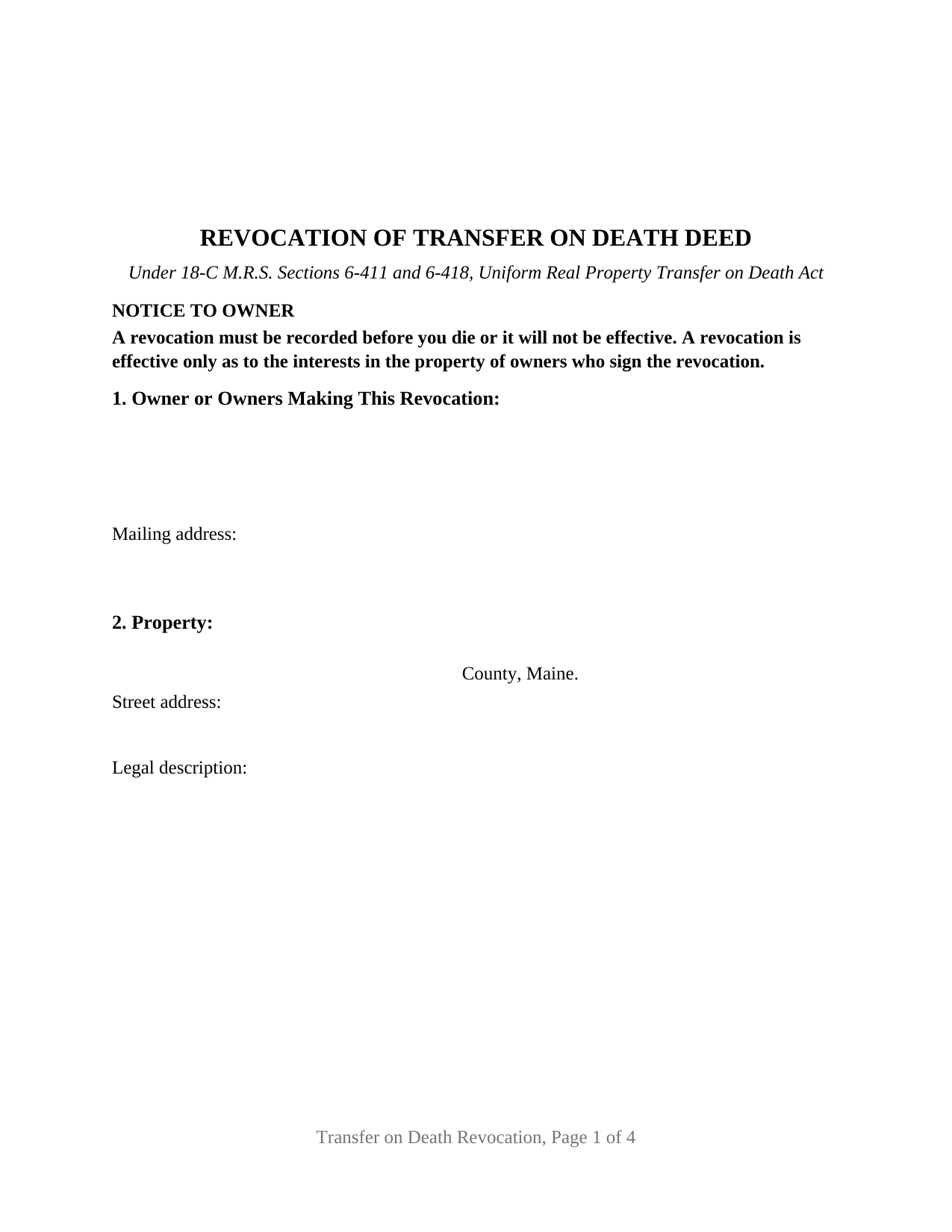
About the Maine Transfer on Death Revocation
How to Use This Form
- Select your county from the list
- Download the county-specific form
- Fill in the required information
- Have the document notarized if required
- Record with your county recorder's office
What Others Like You Are Saying
"My recent experience with Deeds.com has been outstanding. I especially appreciated the sample filled…"
"Very easy to use. However, the "sample" filled in red ink did not print for me to refer to…"
"Great service and fast"
"Good information guiding through filling out the product. Would like form to be more flexible in ter…"
"Perfect, blank forms, just what I ordered. Easy to download, understand, and complete."
4.8/5 from 4,836 reviews. Read all
A recorded Maine transfer on death deed stays revocable for the owner's whole life, but Maine lets it be undone in only one way: by a later instrument that is acknowledged and recorded while the owner is living. This form prepares that instrument, a revocation of a transfer on death deed under 18-C M.R.S. Section 6-411 of the Uniform Real Property Transfer on Death Act, for one or two Maine owners who made the deed.
Why a Maine revocation has to be recorded
Section 6-411 recognizes three instruments that revoke a recorded transfer on death deed: a later transfer on death deed, an instrument of revocation that expressly revokes it, and an inter vivos deed that expressly revokes it. Each works only if it is acknowledged by the transferor after the acknowledgment of the deed being revoked and recorded before the transferor's death in the registry of deeds where the deed is recorded. A recorded deed may not be revoked by a revocatory act on the deed, and a signed revocation that sits unrecorded at the owner's death revokes nothing at all.
That timing rule is the center of this form. Section 3 identifies the deed being revoked by the date in its notarial certificate, its recording date, its Book and Page or document number, and the registry that holds it, so the record itself shows the sequence the statute requires.
The Legislature's own revocation sentence
Maine prints an optional revocation template in 18-C M.R.S. Section 6-418, amended in 2023, and states that the template may be used, that it is not intended to be printed and recorded in its current format, and that the other sections of the Act govern the effect of any revocation instrument. This form carries the template's operative sentence word for word, I revoke all my previous transfers of this property by transfer on death deed, adds the statement that the instrument expressly revokes the deed identified in Section 3, and restates the acknowledged-after and recorded-before-death conditions on the face of the instrument. The template's notice that a revocation is effective only as to the interests of the owners who sign it is carried as well; everything instructional sits on a separate page removed before recording.
One instrument for one or two owners
The form recites the owner or owners making the revocation in one free-form block with a mailing address line, and it preprints nothing about marital status, how title is held, or capacity. It carries two signature blocks, OWNER and SECOND OWNER, and a separate acknowledgment certificate for each, so two owners may acknowledge on different days or before different officers; on a revocation by one owner the second block and its certificate are left blank. Spouses who signed one transfer on death deed as joint owners, and a widowed owner withdrawing a designation made years earlier, present the two-owner and one-owner patterns this instrument recites. Section 6-411(2) supplies the joinder rule the guide walks through: revocation by one transferor does not affect the deed as to another transferor's interest, and a deed of joint owners is revoked only if all of the living joint owners revoke it. The form is not set up for an entity owner, a trustee, an attorney-in-fact, or three or more owners.
Built for Maine registries
Maine's registries apply the Maine Registers of Deeds Association's all-county standard: a 1 3/4 inch clear top on the first page, 3/4 inch side margins, a clean 1 1/2 inch bottom on the last page, and type no smaller than 10 point Times New Roman. The form reserves 2 inches at the top of page one, holds the clean bottom on its last page, prints 12 point Times, and places a typed name beneath every signature as 33 M.R.S. Section 651-A requires. The recording fee under 33 M.R.S. Sections 751 and 752 is a flat $40 for most submitters. Because the revocation conveys no title and names no grantee, the guide explains how the transfer tax chapter's definition of a deed and its transfer on death deed exemptions bear on the declaration of value at the registry counter.
The package includes the fillable revocation form, a completed example filled in for a Cumberland County fact pattern, and the guide that walks through every section, the signing and acknowledgment requirements, and recording. This description and the guide describe the form and the governing Maine statutes in general terms; they are not legal advice.
Important: County-Specific Forms
Our transfer on death revocation forms are specifically formatted for each of the 16 counties in Maine.
After selecting your county, you'll receive forms that meet all local recording requirements, ensuring your documents will be accepted without delays or rejection fees.