Maryland Revocation of Transfer-on-Death Deed (One or Two Owners)
County or Independent City Specific Legal Forms Validated as recently as October 8, 2026 by our Forms Development Team
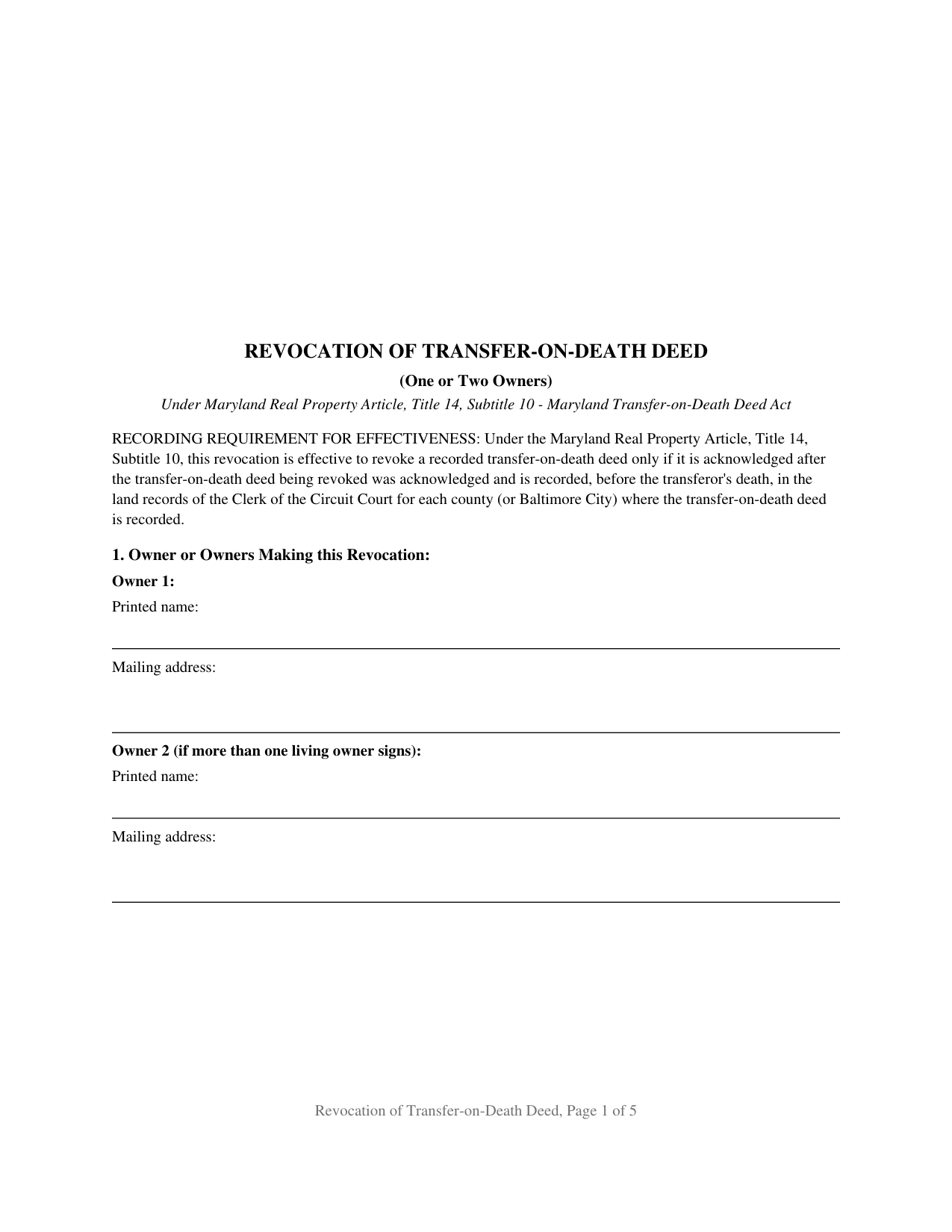
About the Maryland Revocation of Transfer-on-Death Deed (One or Two Owners)
How to Use This Form
- Select your county or independent city from the list
- Download the county or independent city-specific form
- Fill in the required information
- Have the document notarized if required
- Record with your county or independent city recorder's office
What Others Like You Are Saying
"Great to find this makes for easy work when you need to secure your ownership of a property!!Thanks …"
"Excellent source of information and forms. Deeds.com had exactly what I've been looking for and even…"
"Every thing worked perfectly."
"The process was easy and efficient. I will definitely be using this service!"
"was fairly easy to work through the forms but needed better information on what goes on a few of the…"
4.8/5 from 4,836 reviews. Read all
A Maryland transfer-on-death deed stays revocable for the owner's entire life, but once it is recorded, undoing it takes a recorded instrument: the owner cannot simply tear up the deed, and a will does not reach it. This form prepares the revocation the Maryland Transfer-on-Death Deed Act provides, for a deed signed by one owner or by two owners together.
A Recorded Designation Needs a Recorded Revocation
Maryland enacted its transfer-on-death deed in the 2026 session, codified as Title 14, Subtitle 10 of the Real Property Article and modeled on the Uniform Real Property Transfer on Death Act, effective October 1, 2026. It builds in a firm rule: after a transfer-on-death deed is recorded, it may not be revoked by a revocatory act on the deed itself, and it may not be revoked by a will or other testamentary document. The recorded revocation is the instrument the Act provides for the job.
The Timing Two Dates Control
Two dates decide whether a revocation works. It must be acknowledged after the transfer-on-death deed it revokes was acknowledged, and it must be recorded, before the owner's death, in the land records of the county or Baltimore City where that deed is recorded. A revocation left unrecorded at the owner's death revokes nothing, and the property passes to the named beneficiary. The Act applies to a transfer-on-death deed made before, on, or after October 1, 2026 where the transferor dies on or after that date, so a deed recorded in the Act's first months and its revocation run under the same timing rules.
One Owner or Two, and Whose Interest Is Reached
The Act ties revocation to the owner who signs. A revocation reaches only the interest of an owner who signs it, and a transfer-on-death deed made by joint owners with a right of survivorship is revoked only if all of the living joint owners revoke it. The form follows that structure with a signature block and acknowledgment certificate for a first owner and a second, conditional block for a second owner, so a single owner signs alone and two joint owners both sign.
What the Form Asks For
The revocation identifies the owner or owners, each by printed name and mailing address, the property by county or Baltimore City and legal description with the tax account number, and the deed being revoked by its transferor names, acknowledgment and recording dates, and recording reference, all from the recorded deed's stamp or the land-records index. Each owner signs over a (SEAL) notation, and a notary completes a Maryland short-form acknowledgment for each signer. Maryland requires a certification of preparation for recording, which the form carries as a signed prepared-by block. The completed example documents a finished revocation for a Frederick County property.
What the Revocation Does and Does Not Do
A revocation takes a designation out of effect without putting a new one in its place; the property returns to passing under the owner's will or by intestacy unless the owner records something else. A new Maryland transfer-on-death deed naming different beneficiaries revokes an inconsistent earlier deed on its own; that replacement deed is prepared and recorded separately and is not included in this package. The instrument is formatted for Maryland recording, with the required certification of preparation. The package includes the blank fillable PDF, a line-by-line guide, and a completed example. The materials are informational and are not legal advice.
Important: County or Independent City-Specific Forms
Our revocation of transfer-on-death deed (one or two owners) forms are specifically formatted for each of the 24 county or independent cities in Maryland.
After selecting your county or independent city, you'll receive forms that meet all local recording requirements, ensuring your documents will be accepted without delays or rejection fees.