Minnesota Affidavit of Identity and Survivorship for Transfer on Death
County Specific Legal Forms Validated as recently as November 1, 2026 by our Forms Development Team
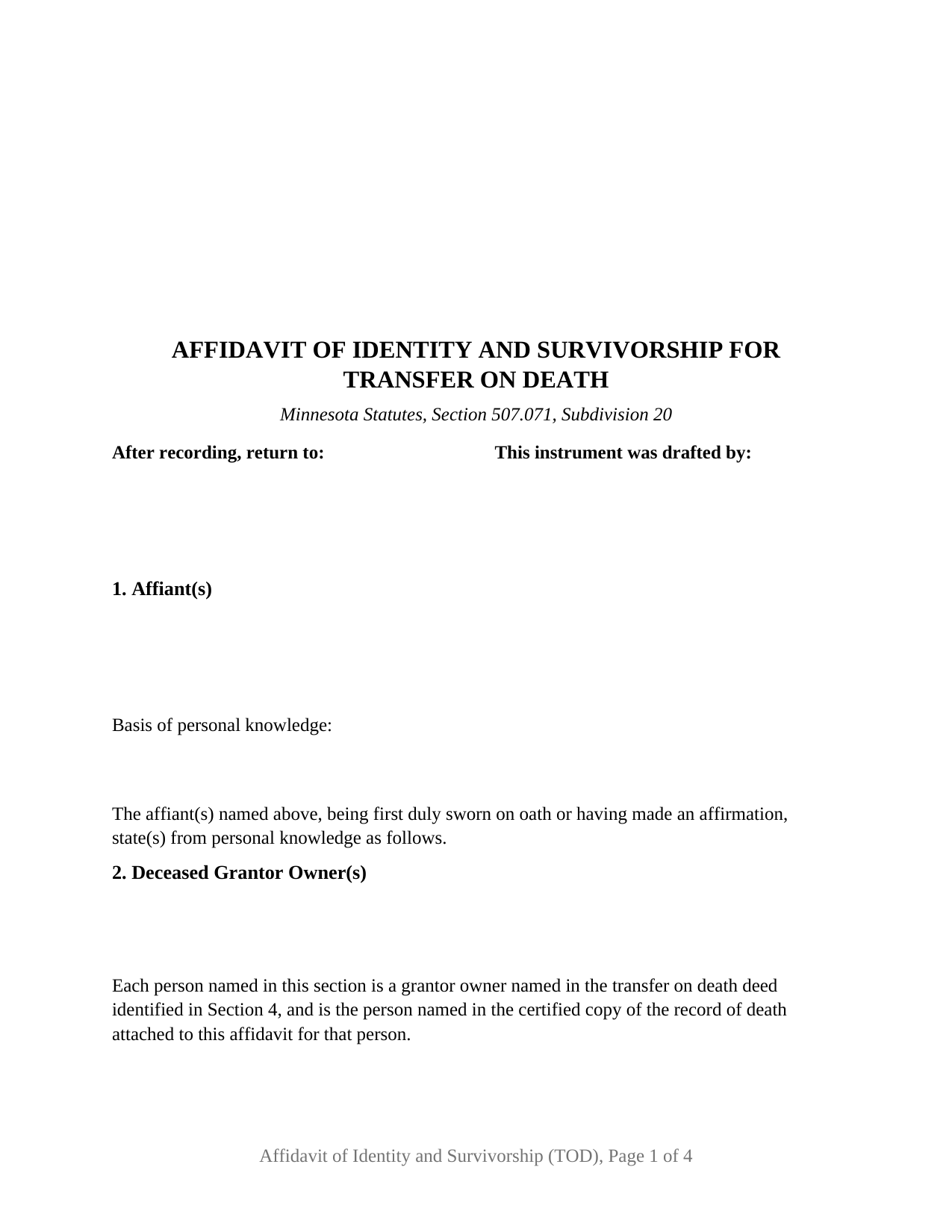
About the Minnesota Affidavit of Identity and Survivorship for Transfer on Death
How to Use This Form
- Select your county from the list
- Download the county-specific form
- Fill in the required information
- Have the document notarized if required
- Record with your county recorder's office
What Others Like You Are Saying
"So far, this is working well. However, I don't see a form to change name due to marriage."
"Easy."
"Excellent Service"
"User friendly!"
"This was the first time I have used Deeds.com and I must say that I am extremely impressed. The pers…"
4.8/5 from 4,839 reviews. Read all
A Minnesota transfer on death deed does its work the moment the grantor owner dies: under Minnesota Statutes, section 507.071, subdivision 2, the interest passes to the grantee beneficiary at that death, without probate. What the land records do not yet show is that the death occurred and that the beneficiary survived it. The Affidavit of Identity and Survivorship for Transfer on Death is the instrument subdivision 20 of the same section names for that gap, and this package prepares it for recording in any Minnesota county.
Proof of a transfer that already happened
The affidavit conveys nothing. It identifies the deceased grantor owner or owners, the recorded transfer on death deed by recording date, document number, office, and county, the real property by legal description, and the grantee beneficiaries who survived the grantor owner, together with any who did not. Once recorded with its attachments, the affidavit is prima facie evidence of the facts it states, and the registrar of titles may rely on those statements to transfer title to registered land.
Three documents, one recording
Minnesota ties the affidavit to two companions. Subdivision 20 calls for a certified copy of the record of death as an attachment, and subdivisions 3 and 23 require the beneficiary to record a clearance certificate, issued by the county agency that recovers medical assistance from decedents' estates and not part of this package, in each county where the property lies. The three may be recorded separately or combined as one document. The affidavit also carries the name and address for future property tax statements, which both subdivision 20 and section 507.092 require before an affidavit of survivorship is recorded. No deed tax attaches, because section 287.22 exempts a transfer on death deed and any affidavit that references one, and no certificate of real estate value is involved because nothing is sold.
Survival by 120 hours
The transfer under a Minnesota TOD deed is subject to section 524.2-702, which treats a beneficiary who fails to survive the grantor owner by 120 hours as having predeceased unless the deed provides otherwise. Section 5 of the form therefore names the beneficiaries who survived by at least 120 hours the grantor owner upon whose death the deed took effect, and separately names any who did not, with a death record attached for each of them. Where a deed was made by two grantor owners, subdivision 6 makes it effective after the death of the last surviving grantor owner, and Section 2 holds both names and both dates of death. Where a deceased beneficiary's descendants take in that beneficiary's place, subdivision 11 makes the affidavit alone not conclusive and requires a recorded court order, obtained separately and not part of this package.
One or two affiants, each with a jurat
The form is built around who swears to it. A single free-form block identifies one or two affiants, natural persons stating facts from personal knowledge, with an entry for the basis of that knowledge, which Hennepin County's published guidance looks for when the affiant is not a grantee beneficiary. Two signature blocks follow, AFFIANT and SECOND AFFIANT (if applicable), each with its own jurat certificate in the short form section 358.66 supplies for a verification on oath or affirmation, so two beneficiaries may swear together or on different days before different officers. The form is not set up as a representative-capacity instrument: a trustee or entity beneficiary, or an attorney-in-fact signing for an affiant, follows a different pattern, and three or more affiants exceed the two blocks the form carries.
Formatted for Minnesota recorders
The instrument reserves the top three inches of its first page for recording data, places the title directly below that space, keeps the borders of section 507.093, prints in 12 point type on letter size pages, and carries the drafter statement of section 507.091 beside the return address. Minnesota's recording fee is the flat $46 of section 357.18.
The package includes the fillable affidavit, a completed example filled in for a Hennepin County fact pattern with two grantor owners and two beneficiary affiants, and a guide that walks through every numbered section, the jurat, and the recording process. This description and the guide describe the form and the governing Minnesota statutes in general terms; they are not legal advice.
Important: County-Specific Forms
Our affidavit of identity and survivorship for transfer on death forms are specifically formatted for each of the 87 counties in Minnesota.
After selecting your county, you'll receive forms that meet all local recording requirements, ensuring your documents will be accepted without delays or rejection fees.