Mississippi Affidavit of Death of Transferor (Transfer on Death)
County Specific Legal Forms Validated as recently as November 8, 2026 by our Forms Development Team
About the Mississippi Affidavit of Death of Transferor (Transfer on Death)
How to Use This Form
- Select your county from the list
- Download the county-specific form
- Fill in the required information
- Have the document notarized if required
- Record with your county recorder's office
What Others Like You Are Saying
"Very responsive and helpful."
"Very happy"
"Easy to use."
"Easiest and most efficient process awesome online communication"
"This was a complete set of the necessary forms, with instructions. It will be very useful. Instant d…"
4.8/5 from 4,847 reviews. Read all
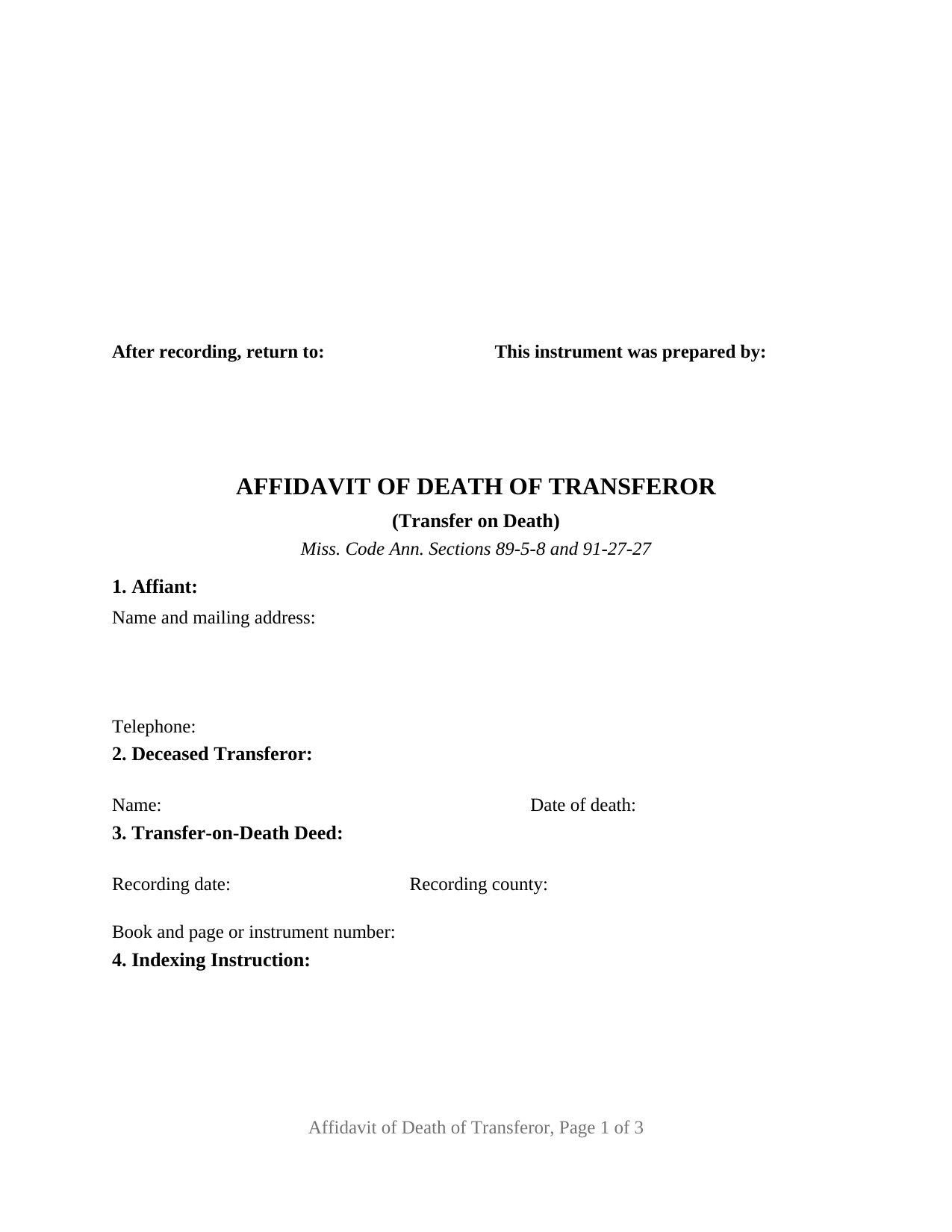
When the owner who signed a Mississippi transfer-on-death deed dies, the recorded deed does its work on its own: under Section 91-27-27 of the Mississippi Code, the owner's interest passes to the surviving designated beneficiaries at the moment of death, with no probate and no new conveyance. What the land records do not yet show is that the death happened. This Mississippi Affidavit of Death of Transferor is the sworn instrument that puts the death, its date, the identity of the recorded deed, and the survival of the named beneficiaries into the chain of title, recorded with the chancery clerk alongside a certified copy of the death certificate.
An affidavit the recording statute makes evidence
Mississippi's transfer-on-death chapter, enacted in 2020, prescribes no post-death filing at all. The affidavit instead rests on Section 89-5-8 of the Mississippi Code, which makes recordable any affidavit containing a statement relating to the death or the time of death of a person who is a party to a document affecting title to real property, when the affidavit is signed and verified upon oath or affirmation before a notarial officer. Once recorded, the affidavit or a certified copy of it is admissible in any action involving the deed or the title, and it is prima facie evidence of the facts it states and of the marketability of the title. That statutory effect is the reason a title examiner, a lender, or a later buyer looks for this affidavit in the index under the deceased owner's name, and it is why the affidavit carries the formal property description the statute has required since July 1, 2021.
What the affiant swears to
The affidavit identifies the deceased transferor by the name on the recorded deed and the date of death on the death certificate, and it identifies the transfer-on-death deed by its recording date, county, and book and page or instrument number. It then lists the designated beneficiaries who survived the transferor and any who did not, because under Section 91-27-27 a beneficiary takes only by surviving the transferor and a non-surviving beneficiary's share lapses to the others. The sworn statements that follow track the chapter's own conditions: the deed was recorded before the death in the county where the property lies, the transferor was not survived by any joint owner with right of survivorship, and no revocation of the deed as to the surviving beneficiaries was recorded before the death. A knowingly false statement in a recorded affidavit of this kind is perjury under the statute and a basis for damages, which is part of what gives the recorded affidavit its weight.
Sworn before a notarial officer, not acknowledged
Because the instrument is an affidavit, the affiant signs and swears to it before a notarial officer, who completes a verification on oath or affirmation, the jurat Mississippi's short-form certificate statute prints as Signed and sworn to (or affirmed) before me. That is a different notarial act from the acknowledgment on a deed, and the form carries the jurat for that reason. The affiant appears in person; Mississippi has no remote online notarization statute, though an oath taken before an authorized officer in another state has the same effect here.
Built for the first page the chancery clerk reads
Mississippi's recording format statute, Section 89-5-24, places specific information on the first page of a recorded document below the three-inch margin reserved for the clerk: the preparer, each party's name, mailing address, and telephone number, the return address, the title, and the legal description or indexing instruction. This form lays out its first page to that statute, with the affiant's contact block, the deceased transferor, the deed reference, and the sectional indexing instruction all on page one and the legal description beginning on the page that follows, as the statute's own continuation rule allows. The body type is 12 point over the ten-point statutory minimum, and the margins clear the statute's three-fourths-inch floor, so the affidavit records at the base fee rather than with the ten-dollar nonconforming-document surcharge.
The configuration this form recites
The form recites one affiant, a natural person swearing in that person's own right, which in the ordinary pattern is a designated beneficiary who survived the transferor; one deceased transferor; and one recorded transfer-on-death deed. Its statements fix the death of a sole transferor or of the last surviving joint owner, since under Section 91-27-27 a deed made by joint owners with right of survivorship becomes effective only at the last of their deaths, and a surviving joint owner takes the property at an earlier death by survivorship instead. The form is not set up for an affiant signing as a trustee, attorney-in-fact, or officer of an entity beneficiary, for two affiants on one instrument, or for a deed whose other transferor is still living; those patterns call for different recitals. The transfer-on-death deed the affidavit relates to, sometimes searched as a TOD deed or beneficiary deed, is a separate instrument recorded during the owner's life and is not included in this package.
What the affidavit changes, and what it leaves alone
The affidavit transfers nothing; the deed did that at death. It does not clear the mortgage, liens, or other interests the beneficiary takes subject to under Section 91-27-29, does not revive a deed revoked of record, and does not make effective a deed that was never recorded before the owner died. It is prima facie evidence, which is exactly what a clean chain of title after a transfer-on-death deed needs and no more.
The package includes the fillable affidavit, a completed example filled in for a realistic Rankin County fact pattern, and the guide that walks through every section, the governing statutes, and the recording process. This description and the guide describe the form and the governing statutes in general terms; they are not legal advice.
Important: County-Specific Forms
Our affidavit of death of transferor (transfer on death) forms are specifically formatted for each of the 82 counties in Mississippi.
After selecting your county, you'll receive forms that meet all local recording requirements, ensuring your documents will be accepted without delays or rejection fees.