Mississippi Transfer on Death Revocation
County Specific Legal Forms Validated as recently as November 8, 2026 by our Forms Development Team
About the Mississippi Transfer on Death Revocation
How to Use This Form
- Select your county from the list
- Download the county-specific form
- Fill in the required information
- Have the document notarized if required
- Record with your county recorder's office
What Others Like You Are Saying
"Very satisfied with what I purchased."
"Very easy and fast. Couldnt ask for anything better."
"Easy to obtain form, easy to use. Came with instrucions and references to state statutes. Very Helpf…"
"So easy to use. The directions are very clear."
"Does everything I expected it to do. Very helpful. It is in compliance with applicable Nevada State …"
4.8/5 from 4,847 reviews. Read all
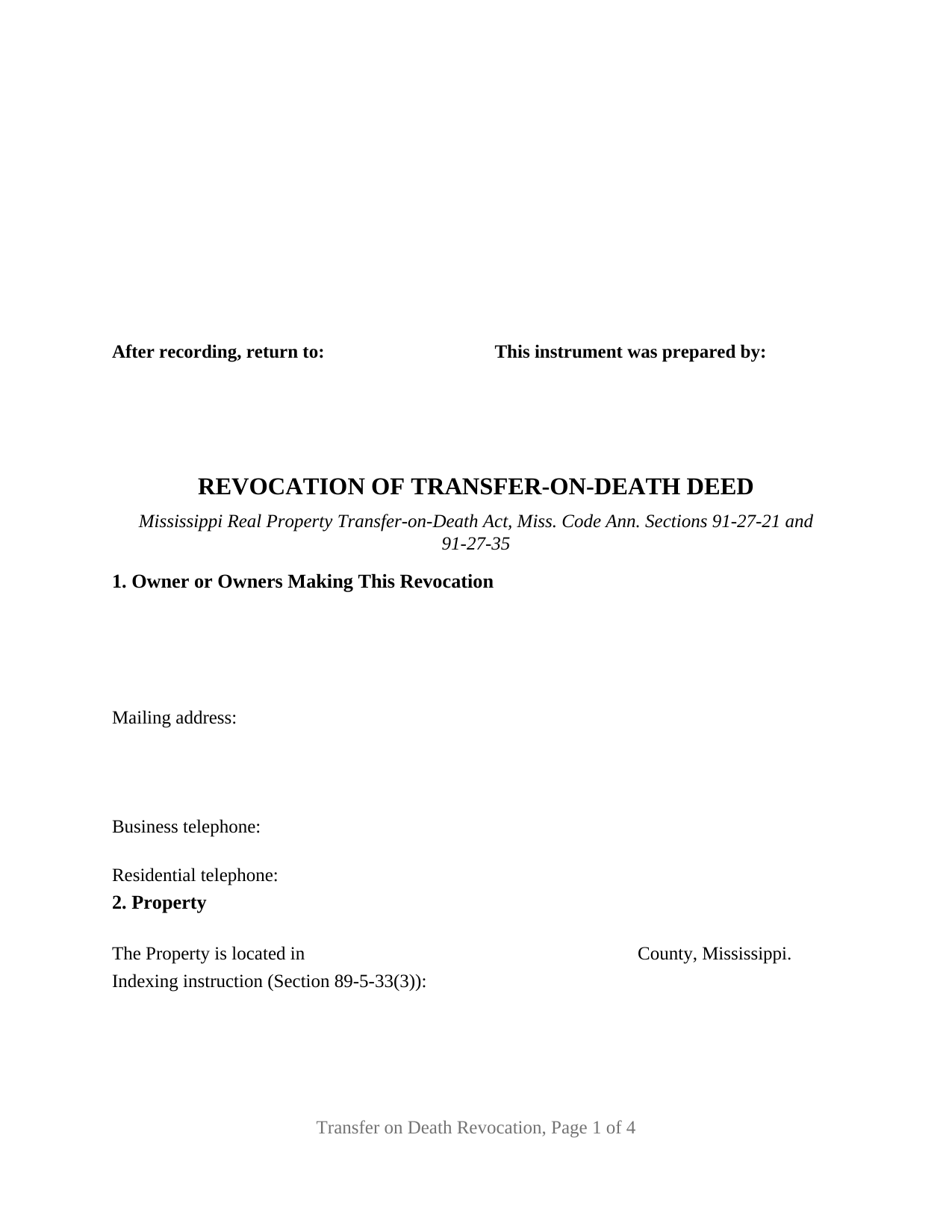
A Mississippi transfer-on-death deed is undone the same way it was made: by a recorded instrument. This Mississippi Transfer on Death Revocation is the instrument of revocation that Section 91-27-21 of the Mississippi Real Property Transfer-on-Death Act recognizes, prepared for one or two owners who made a recorded transfer-on-death deed and now revoke it. The form carries the operative sentence and the owner notice of the optional statutory revocation form in Section 91-27-35, identifies the deed being revoked by its acknowledgment date and its book and page or instrument number, and ends with a signature block and a separate acknowledgment certificate for each owner.
Two timing rules decide whether the revocation works
Section 91-27-21 makes an instrument of revocation effective only when two things are true about its timing. First, the revocation is acknowledged by the transferor after the acknowledgment of the deed being revoked, which is why the form asks for the acknowledgment date of the original deed: the two notary certificates, read together, show the sequence. Second, the revocation is recorded before the transferor's death in the official records of the chancery clerk of the county where the deed being revoked is recorded. A revocation that is signed, notarized, and kept in a drawer revokes nothing. The form prints the statutory form's own notice to the owner beside the operative sentence, stating that the revocation must be recorded before the owner's death or it will not be effective.
The chapter closes the other routes an owner might assume exist. Under Section 91-27-21(b), a will does not revoke or supersede a transfer-on-death deed, so a later will naming a different person leaves the recorded deed in force. Section 91-27-3(h) adds that cancel and revoke mean the same thing in this chapter, which is why the instrument is also searched for as a cancellation of a transfer on death deed or a TOD deed revocation form.
Effective only for the owners who sign
The statutory notice on the form carries a second sentence: the revocation is effective only as to the interests in the property of the owners who sign it. That sentence restates Section 91-27-21(d), under which a deed made by more than one transferor is revoked, by a revocation one of them signs, only as to that transferor's interest. Section 91-27-21(e) adds the rule for co-owners whose title carries a right of survivorship: a transfer-on-death deed made by joint owners with right of survivorship is revoked only if all of the living joint owners revoke it. Section 91-27-3(c) draws that definition to include a joint tenant and a tenant by the entirety and to exclude a tenant in common, and under Section 89-1-7 a Mississippi deed to two or more persons, spouses included, creates a tenancy in common unless the survivorship form manifestly appears in the instrument. The vesting deed by which the owners took title shows which rule applies, and the guide walks through both.
What the form recites and who it describes
The form is the general configuration of the instrument. Section 1 is a free-form block that receives the name of each owner who made the transfer-on-death deed, written as it appears on that deed, with whatever status recital the owner states; nothing about marital status, how title is held, or capacity is preprinted. The form carries two owner signature blocks, headed OWNER and SECOND OWNER (if applicable), and two acknowledgment certificates, one for each signer, so two owners can appear before different notaries on different dates or in different states, and a single owner leaves the second block and its certificate blank. One owner revoking a deed made alone, two spouses revoking the deed they made together, and two co-owners who hold as tenants in common and both sign present the patterns this form recites.
The form is not set up as an instrument signed by a corporation, limited liability company, or trust, by a trustee, or by an attorney-in-fact under a power of attorney, and it does not accommodate three or more owners on one instrument. It revokes the identified deed in its entirety as to each signer's interest; a partial revocation, or a revocation by a later inconsistent transfer-on-death deed, is a different instrument that Section 91-27-21(a)(1) also recognizes and that this package does not include. A new beneficiary designation is likewise a new transfer-on-death deed under Section 91-27-17, prepared and recorded separately and not included here.
Built for the Mississippi chancery clerk's first page
Mississippi puts more on the first page of a recorded instrument than most states do. Section 89-5-24(2) places the preparer's name, address, and telephone number, the name, mailing address, and telephone number of every party, the return address, the title, and the legal description or the indexing instruction on the first page below the three-inch margin reserved for the clerk. The form lays all of those out on its first page, with the indexing instruction of Section 89-5-33(3), the entry by which the clerk indexes land by section, township, and range or by lot, block, and subdivision, in its own labeled box; the legal description, copied from the transfer-on-death deed, begins on the second page under the statute's own continuation rule. The instrument runs four pages in twelve-point type on letter-size paper, inside the format standards Section 89-5-24 sets, and records for the Section 25-7-9 fee for the first five pages plus any county archive fee. No transfer tax or transfer declaration applies.
Signing follows the Revised Mississippi Law on Notarial Acts. Each owner signs in that owner's own right and acknowledges the instrument before a notarial officer, who completes a certificate in the Section 89-3-7(2) short form, with the commission expiration date and official seal Section 25-34-31 requires. Mississippi requires personal appearance before the officer and has no remote online notarization statute. A spouse who did not make the transfer-on-death deed is not a transferor and has no signature line, because the revocation conveys and encumbers nothing and the homestead joinder rule of Section 89-1-29 reaches conveyances and encumbrances of the homestead.
The package includes the fillable Mississippi Transfer on Death Revocation form, a completed example filled in for a Rankin County fact pattern in which two owners revoke the deed they recorded together, and the guide that walks through every numbered section, the signing rules, and the recording process. This description and the guide describe the form and the governing Mississippi statutes in general terms; they are not legal advice.
Important: County-Specific Forms
Our transfer on death revocation forms are specifically formatted for each of the 82 counties in Mississippi.
After selecting your county, you'll receive forms that meet all local recording requirements, ensuring your documents will be accepted without delays or rejection fees.