Mississippi Disclaimer of Interest (Transfer on Death Beneficiary)
County Specific Legal Forms Validated as recently as November 8, 2026 by our Forms Development Team
About the Mississippi Disclaimer of Interest (Transfer on Death Beneficiary)
How to Use This Form
- Select your county from the list
- Download the county-specific form
- Fill in the required information
- Have the document notarized if required
- Record with your county recorder's office
What Others Like You Are Saying
"I am happy I can record this this way."
"My sale is a land contract and it is complicated. We were thinking we'd have to get an attorney. You…"
"Easy to use this app and I was able to print my forms immediately! Great service and I would use it …"
"Just what I was looking for"
"EXCELLENT SERVICE. WILL MAINTAIN CONTACT FOR FUTURE REFERENCE. THANK YOU!"
4.8/5 from 4,847 reviews. Read all
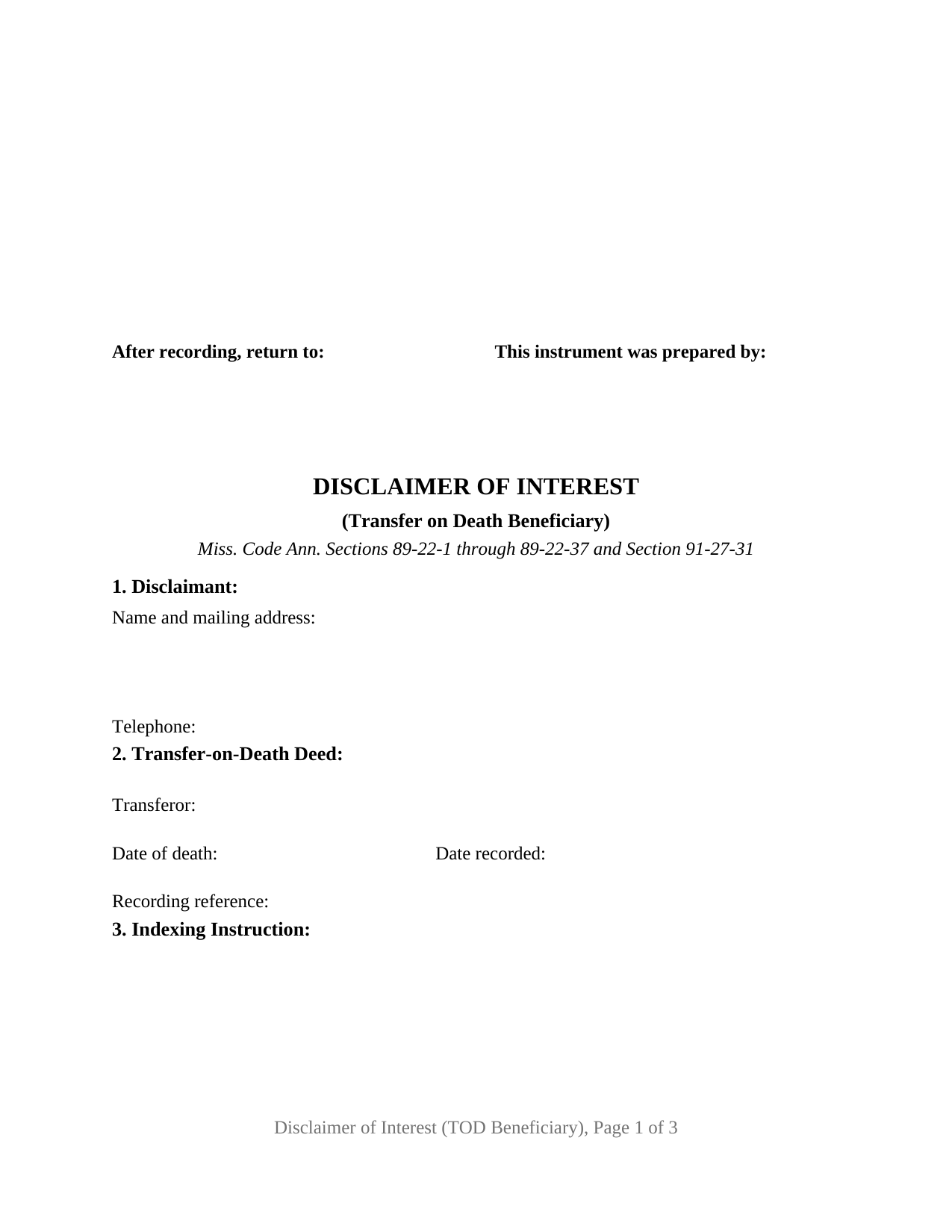
A person named as the beneficiary of a Mississippi transfer on death deed is not required to take the property. This form prepares a disclaimer of interest by which one designated beneficiary refuses, in whole, the interest that a recorded Mississippi transfer-on-death deed would pass to that beneficiary at the transferor's death, under the Mississippi Uniform Disclaimer of Property Interests Act (2002/2010), Sections 89-22-1 through 89-22-37 of the Mississippi Code, and Section 91-27-31 of the Mississippi Real Property Transfer-on-Death Act.
A refusal, not a transfer
Mississippi defines a disclaimer as the refusal to accept an interest in property (Section 89-22-3). The person refusing conveys nothing and names no one. Section 89-22-9(g) states the point directly: a disclaimer made under the chapter is not a transfer, assignment, or release. That is what separates a disclaimer from a quitclaim deed from the beneficiary to a relative, and it is why the form carries no grantee, no consideration, and no warranty language. Where the disclaimed interest goes is fixed by statute and by the deed itself. Section 89-22-11 passes the interest according to any provision in the deed for a disclaimed interest and otherwise as if the disclaimant had died immediately before the time of distribution, and the transfer-on-death act's own rules in Section 91-27-27 then apply: the interest of a designated beneficiary who does not survive the transferor lapses, a lapsed share among concurrent beneficiaries passes to the others in proportion to their interests, and an alternate beneficiary named in the deed takes in the case the deed describes.
What the 2020 act changed
The disclaimer statute Mississippi used before 2020, Sections 89-21-1 through 89-21-17, carried a nine-month filing deadline and a recording step tied to it. Laws 2020, chapter 406, repealed that chapter effective July 1, 2020 and enacted the current act in its place, the same session law that created the transfer-on-death deed. The new act sets no state-law deadline of its own. The nine-month period survives only in Section 89-22-29, which ties a tax-qualified disclaimer to Section 2518 of the Internal Revenue Code and its conditions. The elements of an effective disclaimer now sit in one subsection, Section 89-22-9(d): a writing or other record that declares the disclaimer, describes the interest disclaimed, is signed by the person making it, and is delivered or filed in the manner Section 89-22-25 provides. The chapter prescribes no form, and this form is drafted to those four elements.
Why the legal description is on the form
Recording is the notice step for a disclaimer of Mississippi real estate. Section 89-22-31 provides that a disclaimer of an interest in or relating to real property does not provide constructive notice to all persons unless it contains a legal description of the property and is filed for recording in the office of the chancery clerk of the county where the property is located; an effective disclaimer that meets both conditions is constructive notice from the time of filing, while an unrecorded disclaimer remains valid between the disclaimant and the persons who take because of it. The form therefore carries the full legal description copied from the recorded transfer-on-death deed, the sectional indexing instruction Section 89-5-33(3) requires, and, on its first recorded page, the items Section 89-5-24(2) places there: the preparer statement, the return address, the disclaimant's name, mailing address, and telephone number, the title, and the indexing instruction, all below the three-inch margin the chancery clerk uses for recording data.
One beneficiary, the whole interest
The form recites exactly one disclaimant, a natural person who is a designated beneficiary named in a transfer-on-death deed recorded before the transferor's death, signing in that person's own right after the death. It identifies the deed by the transferor's name, the transferor's date of death, the recording date, and the chancery clerk's recording reference, and it fixes a disclaimer in whole: the disclaimant DISCLAIMS AND REFUSES TO ACCEPT the entire interest that would have passed under that deed. It recites that the disclaimant has not accepted the interest or a benefit under it, has not assigned, conveyed, encumbered, pledged, or transferred it, and has not waived the right to disclaim, the events that bar a disclaimer under Section 89-22-27, and it states that the disclaimer directs no disposition of the interest. One signature block headed DISCLAIMANT and one acknowledgment certificate in the Section 89-3-7(2) short form follow. The form is not set up as a partial disclaimer expressed as a fraction or percentage under Section 89-22-9(e), as a disclaimer by a personal representative, trustee, or agent in a representative capacity, or as a joint instrument for two beneficiaries; each designated beneficiary who refuses an interest signs a disclaimer of that beneficiary's own.
Signing and delivery
The disclaimant signs before a notarial officer, who completes the acknowledgment certificate; Section 89-22-9(d) itself asks only for a signature, and the acknowledgment is what makes the document recordable under Section 89-3-1. No spouse signs, because the homestead joinder rule of Section 89-1-29 reaches conveyances and encumbrances and a disclaimer is neither. Delivery under Section 89-22-25 is a separate element from recording, and the guide describes what that section provides for an interest created by a beneficiary designation, together with the point at which a disclaimer becomes irrevocable under Section 89-22-9(f). An affidavit relating to the transferor's death under Section 89-5-8, where one is used to place the death of record, is a separate instrument recorded apart from the disclaimer and not included in this package.
The package includes the fillable disclaimer form, a completed example filled in for a Madison County fact pattern, and the guide that walks through every numbered section, the delivery and recording rules, and the effect of the disclaimer under the transfer-on-death act. This description and the guide describe the form and the governing Mississippi statutes in general terms; they are not legal advice.
Important: County-Specific Forms
Our disclaimer of interest (transfer on death beneficiary) forms are specifically formatted for each of the 82 counties in Mississippi.
After selecting your county, you'll receive forms that meet all local recording requirements, ensuring your documents will be accepted without delays or rejection fees.