Montana Affidavit of Death of Transferor
County Specific Legal Forms Validated as recently as November 11, 2026 by our Forms Development Team
About the Montana Affidavit of Death of Transferor
How to Use This Form
- Select your county from the list
- Download the county-specific form
- Fill in the required information
- Have the document notarized if required
- Record with your county recorder's office
What Others Like You Are Saying
"One thing I suggest is use the nomenclature Borrower / Lender / instead of Mortgatator / Mortgatee… …"
"First time user and the service was great.. I typically go to recording kiosk at the libraries. This…"
"Hi When and how will I get the copy of my deed ? Thanks"
"Very fast and reliable service."
"The process was quite easy, following the instructional guide. I have yet to find out if the deed wa…"
4.8/5 from 4,850 reviews. Read all
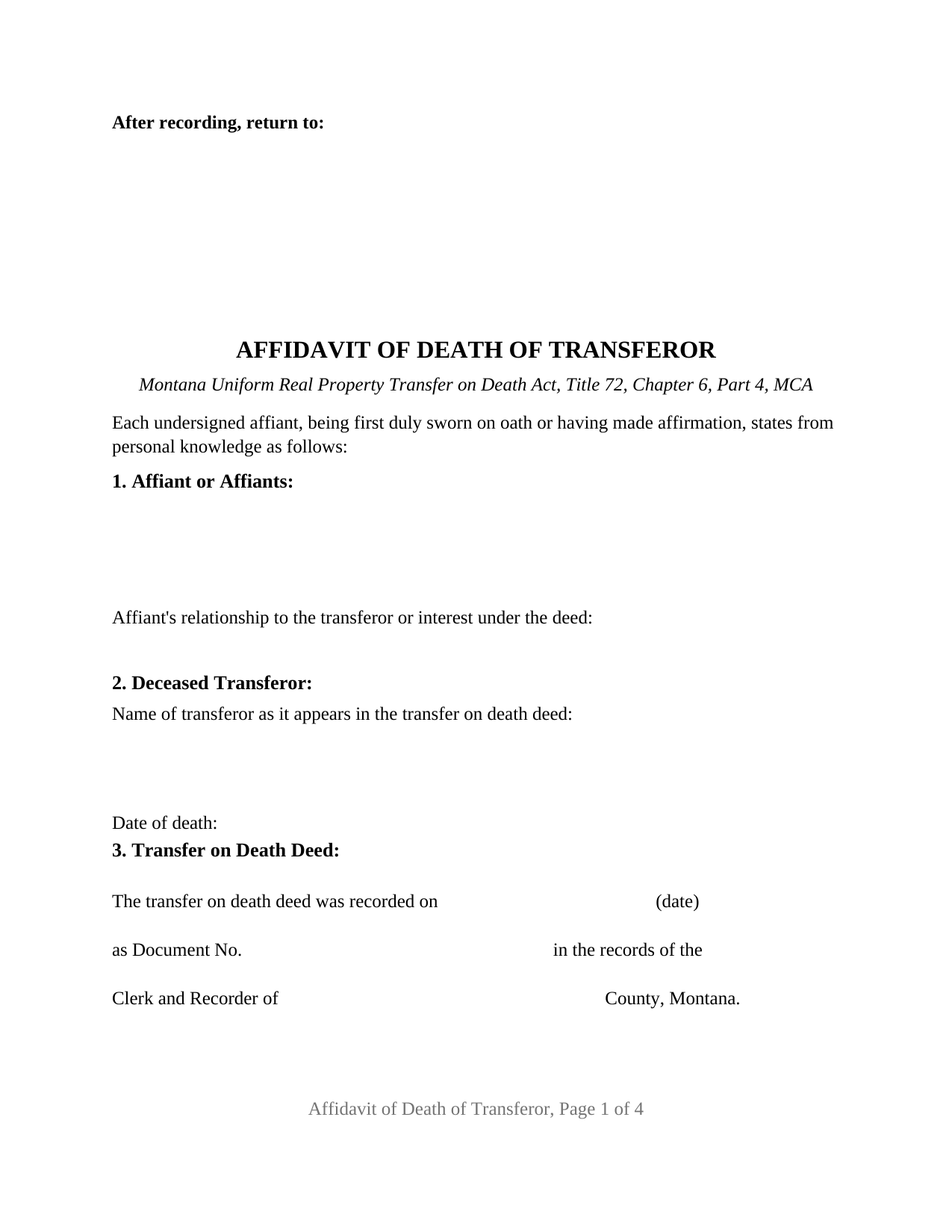
A Montana transfer on death deed moves real property to its designated beneficiary at the moment the owner dies, by force of statute and without a court. What the county record does not yet show at that moment is that the death happened. The Montana Affidavit of Death of Transferor is the sworn instrument a beneficiary records, with a certified copy of the death certificate attached, to put the transferor's death, the identity of the recorded TOD deed, and the survivorship of the named beneficiaries into the records of the Clerk and Recorder where the deed was recorded.
The transfer happens at death; the affidavit proves it
Under Section 72-6-412(1)(a) of the Montana Code Annotated, on the death of the transferor the interest in the property is transferred to the designated beneficiary in accordance with the deed. Nothing further is executed by the owner's estate, and no deed from a personal representative follows. The statute also deems the TOD deed recorded at the transferor's death for purposes of the recording act, so the chain of title runs from the owner's vesting deed, through the recorded transfer on death deed, to the beneficiary. The link that chain lacks is proof of the death, and Montana's Uniform Real Property Transfer on Death Act, MCA 72-6-401 through 72-6-418, prescribes no post-death filing to supply it. The affidavit fills that gap in the way Montana title practice has settled on: a sworn statement, signed before a notary, recorded with the death certificate in the county where the property lies. The Montana State University Extension MontGuide on transfer on death deeds describes exactly this step, and the Montana Department of Revenue requires the beneficiary to file a Realty Transfer Certificate after the owner's death with a copy of the recorded deed and the certified death certificate, a separate state form prepared and filed apart from this package.
What the affiant swears to
The affidavit identifies the deceased transferor by the name used in the deed and the date of death on the certificate, identifies the deed by its recording date, document number, and county, and copies the legal description from the deed so the two instruments index together. It then records two facts the statute makes decisive. The first is survivorship: under MCA 72-6-412(1)(b) a designated beneficiary's interest is contingent on surviving the transferor, measured at 120 hours under MCA 72-2-712, and an interest that fails to survive lapses, so the affidavit names the beneficiaries who survived and any who did not. The second is the absence of a revocation: MCA 72-6-410 permits revocation only by a later recorded TOD deed, a recorded instrument of revocation, or a recorded inter vivos deed that expressly revokes, so the county record itself answers the question, and the affiant swears to what that record shows. The affidavit also states that the transferor was not a joint owner survived by another joint owner, because under MCA 72-6-412(3) a TOD deed made by a joint owner waits for the death of the last surviving joint owner, and until then the property belongs to the survivor.
A jurat, not an acknowledgment
Because the instrument is an affidavit, its notarial certificate is a verification on oath or affirmation, the jurat of MCA 1-5-610(3), reading in the statute's words that the record was signed and sworn to (or affirmed) before the officer. The form carries two signature blocks and two separate jurat certificates, so that one affiant or two may swear, on the same day or on different days, before the same notary or different ones, in Montana or elsewhere. The second block and its certificate simply stay blank when one person swears. That certificate architecture is the form's design; Montana's short forms accommodate more than one named individual in a single certificate, and the guide says so.
Who the form recites
The form recites one or two natural persons as affiants, each named with a mailing address and each stating a relationship to the transferor or an interest under the deed. The pattern the completed example illustrates, and the one the MontGuide describes, is the designated beneficiaries themselves: two adult children named in their late father's recorded deed, swearing together to his death and their survivorship. A single beneficiary swearing alone presents the same instrument with one block used. The form is not set up as a trustee's or an entity's affidavit, carries no attorney-in-fact signature, and does not accommodate three or more affiants on one instrument. It is also not the instrument for a death that ends a joint tenancy or a life estate; Montana's recording statute, MCA 7-4-2613(1)(c), describes an acknowledged statement for the death of the holder of that kind of interest, and a TOD deed by a joint owner whose co-owner survives transfers nothing at that first death.
Built to Montana's recording standards
The instrument is laid out to MCA 7-4-2636: a letter size page with three inches reserved at the top of the first page for the clerk, one inch at the top of each later page and at the bottom of every page, half-inch sides, and the return name and mailing address in the upper left corner of the first page. Recording fees under MCA 7-4-2637, as amended in 2025, run $20 for the first page and $10 for each additional page, and the attached death certificate counts among the pages. The guide walks through the Realty Transfer Certificate, the water right disclosure that rides on it, the certified death certificate available under MCA 50-15-121, and the temporary insurance coverage MCA 72-6-412(5) now extends to a TOD deed beneficiary for up to 45 days after the owner's death.
The package includes the fillable affidavit, a completed example filled in for a Gallatin County fact pattern, and the guide that describes every section, the signing and notarization, and the recording process. This description and the guide describe the form and the governing Montana statutes in general terms; they are not legal advice.
Important: County-Specific Forms
Our affidavit of death of transferor forms are specifically formatted for each of the 56 counties in Montana.
After selecting your county, you'll receive forms that meet all local recording requirements, ensuring your documents will be accepted without delays or rejection fees.