Montana Transfer on Death Revocation
County Specific Legal Forms Validated as recently as November 11, 2026 by our Forms Development Team
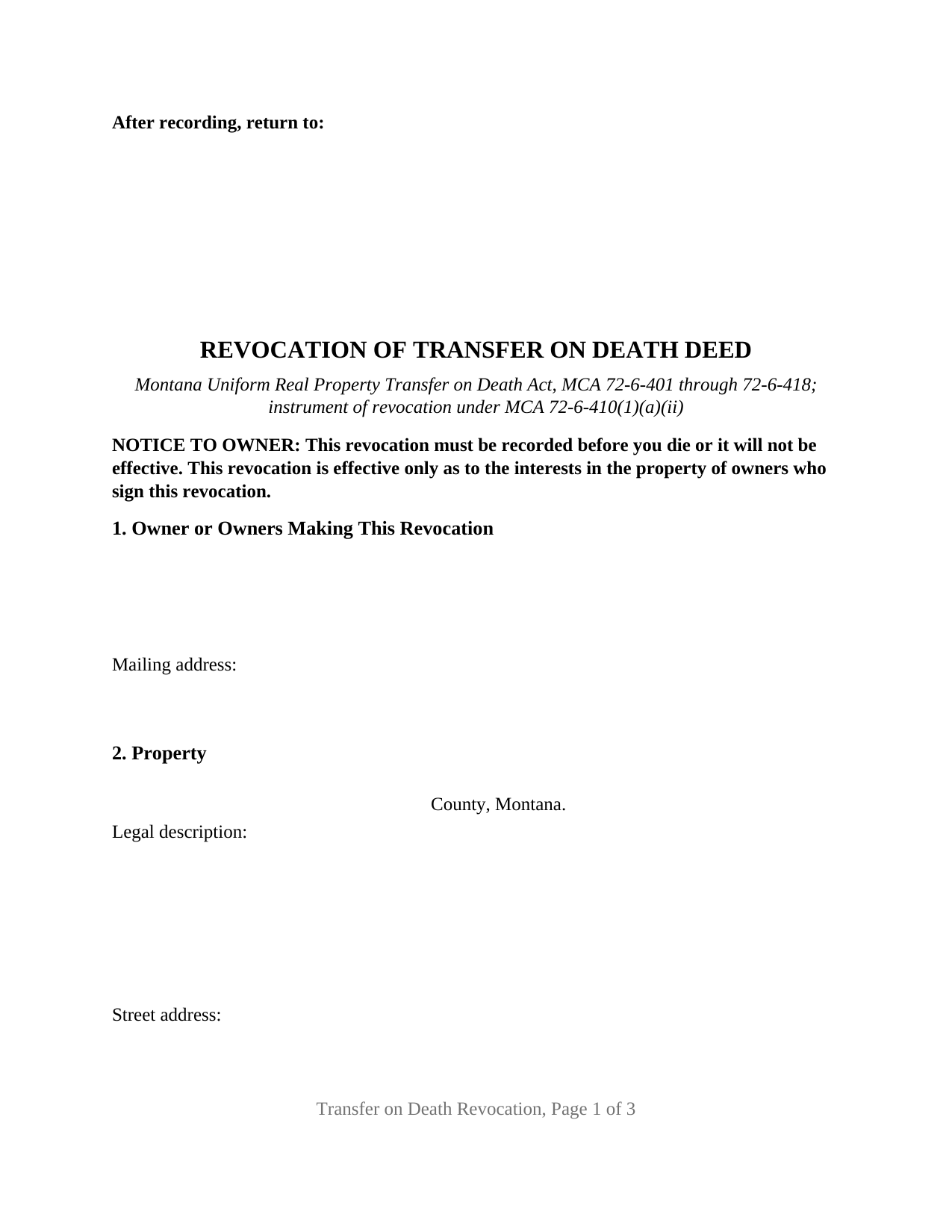
About the Montana Transfer on Death Revocation
How to Use This Form
- Select your county from the list
- Download the county-specific form
- Fill in the required information
- Have the document notarized if required
- Record with your county recorder's office
What Others Like You Are Saying
"Excellent product! Easy to fill out, complete directions. I highly recommend."
"Downloaded perfect. Can hardly wait to get them done."
"The process for getting the forms I needed was easy through Deeds.com I would use them again!"
"Amazing service from competent individuals that really go above and beyond to get you documents proc…"
"Quality forms and information. Everything went smoothly."
4.8/5 from 4,850 reviews. Read all
A recorded Montana transfer on death deed stays in force until a recorded instrument takes it out of force. Tearing up the deed, writing a new will, or telling the beneficiary changes nothing, because MCA 72-6-410 allows revocation by instrument only and forbids revocation by any act on the deed once it is recorded. This form prepares that instrument of revocation for one or two owners who made a Montana transfer on death deed, in the words of the optional statutory form at MCA 72-6-416.
Revocation by instrument, never by act
Montana adopted the Uniform Real Property Transfer on Death Act in 2019 as MCA 72-6-401 through 72-6-418, replacing the beneficiary deed statute of 2007. Under MCA 72-6-410(1), an instrument revokes a recorded transfer on death deed, in whole or in part, only if it is one of three things: a later transfer on death deed that revokes the earlier one expressly or by inconsistency, an instrument of revocation that expressly revokes the deed, or an inter vivos deed that expressly revokes it. This form is the second kind. Its operative sentence is the statutory form's own: I revoke all my previous transfers of this property by transfer on death deed. A second sentence ties that revocation to the specific recorded deed the form identifies by acknowledgment date, recording date, document number, and county, as to the interest of each owner who signs.
After a transfer on death deed is recorded, MCA 72-6-410(3) provides that it may not be revoked by a revocatory act on the deed. A will does not revoke it either. What does revoke it, apart from this instrument, is an inter vivos transfer of the property, which MCA 72-6-410(4) treats as revoking any prior transfer on death deed to it; that is a different instrument, prepared and recorded separately and not included in this package.
Acknowledged after, recorded before
Two timing conditions decide whether the revocation works at all, and the form prints the statutory form's own notice about the second one directly under its title. Under MCA 72-6-410(1)(b), the revocation is acknowledged by the transferor after the acknowledgment of the deed being revoked, and it is recorded before the transferor's death in the public records of the county clerk and recorder of the county where the deed is recorded. An instrument signed and notarized but left unrecorded at the owner's death revokes nothing; the recorded transfer on death deed operates as written. The form asks for the acknowledgment date of the deed being revoked in its own blank, so the sequence is visible on the face of the instrument, and the guide describes the recording step in the county where the deed was recorded.
One owner, two owners, and the joint owner rule
This is the general configuration of the Montana TOD deed revocation: one free-form block receives the name of one or two natural persons who made the deed being revoked, with whatever marital status recital the filler supplies, and nothing about status, vesting, or capacity is preprinted. Two signature blocks follow, OWNER and SECOND OWNER (if applicable), each with its own acknowledgment certificate in the Montana short form of MCA 1-5-610(1), so two owners may acknowledge on different dates, before different notarial officers, or in different states. A sole owner completes the first block and leaves the second blank. The form is not set up as an entity or trustee transferor, an agent acting under a power of attorney, or three or more owners on one instrument.
Who signs follows MCA 72-6-410(2). Where a deed was made by more than one transferor, revocation by one transferor does not affect the deed as to the interest of another, and a deed of joint owners is revoked only if it is revoked by all of the living joint owners. Montana defines a joint owner in MCA 72-6-402(3) as an individual who owns property concurrently with others with a right of survivorship; the definition includes a joint tenant and excludes a tenant in common, and Montana's only survivorship co-ownership of real property is the joint tenancy with right of survivorship. So a deed signed by two joint tenants is revoked when both living joint tenants sign this form, while a deed signed by two tenants in common is revoked as to each signing owner's own interest. The statutory notice the form carries says the same thing in one sentence: the revocation is effective only as to the interests of the owners who sign it.
Recording in Montana
The instrument is laid out to Montana's standard-document rules in MCA 7-4-2636: letter size, 12-point type, 3 inches reserved at the top of the first page with the return name and mailing address in the upper left corner, and 1-inch margins elsewhere, so it records at the standard fee of MCA 7-4-2637 as amended in 2025, $20 for the first page and $10 for each additional page, rather than with the nonstandard surcharge. A Realty Transfer Certificate accompanies an instrument evidencing a transfer of real estate under MCA 15-7-305; the Department of Revenue states that none is required when a transfer on death deed itself is recorded, and a revocation transfers nothing. The guide walks through the fee schedule, the format statute, and the county clerk and recorder's intake.
The package includes the fillable Montana Transfer on Death Revocation form, a completed example filled in for a Gallatin County fact pattern with two owners revoking one recorded deed, and the guide that describes every section, the signing sequence, and recording. This description and the guide describe the form and the governing Montana statutes in general terms; they are not legal advice.
Important: County-Specific Forms
Our transfer on death revocation forms are specifically formatted for each of the 56 counties in Montana.
After selecting your county, you'll receive forms that meet all local recording requirements, ensuring your documents will be accepted without delays or rejection fees.