Montana Warranty Deed
County Specific Legal Forms Validated as recently as October 20, 2026 by our Forms Development Team
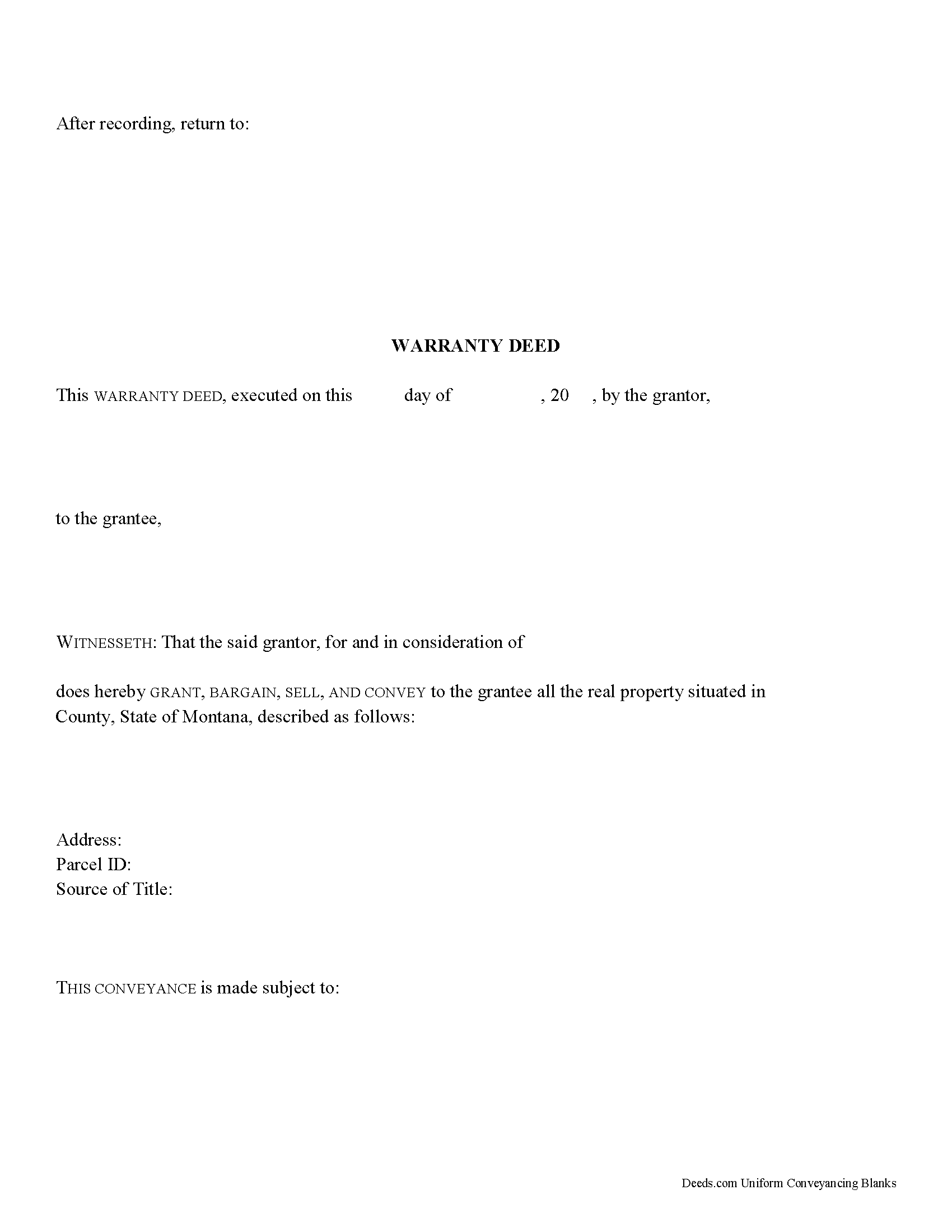
About the Montana Warranty Deed
How to Use This Form
- Select your county from the list
- Download the county-specific form
- Fill in the required information
- Have the document notarized if required
- Record with your county recorder's office
What Others Like You Are Saying
"Fast and efficient"
"Most people coming to this sight will not have the knowledge for deeds. Therefore, I wish there were…"
"A great service, making it fast and easy to prepare warranty deeds for property transfer sales. I re…"
"Your service was as you promoted and I was able to get a copy of my deed and find the information on…"
"Yes it helped with some things but I need more info"
4.8/5 from 4,830 reviews. Read all
Montana caps what a deed implies. Section 70-20-304 of the Montana Code Annotated provides that the word grant implies only two covenants and none other, and both of them stop at the grantor's own acts. Anything beyond that ceiling has to be written onto the page, and it has to be written carefully, because the same statute makes express terms the lever that cuts the implied covenants down. This Montana warranty deed writes the full set of express covenants and then states, in so many words, that they are added to the statutory ones and do not restrain them.
The ceiling the word grant sets
What grant carries in Montana is narrow: that the grantor had not already conveyed the same estate to anyone else, and that the estate is clear of encumbrances the grantor or someone claiming under the grantor made or suffered. Both may be sued on as though typed into the instrument. Montana publishes a bare form of grant at Section 70-20-103 and no statutory general warranty deed, so a warranty deed, sometimes searched as a full covenant deed, is a matter of drafting rather than of legislative template. Section 8 of this form supplies the covenants: seisin, right to convey, freedom from encumbrances apart from the matters listed, quiet enjoyment, and a promise to warrant and forever defend the title against every lawful claim. Section 70-17-203 sends covenants of warranty and quiet enjoyment forward with the land to later owners, so the promise outlives the closing. The exceptions box is the counterweight. Whatever is written there, recorded easements, a trust indenture, current taxes, subdivision restrictions, is carved out of both the conveyance and the warranty, which makes that entry the most consequential blank on the page.
One form, one or two people on each side
The form is the general configuration of the deed. Its grantor block is a single open block that takes one name or two, along with whatever status wording the signers use, and the grantee block has the same shape and takes any co-ownership designation the buyers take title under. Nothing about marital status, capacity, or vesting is preprinted anywhere on the instrument, so the words in those blocks are the words the parties supply. Two signature blocks follow the operative section, headed GRANTOR and SECOND GRANTOR (if applicable), with an acknowledgment certificate for each in the Montana short form of Section 1-5-610; a single-owner conveyance simply leaves the second block and its certificate blank. A sole owner deeding a cabin to a married couple, and two owners deeding to one buyer, are both patterns this instrument records without alteration. What it is not set up as is a conveyance signed by an entity officer, a trustee, or an attorney-in-fact, each of which is executed and acknowledged in a representative capacity, or a transfer by three or more owners on either side.
Formatting that the fee schedule enforces
Montana treats deed formatting as a price, not a veto. Under Section 7-4-2637(2) a document that misses the standard-document conditions of Section 7-4-2636 is recorded anyway, at the standard fee plus ten dollars. The blanks that genuinely stop a filing sit elsewhere: Section 7-4-2618 forbids the clerk and recorder to receive a deed unless the grantee's post office address is in the instrument, Section 70-21-203 requires acknowledgment before recording, and Section 15-7-305 withholds acceptance until a Realty Transfer Certificate is in hand, a Department of Revenue form obtained and filed separately from this package. The deed itself is drawn to the standard: letter paper, black type at twelve point, three inches held clear at the top of the first page, and the return name and address inside that band at the upper left. Recording matters for a second reason. Montana ranks conveyances under a race-notice rule, so a deed that sits unrecorded is exposed to a later good faith purchaser who records first.
What arrives with the purchase
The download is a fillable Montana warranty deed formatted for the county clerk and recorder, a completed example filled in for a Missoula County sale so every blank can be read against a realistic entry, and a guide covering the statutory framework, the co-ownership forms Montana recognizes for grantees, each numbered section, signing and notarization, and the recording package. These materials describe Montana law in general terms and are informational only, not legal advice; a Montana attorney can address how the rules operate on a particular title.
Important: County-Specific Forms
Our warranty deed forms are specifically formatted for each of the 56 counties in Montana.
After selecting your county, you'll receive forms that meet all local recording requirements, ensuring your documents will be accepted without delays or rejection fees.