Nevada Death of Grantor Affidavit
County or Independent City Specific Legal Forms Validated as recently as November 15, 2026 by our Forms Development Team
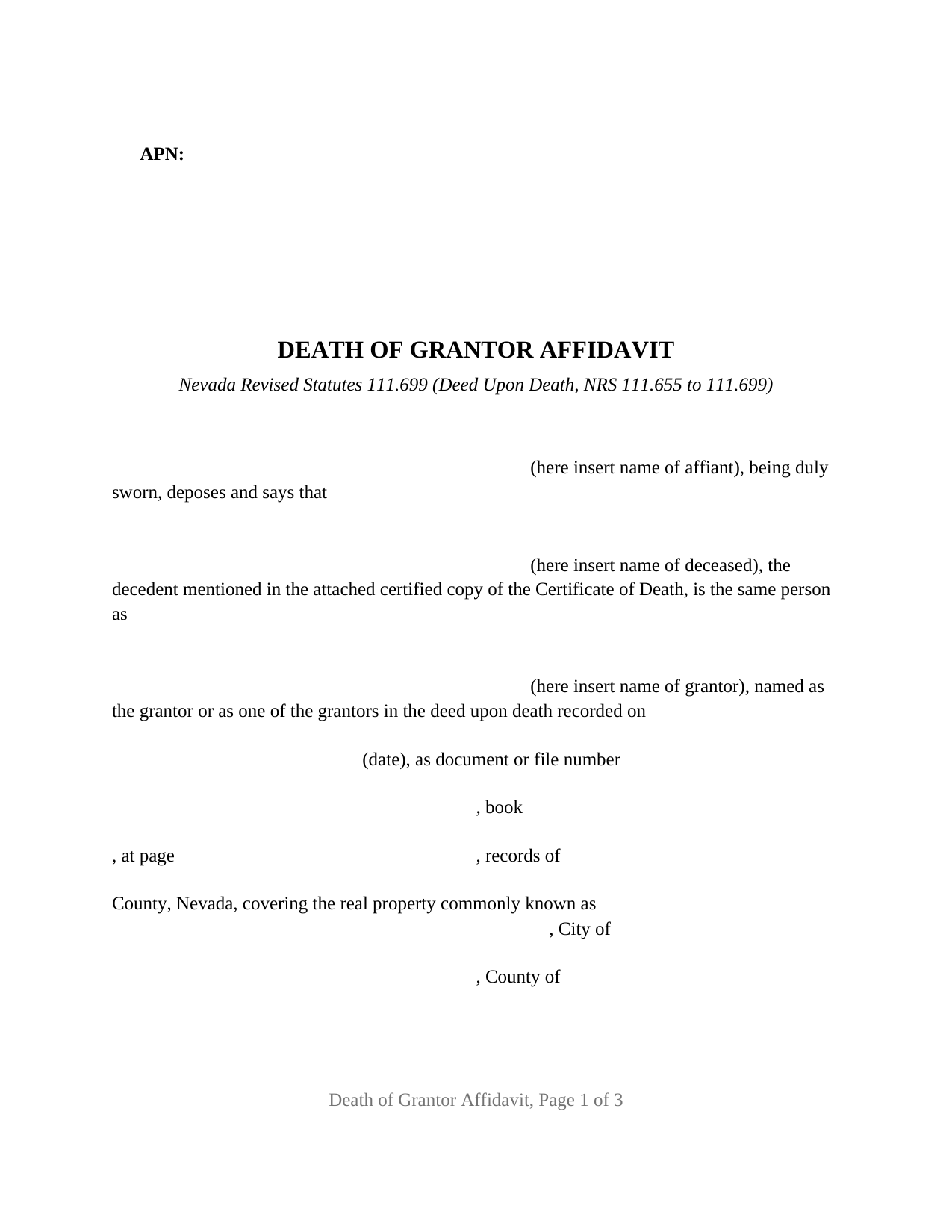
About the Nevada Death of Grantor Affidavit
How to Use This Form
- Select your county or independent city from the list
- Download the county or independent city-specific form
- Fill in the required information
- Have the document notarized if required
- Record with your county or independent city recorder's office
What Others Like You Are Saying
"Quick, Simple order process with many options of forms to download!"
"A great way to access form knowledge"
"Got the documents needed.. simple to use!!!"
"Excellent service even faster then I expected. Very pleased and a reasonable priced document. I enco…"
"I had overwhelming emotions taking my deceased wife's name off my condo, so it took me a year to ste…"
4.8/5 from 4,856 reviews. Read all
A Nevada deed upon death moves real property to a named beneficiary at the owner's death without probate, but the county record does not learn of the death on its own. The Nevada Death of Grantor Affidavit is the document NRS 111.699 places on that record once the grantor has died: an affidavit by the beneficiary, recorded in the office of the county recorder where the deed upon death was recorded, with a copy of the grantor's death certificate and a declaration of value attached. This form reproduces the affidavit the statute prints, in the statute's words, for one affiant.
The affidavit that completes a deed upon death
Under NRS 111.671 a deed upon death, which Nevada enacted in 2011 and which other states call a transfer on death deed or beneficiary deed, conveys the grantor's interest effective upon the grantor's death. NRS 111.683 makes the deed effective without notice, delivery, acceptance, or consideration, so nothing passes through the beneficiary's hands at the death itself. What the beneficiary does afterward is governed by NRS 111.699: upon the death of the last grantor, a declaration of value under NRS 375.060 and a copy of the death certificate of each grantor must be attached to a Death of Grantor Affidavit and recorded where the deed was recorded. The affidavit states, under oath, that the decedent named in the attached certificate of death is the same person as the grantor named in the recorded deed, identifies that deed by its recording date, document number, book and page, and county, describes the property by its common address and its legal description, and states that the affiant is the beneficiary, one of the beneficiaries, or the authorized representative of a beneficiary, naming every beneficiary the deed listed.
Why the recorded affidavit matters to a later buyer
NRS 111.689, the section governing claims against property transferred by a deed upon death, gives a person who deals with a beneficiary in good faith and for valuable consideration the same rights and protections as a person dealing with a distributee named in a final order of distribution, on the condition that a Death of Grantor Affidavit was recorded under NRS 111.699. The recorded affidavit is therefore the document a title examiner looks for after a deed upon death owner dies. The same section requires the beneficiaries to publish and mail a notice to creditors, which is prepared separately and is not part of this package, and NRS 111.691 provides that the beneficiary inherits the property subject to the liens that existed at the grantor's death. The affidavit itself transfers nothing and clears nothing; it places the death and the beneficiary's identity on the record where the deed already sits.
One affiant, the statute's own sentences, and the statute's own certificate
NRS 111.699 requires the affidavit to be in substantially the form the statute prints, and that form is written for one affiant. This form follows it: the statutory sentences are printed verbatim around their blanks, the affiant's name appearing where the statute asks for it, the deceased grantor's name where the statute joins the death certificate to the deed, and the recording data, property description, and list of beneficiaries in the statute's order. The form carries one AFFIANT signature block with a printed-name line beneath the signature, which NRS 247.190 asks of every signer of a recorded document, and it carries the notarial certificate the statute prints rather than Nevada's general short form: a venue reading State of Nevada, a sworn sentence beginning Subscribed and sworn to on this, and an acknowledgment sentence in which the affiant is personally known to the officer or proved on satisfactory evidence, both completed by one notarial officer under one signature and seal. The affidavit's uppercase affirmation that the document submitted for recording contains a Social Security number of a person or persons is the statute's sentence, printed because the attached death certificate carries that number. A deed upon death that named two beneficiaries presents the pattern the completed example recites, one beneficiary making the affidavit and listing both; a deed made by two grantors presents the pattern in which the affidavit follows the death of the last grantor with both death certificates attached. The form is not set up for two affiants on one instrument, for an entity or fiduciary affiant beyond the statutory words authorized representative, or for the affidavit of death a surviving joint tenant or surviving spouse records under NRS 111.365, which rests on a survivorship estate rather than a deed upon death.
What Nevada recorders read on the first page
Nevada's recording statute treats a Death of Grantor Affidavit as an affidavit of death, and NRS 111.312 provides that the county recorder shall not record an affidavit of death unless it contains the mailing address of the person requesting the recording, there being no grantee, and the assessor's parcel number at the top left corner of the first page when the assessor has assigned one. The form reserves the top left space of its first page for the parcel number and carries a mailing address block for the requester at the end, beside the return address block Nevada recorders ask for on the face of each document. The page itself follows NRS 247.110: letter size white paper, a blank three inch by three inch space at the upper right of the first page for the recorder's label, one inch side and bottom margins, and black type that prints at twelve points over the ten point Times New Roman minimum. The real property transfer tax does not reach this filing; NRS 375.090(10) exempts a Death of Grantor Affidavit recorded under NRS 111.699 by name, and the declaration of value that accompanies it, the Nevada Tax Commission's form under NRS 375.060, carries that exemption claim and is recorded without a fee of its own.
Where the facts in the blanks come from
Every entry on the affidavit comes from a document the beneficiary already holds. The grantor's name, the recording date, the document number, the county, the parcel number, the property address, the legal description, and the names of the beneficiaries are read from the recorded deed upon death and the recorder's stamp on it. The decedent's name is read from the certified copy of the certificate of death that the statute requires to be attached. The affiant's own name and mailing address complete the picture. The completed example included with the package shows a Washoe County fact pattern filled in that way, with a son named as one of two beneficiaries making the affidavit after his mother's death and the officer's certificate completed in the statute's words, so that each blank of the fillable form has a model entry beside it in the guide.
The package includes the fillable Nevada Death of Grantor Affidavit form, a completed example filled in for a realistic Washoe County fact pattern, and the guide that walks through each blank, the attachments NRS 111.699 names, the statutory certificate, and recording in the county where the deed upon death was recorded. This description and the guide describe the form and the governing Nevada statutes in general terms; they are not legal advice.
Important: County or Independent City-Specific Forms
Our death of grantor affidavit forms are specifically formatted for each of the 17 county or independent cities in Nevada.
After selecting your county or independent city, you'll receive forms that meet all local recording requirements, ensuring your documents will be accepted without delays or rejection fees.