Nevada Revocation of Deed Upon Death
County or Independent City Specific Legal Forms Validated as recently as November 15, 2026 by our Forms Development Team
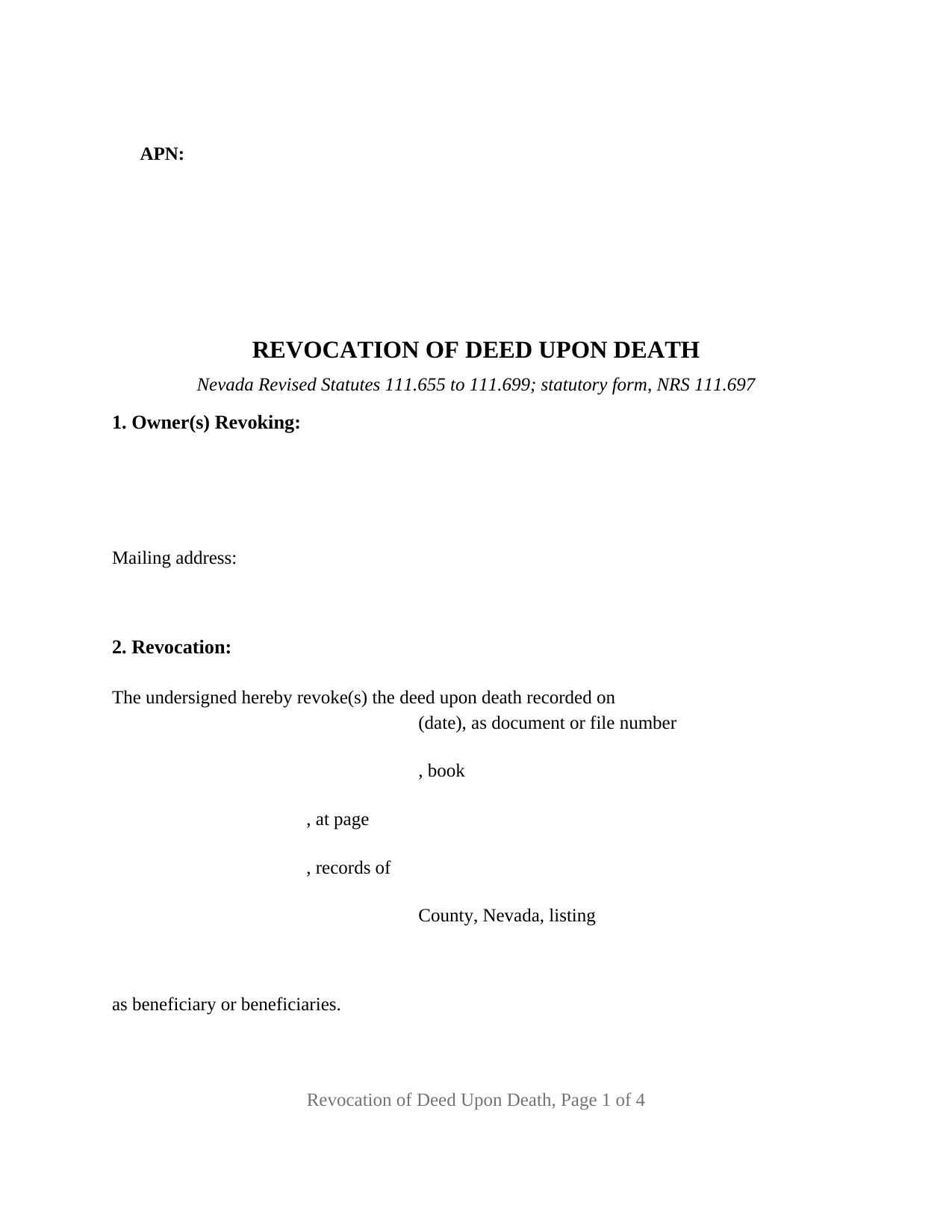
About the Nevada Revocation of Deed Upon Death
How to Use This Form
- Select your county or independent city from the list
- Download the county or independent city-specific form
- Fill in the required information
- Have the document notarized if required
- Record with your county or independent city recorder's office
What Others Like You Are Saying
"Great experience, highly recommend."
"The forms were as I expected them to be. The guide was very helpful. Overall very good."
"Very easy to navigate, download,and print forms!"
"Wow -- amazingly fast turnaround and excellent customer service and communication. Thank you for sav…"
"So far so good. It was reasonably easy to download and complete the form using information found in …"
4.8/5 from 4,856 reviews. Read all
A Nevada deed upon death stays revocable for the owner's whole life, but revoking it takes a recorded instrument. Marking up the original or tearing it up does nothing to a deed upon death that sits in the county recorder's index. This Nevada Revocation of Deed Upon Death is the instrument NRS 111.697 prescribes for that purpose, prepared as a fillable form for one owner or two owners who created the deed together.
Why a recorded instrument, and not the deed itself
NRS 111.697 states the rule in three parts. A deed upon death may be revoked at any time by the owner or, where more than one owner created it, by any of the owners who created it, even if the deed itself says otherwise. The revocation is valid only if it is executed and recorded, as provided by law, in the office of the county recorder of the county where the property is located before the death of the owner who executes it. And a deed upon death may not be revoked by a revocatory act on the deed. The statute then prints the form the revocation must substantially follow, and this product carries that form: its operative sentence, its affirmation that the document contains no Social Security number, its date and signature lines, and its notary certificate are the statute's own words.
Recording is the hinge. A signed revocation that never reaches the recorder before the executing owner's death revokes nothing, so the instrument carries the statute's validity sentence in capital letters above the signature blocks. That one warning stays on the recorded page because its absence is the one omission that can silently defeat the instrument.
What the revocation identifies
The statutory form does not restate the legal description or name a new beneficiary. It identifies the deed upon death being revoked the way the recorder's index does: the date it was recorded, its document or file number, the book and page where a county still assigns them, the Nevada county whose records hold it, and the beneficiary or beneficiaries it listed. Every one of those entries comes off the recorded deed, most of them from the recorder's stamp or label on its first page. The assessor's parcel number goes in the labeled space at the top left of the first page, where NRS 111.312 places it, and the owners' mailing address rides in the owner block.
What the revocation accomplishes is narrow and complete. The identified deed upon death comes out of effect, and the property passes at the owner's death under the owner's will, by intestate succession, or under any later deed upon death the owner records. Nothing transfers now, no title changes hands, and no lien or mortgage is touched. An owner who wants a different beneficiary records a new deed upon death instead, which NRS 111.677 makes the effective deed when it is the last one recorded before death; that deed is a separate instrument recorded separately and is not included in this package.
One owner or two, on the same form
The form is set up for natural persons signing in their own right. One free-form owner block receives the owner, or both owners, as named on the recorded deed, with whatever marital-status recital the filler supplies; nothing about status, vesting, or capacity is preprinted. Two signature blocks follow, headed OWNER and SECOND OWNER (if applicable), and each is paired with its own notary certificate in the wording the NRS 111.697 form prints. On a one-owner revocation the second block and its certificate stay blank. The separate certificates are a feature of the form's layout rather than a statutory command, and they let two owners sign on different days or before different notaries.
The two-owner pattern matters most where the property is held as joint tenants with right of survivorship or as community property with right of survivorship. NRS 111.697 provides that a revocation of such a deed that is not executed by all the owners does not become effective unless it is executed and recorded by the last surviving owner. Two living owners who both sign, each in the owner's own block, present the all-owners execution the section describes; the completed example shows exactly that, a married couple in Washoe County revoking the deed they recorded in 2024. The form is not set up for an entity or trustee owner, a signature under a power of attorney, or three or more owners on one instrument.
The certificate the statute prints
The notary certificate on this form is unusual by national standards and distinctly Nevadan. The NRS 111.697 form prints a State of Nevada venue, a sworn sentence (subscribed and sworn to before the named notary by the named principal), and an acknowledgment sentence (the principal personally appeared, was known or proved to be the person whose name is subscribed, and acknowledged executing the instrument), all under one notary signature and seal. NRS 240.1655 makes a certificate in a form otherwise prescribed by Nevada law sufficient, so the form carries the statute's certificate rather than the general short form, with the notary completing the county, the written date, and the two names.
Built for the Nevada recorder's counter
The instrument is laid out to NRS 247.110: letter-size white paper, one-inch margins, the blank three-inch square at the upper right of the first page for the recorder's label, and 12-point type over the statute's 10-point floor. The revocation conveys nothing and transfers no title, so it is outside the real property transfer tax of NRS 375.020, and the Declaration of Value that NRS 375.060 attaches to deeds evidencing a transfer of title has no transfer to declare; each county recorder publishes its own intake practice for documents of this kind, and the guide describes where to find it. Recording fees are set county by county under NRS 247.305.
The package includes the fillable Revocation of Deed Upon Death form, a completed example filled in for a realistic Washoe County fact pattern, and a guide that walks through every section, the signing formalities, and the recording process. This description and the guide describe the form and the governing Nevada statutes in general terms; they are not legal advice.
Important: County or Independent City-Specific Forms
Our revocation of deed upon death forms are specifically formatted for each of the 17 county or independent cities in Nevada.
After selecting your county or independent city, you'll receive forms that meet all local recording requirements, ensuring your documents will be accepted without delays or rejection fees.