Lyon County Deed Upon Death (Two Joint Tenants with Right of Survivorship, Last Survivor) Form
Last validated November 15, 2026 by our Forms Development TeamFormatted for recording in Lyon County, for property anywhere in the county or independent city: rural and unincorporated areas as well as Dayton, Fernley, Silver City, Silver Springs, Smith, Wellington, Yerington.
- 3 documents included
- Immediate PDF download
- Formatting guarantee
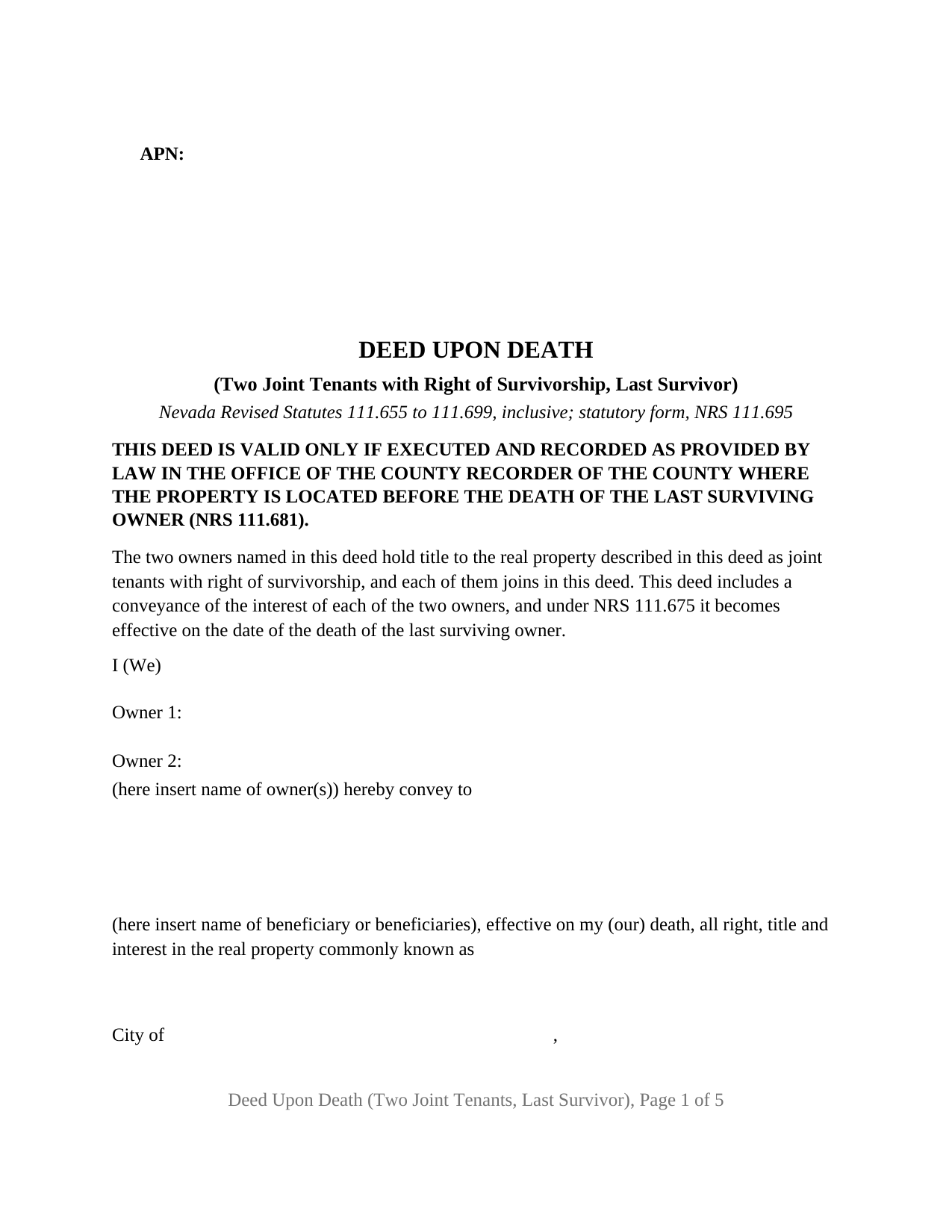
Lyon County Deed Upon Death (Two Joint Tenants with Right of Survivorship, Last Survivor) Form
Fill in the blank Deed Upon Death (Two Joint Tenants with Right of Survivorship, Last Survivor) form formatted to comply with all Nevada recording and content requirements.
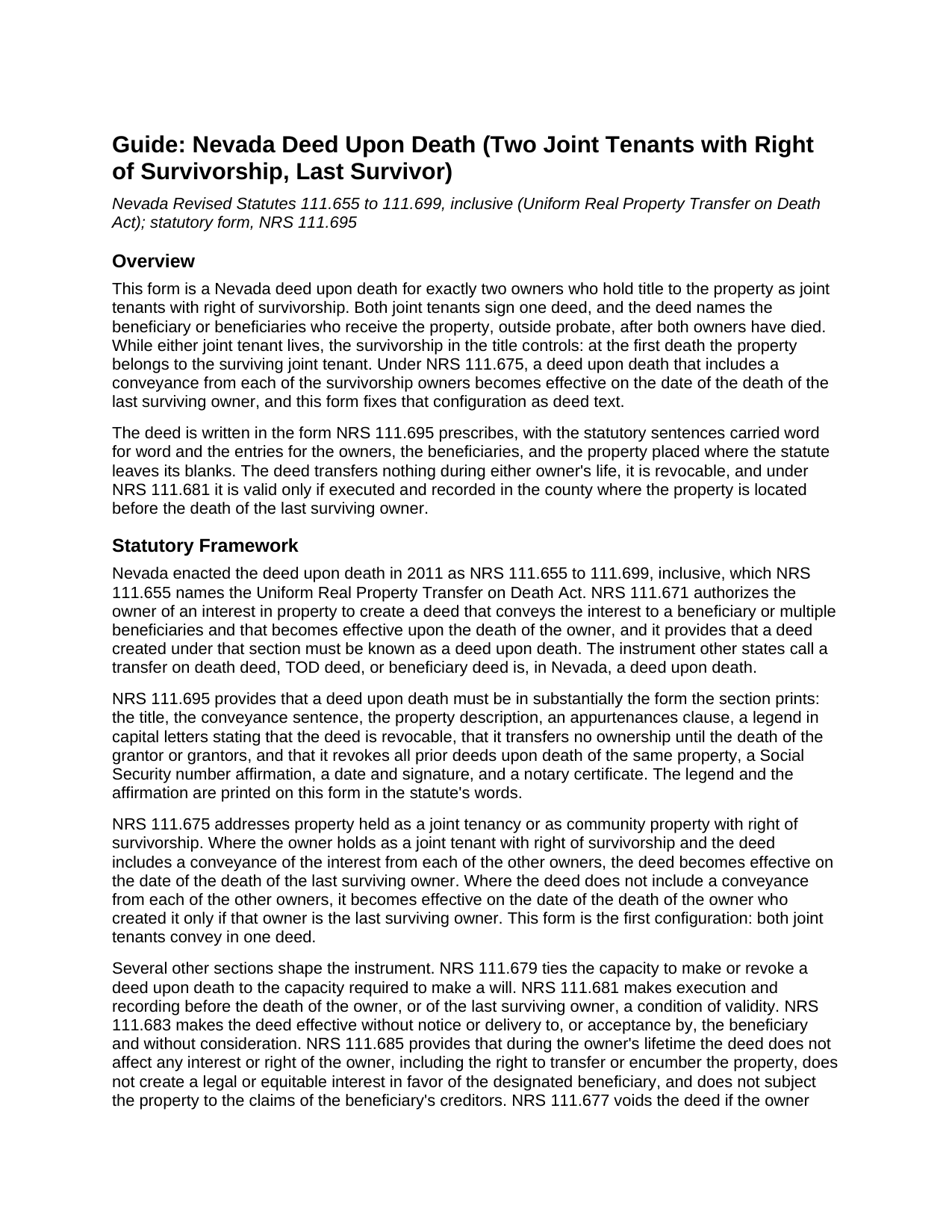
Lyon County Deed Upon Death (Two Joint Tenants with Right of Survivorship, Last Survivor) Guide
Line by line guide explaining every blank on the Deed Upon Death (Two Joint Tenants with Right of Survivorship, Last Survivor) form.
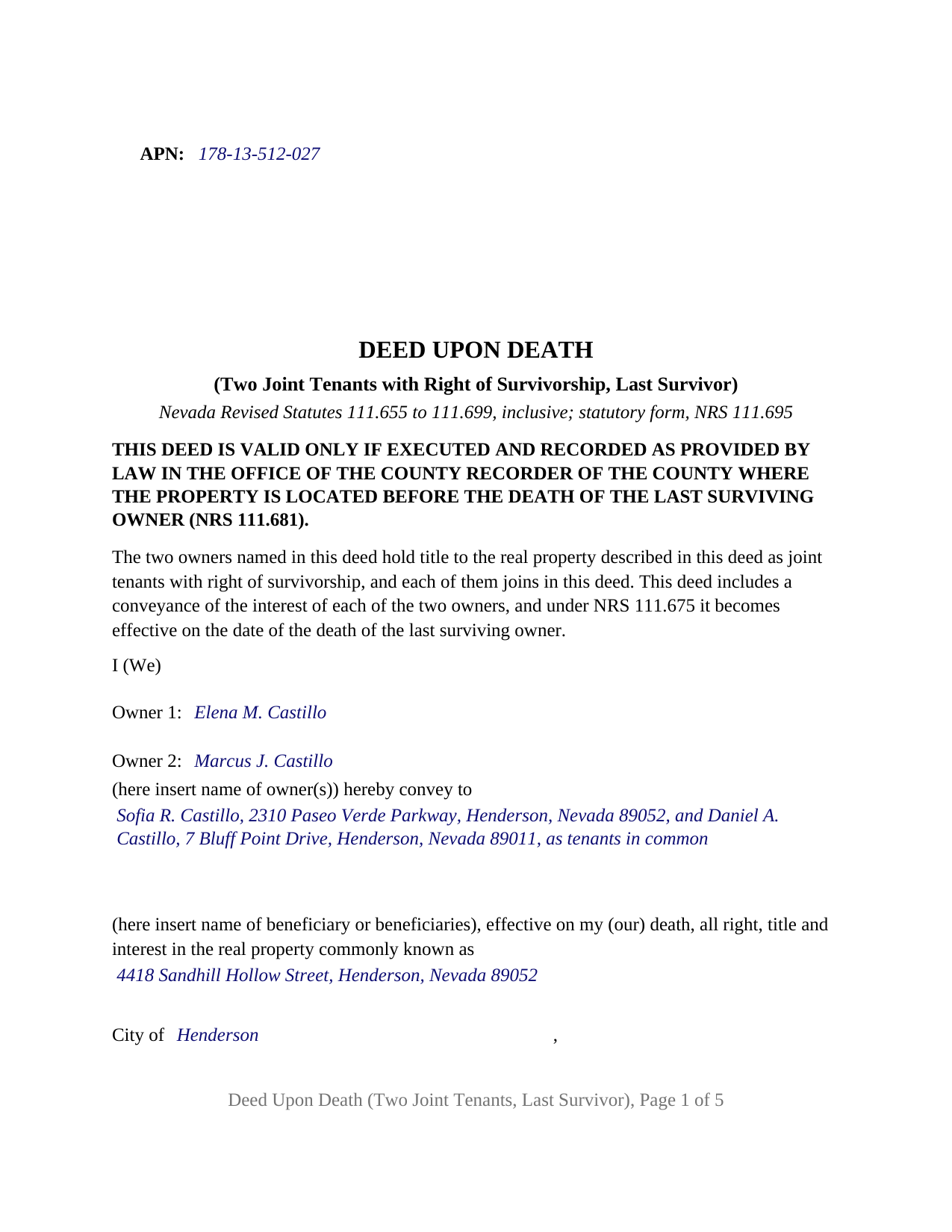
Lyon County Completed Example of the Deed Upon Death (Two Joint Tenants with Right of Survivorship, Last Survivor) Document
Example of a properly completed Nevada Deed Upon Death (Two Joint Tenants with Right of Survivorship, Last Survivor) document for reference.
All 3 documents above included • One-time purchase • No recurring fees
Immediate Download • Secure Checkout
Additional Nevada and Lyon County documents included at no extra charge:
Where to Record Your Documents
Lyon County Recorder
Yerington, Nevada 89447
Hours: 8:00am-5:00pm M-F
Phone: (775) 463-6581
Recording Tips for Lyon County:
- Bring your driver's license or state-issued photo ID
- Ensure all signatures are in blue or black ink
- Ask if they accept credit cards - many offices are cash/check only
- Check that your notary's commission hasn't expired
- Documents must be on 8.5 x 11 inch white paper
Cities and Jurisdictions in Lyon County
Properties in any of these areas use Lyon County forms:
- Dayton
- Fernley
- Silver City
- Silver Springs
- Smith
- Wellington
- Yerington
Hours, fees, requirements, and more for Lyon County
How do I get my forms?
Forms are available for immediate download after payment. The Lyon County forms will be in your account ready to download to your computer. An account is created for you during checkout if you don't have one. Forms are NOT emailed.
Are these forms guaranteed to be recordable in Lyon County?
Yes. Our form blanks are guaranteed to meet or exceed the applicable formatting requirements used for recording in Lyon County, including margin requirements, font requirements, and other layout standards. This guarantee applies to formatting, not to the legal sufficiency of information entered by the user or the suitability of a form for a particular transaction.
Can I reuse these forms?
Yes. You can reuse the forms for your personal use. For example, if you have multiple properties in Lyon County you only need to order once.
What do I need to use these forms?
The forms are PDFs that you fill out on your computer. The free Adobe Acrobat Reader is recommended, and most PDF apps also work. You do NOT enter your property information online - you download the blank forms and complete them privately on your own computer.
Are there any recurring fees?
No. This is a one-time purchase. Nothing to cancel, no memberships, no recurring fees.
How much does it cost to record in Lyon County?
Recording fees in Lyon County vary. Contact the recorder's office at (775) 463-6581 for current fees.
Questions answered? Let's get started!
Two Nevada joint tenants with right of survivorship can name, in one deed, who receives their property after both of them have died. This form prepares a Nevada deed upon death for exactly that configuration: two owners who hold title as joint tenants with right of survivorship, both signing one instrument in the statutory form of NRS 111.695, with the transfer timed by NRS 111.675 to the death of the last surviving owner.
A deed that waits for the second death
A joint tenancy already decides what happens at the first death: the surviving joint tenant takes the whole property by survivorship, and nothing in a deed upon death changes that. What the joint tenants cannot do through the title alone is say where the property goes when the survivor dies. NRS 111.675 supplies the mechanism. Where the owner holds as a joint tenant with right of survivorship and the deed upon death includes a conveyance of the interest from each of the other owners, the deed becomes effective on the date of the death of the last surviving owner. This form prints that configuration as fixed deed text: the two owners hold as joint tenants with right of survivorship, each joins in the deed, the deed includes a conveyance of the interest of each of them, and it becomes effective on the date of the death of the last surviving owner.
The alternative the statute describes is what happens when only one joint tenant signs. Under NRS 111.675(2), a deed that does not include a conveyance from each of the other owners becomes effective only if the owner who created it turns out to be the last surviving owner. A deed by both joint tenants removes that contingency; whichever of the two dies second, the recorded deed operates at that death.
The statute's words, with two signatures
Nevada prescribes the deed's form. NRS 111.695 prints the conveyance sentence, I (We) hereby convey to the named beneficiary or beneficiaries, effective on my (our) death, all right, title and interest in the described property, together with the appurtenances clause, the capitalized legend that the deed is revocable, transfers no ownership until the death of the grantor or grantors, and revokes all prior deeds upon death of the same property, and the affirmation that the document contains no Social Security number. The form carries each of those sentences verbatim, the first-person plural the statute itself prints doing the work for two grantors, and adds the joint tenancy recital above the statutory text so the recorded deed states on its face which configuration of NRS 111.675 it invokes.
The form carries two owner signature blocks and two notary certificates, one following each joint tenant's signature, so the two owners may acknowledge on different dates or before different notaries. Each certificate is the one the NRS 111.695 form prints rather than the general short form: the State of Nevada venue, a sworn sentence completed with the date and the notary's name, and an acknowledgment sentence in which the owner, personally known to the notary or proved by satisfactory evidence, acknowledges executing the instrument, closing with the notary's signature and seal. NRS 240.1655(3)(b) makes a certificate in a form otherwise prescribed by Nevada law sufficient, and the guide describes what the notary completes and how an owner who signs in another state proceeds under NRS 240.164.
The joint tenancy the deed recites
The configuration section of this form is its recital: exactly two record owners who hold the described property as joint tenants with right of survivorship, signing in their own right. In Nevada that estate exists only where the vesting deed expressly declared it (NRS 111.065); a deed to two or more persons that is silent creates a tenancy in common under NRS 111.060. Two siblings who took title together, a parent and an adult child, unmarried partners, and two spouses whose vesting deed declared a joint tenancy present the pattern this deed recites. The form is not set up for a sole owner, for owners who hold as tenants in common or as community property with right of survivorship, for three or more owners, for an attorney-in-fact, or for a trustee or entity owner; those configurations follow different patterns, and the recital in this form does not describe them.
The beneficiary entry takes the names and mailing addresses of one or more beneficiaries and, under NRS 111.673, the tenancy in which multiple beneficiaries take. The completed example shows two Henderson joint tenants, a sister and brother who hold a Green Valley Ranch lot together, conveying to two beneficiaries as tenants in common, with the certificates completed on different November dates before different Clark County notaries.
Recording before the second death
Under NRS 111.681 the deed is valid only if it has been executed and recorded, as provided by law, with the recorder of the county in which the property lies before the death of the owner or of the last surviving owner. For two joint tenants that deadline is the second death, and the form restates the condition in capital letters under its title. Recording promptly after both signatures brings the deed of record while both owners are living. The first page carries the assessor's parcel number at its top left corner as NRS 111.312(1)(b) places it, with the beneficiary mailing address and the tax statement address NRS 111.312 requires, and the deed goes to the recorder with the State of Nevada Declaration of Value claiming the NRS 375.090(10) exemption from the real property transfer tax. The Clark County recorder, where the example is set, publishes an eleven-digit parcel number format, and the guide shows the entry.
Revocation by two, or by the survivor
NRS 111.697 lets either owner revoke at any time by a recorded revocation, but it adds a rule specific to this configuration: where the property is held as joint tenants with right of survivorship and the revocation is not executed by all the owners, the revocation does not become effective unless it is executed and recorded by the last surviving owner. While both joint tenants live, one of them cannot undo the recorded designation alone. The revocation of deed upon death is a separate statutory instrument prepared and recorded separately and not included in this package. After the second death, the beneficiary records the NRS 111.699 Death of Grantor Affidavit with each grantor's death certificate and a declaration of value, likewise a separate instrument prepared and recorded separately and not included in this package, and the beneficiary takes subject to liens existing at that death under NRS 111.691.
The package includes the fillable deed upon death form in the NRS 111.695 statutory text with the two-joint-tenant recital, a completed example filled in for a realistic Clark County fact pattern, and the guide that explains each entry, the Nevada statutes behind the form, and the steps at the recorder's counter. This description and that guide are general descriptions of the form and of the Nevada statutes that govern it, not legal advice.
Important: Your property must be located in Lyon County to use these forms. Documents should be recorded at the county or independent city recording office listed above.
This Deed Upon Death (Two Joint Tenants with Right of Survivorship, Last Survivor) meets all recording requirements specific to Lyon County.
Our Promise
The documents you receive here are guaranteed to meet or exceed the applicable Lyon County recording format requirements. If there is a rejection caused by our formatting, we will correct the issue or refund your payment. This guarantee applies to document formatting only and does not extend to information entered by the user, the selection of the form, or the legal effect of the completed document.
Save Time and Money
Get your Lyon County Deed Upon Death (Two Joint Tenants with Right of Survivorship, Last Survivor) form done right the first time with Deeds.com Uniform Conveyancing Blanks. At Deeds.com, we understand that your time and money are valuable resources, and we don't want you to face a penalty fee or rejection imposed by a county recorder for submitting nonstandard documents. We constantly review and update our forms to meet rapidly changing state and county recording requirements for roughly 3,500 counties and local jurisdictions.
4.8 out of 5 - ( 4,858 Reviews )
Lesley B. 5 out of 5 stars
It was so quick and easy to access.. Thank you!!
Thank you for your feedback. We really appreciate it. Have a great day!
Charmaine D. 5 out of 5 stars
Very easy to use.
Thank you!
David P. 5 out of 5 stars
Thank you. I was just looking but still think it is a great website. Used it a couple of years ago for a deed. Thank you.
Thank you for your feedback. We really appreciate it. Have a great day!
Barbara K. 5 out of 5 stars
Found what I needed quickly, easy website to maneuver. Like having a sample to look at along with instructions.
Thank you for your feedback. We really appreciate it. Have a great day!
Harry S. 5 out of 5 stars
This is my first time using the service. Wow! How efficient and effortless! Keep up the good work!
Thank you!
Janet B. 5 out of 5 stars
Review: Very user friendly and that is very important to me. Quick, easy and clear instructions. I would highly recommend deeds.com for your online filing services.
Thank you for your feedback. We really appreciate it. Have a great day!
Rubin C. 5 out of 5 stars
Very good forms and the online recording was a blessing.
Thank you for your feedback. We really appreciate it. Have a great day!
Rosa D. 5 out of 5 stars
Obtaining a quick claim deed from this website was easy and friendly I must say. Thank you so much.
Thank you for your feedback. We really appreciate it. Have a great day!
Michael S. 5 out of 5 stars
Great Price & Really Easy To Download
We are motivated by your feedback to continue delivering excellence. Thank you!
Sandra T T. 5 out of 5 stars
Great website to find state documents. I do like the one-time charge also vs a recurring charge. Thank you!
Thank you, Sandra! We’re glad you found the state documents you needed and appreciate you mentioning the one-time charge option. We believe in keeping things straightforward and transparent. Thanks again for your kind words and for choosing Deeds.com!
Michael M. 5 out of 5 stars
Received the documents as ordered in a timely fashion. Can't ask for much better than that!
Thank you!
Joan B. 5 out of 5 stars
So quick and easy! No searching for a parking place or waiting in line. Thank you!
We appreciate your business and value your feedback. Thank you. Have a wonderful day!
Pedro M. 5 out of 5 stars
Very good service......
Your feedback is greatly appreciated. Thank you for taking the time to share your experience!
Rachel S. 5 out of 5 stars
It would be nice to get a reply in a small window that says "Your request package has been submitted." That way I can log out and wait for the email. I do love the efficient service.
Thank you!
Marion R. 4 out of 5 stars
YOU WERE NOT ABLE TO PROVIDE SERVICE IN THE COUNTY WE NEEDED IN NEW MEXICO. YOUR RESPONSE WAS QUICK SO I APPRECIATE THAT. THANK YOU
Thank you for your feedback Marion.