New Hampshire Transfer on Death Deed
County Specific Legal Forms Validated as recently as November 15, 2026 by our Forms Development Team
About the New Hampshire Transfer on Death Deed
How to Use This Form
- Select your county from the list
- Download the county-specific form
- Fill in the required information
- Have the document notarized if required
- Record with your county recorder's office
What Others Like You Are Saying
"This was the easiest, quickest, most understandable way I've seen yet to retrieve deeds from various…"
"I appreciate a service that can reach any county in Texas to file deed distribution deeds. It is con…"
"Deeds.com is a very Good company. They helped me when I needed the"
"Easy to order what I needed."
"Very nice. easy to use and not too expensive."
4.8/5 from 4,856 reviews. Read all
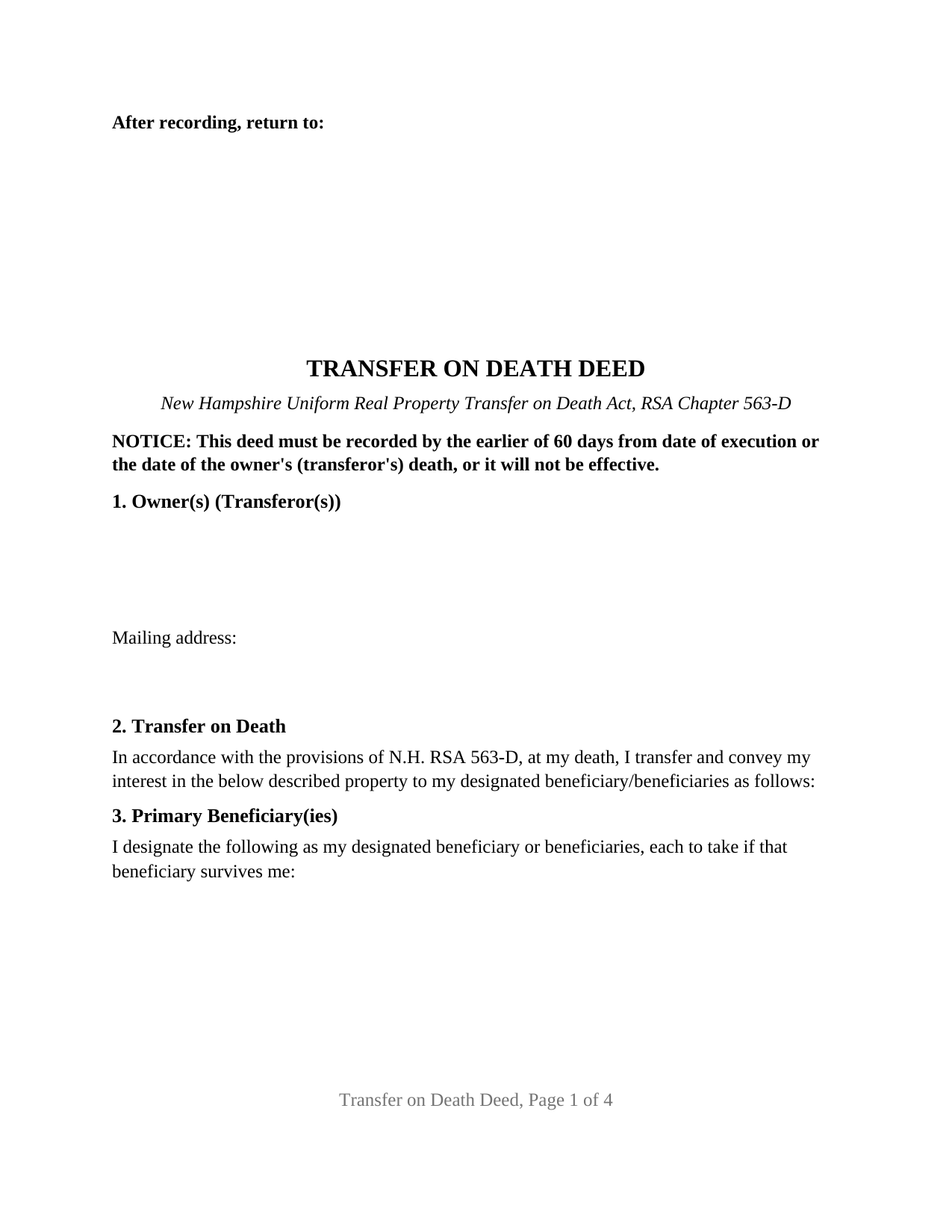
A New Hampshire transfer on death deed names who receives real estate when the owner dies, without probate and without giving anything up during life. This form prepares that deed under RSA Chapter 563-D, the Uniform Real Property Transfer on Death Act, for one or two owners of New Hampshire real property, and it is built around the rule that gives the New Hampshire deed two recording deadlines: the deed is void unless it is recorded within 60 days after it is signed, as well as before the owner's death.
Two clocks, not one
Recording before the owner dies is the familiar transfer on death deed rule. RSA 563-D:9 adds a second clock. The deed is void unless it is recorded prior to the transferor's death, within 60 days following the date of execution, and at length in the registry of deeds for the county or counties in which the real estate lies. A deed signed in March and left in a drawer until June transfers nothing, however carefully it was signed and acknowledged. The same section lists the other three requirements: the deed meets RSA 477:3 (signed by the owner and acknowledged before a justice, notary public, or commissioner, with the grantee's mailing address), bears the title Transfer on Death Deed, and states that the transfer to the designated beneficiary occurs at the transferor's death. The form carries the title the statute names, the recording notice the RSA 563-D:19 optional form prints, and the form's own operative sentence word for word, so the three content requirements are preprinted, and what remains is execution before a notarial officer and the trip to the registry within the 60 days.
What the deed does during life, and at death
During the owner's life the deed does nothing to title. RSA 563-D:12 provides that it does not affect the owner's right to sell, mortgage, or lease the property, does not affect creditors, does not affect eligibility for public assistance, and creates no interest in the beneficiary. RSA 563-D:6 keeps it revocable even if the deed says otherwise, and RSA 563-D:11 describes the only way to revoke a recorded deed: a later instrument executed with the formalities of a deed, acknowledged after the deed being revoked, and recorded by the earlier of 60 days from its execution and the owner's death. Marking up the recorded deed revokes nothing.
At death, RSA 563-D:13 transfers whatever interest the owner then holds to the beneficiaries who survive, subject to every mortgage, lien, and other matter affecting the property at that moment and to estate creditor claims under RSA 563-D:16, and without covenant or warranty of title. Two or more beneficiaries take equal undivided shares as tenants in common unless the deed specifically creates a joint tenancy between them, and the share of a beneficiary who does not survive passes to the others in proportion to their interests unless the deed provides otherwise. Divorce after the deed is signed removes a former spouse as beneficiary under RSA 563-D:14 unless the deed says otherwise. The beneficiaries then record the notice of death affidavit RSA 563-D:22 describes, within 60 days after the death; that affidavit is prepared and recorded separately and is not included in this package, and the statute states that filing it is not a condition of the transfer of title.
One or two owners on one instrument
The form recites an open owner block that receives one or two natural persons signing in their own right, with the marital status recital that commonly follows a name in a New Hampshire deed, and it preprints nothing about vesting, status, or capacity. It carries two signature blocks, OWNER and SECOND OWNER (if applicable), and two acknowledgment certificates in the RSA 456-B:8 short form, one for each owner, so that two owners can acknowledge on different dates, before different notarial officers, or in different states; on a deed by one owner the second block and certificate stay blank. A single owner naming one child, a single owner naming three beneficiaries in equal shares, and two owners who hold with a right of survivorship naming the same beneficiaries present the patterns the form recites. For joint owners, RSA 563-D:13, III makes the deed effective only at the death of the last surviving joint owner, and RSA 563-D:11 provides that a deed of joint owners is revoked only by all of the living joint owners. The form is not set up as a deed by an entity, a trustee, a guardian or conservator acting under court order, or an agent under a power of attorney, and it is not set up for three or more owners on one instrument.
Beneficiaries, shares, and a secondary designation
The primary beneficiary block names one or more beneficiaries by full name and mailing address, the address being a condition of the register's acceptance under RSA 478:4-a. RSA 563-D:2 defines a beneficiary as a person and defines person broadly, so an individual, a trust named through its trustee, a charity, or a company can be named; the guide describes the naming convention for each. An optional secondary beneficiary block names who takes if no primary beneficiary survives the owner, the designation the RSA 563-D:19 optional form prints as its SECONDARY BENEFICIARY paragraph. The guide describes the statutory default shares and lapse rules of RSA 563-D:13 that apply where the deed says nothing more.
Recording in a New Hampshire registry of deeds
The property section opens with the municipality and the county, because RSA 478:4-a requires the names of all municipalities in which the property is located in the first sentence of the first description paragraph, and the register may not accept a deed without them. The form also carries the RSA 563-D:19 statement that the deed is exempt from real estate transfer tax under RSA 78-B:2, XXV as a revocable transfer on death deed for no consideration, which is the statement RSA 78-B:6 requires on an instrument recorded without tax stamps. The guide carries the registry format standards, the fee schedule, and the county variations.
A beneficiary deed, a TOD deed, by any name
Buyers search for this instrument as a beneficiary deed, a TOD deed, or a revocable transfer on death deed; in New Hampshire the statute calls it a transfer on death deed and RSA 563-D:9 requires that title on the instrument. The package includes the fillable transfer on death deed, a completed example filled in for a Merrimack County fact pattern with two owners and two beneficiaries, and the guide that walks through every section, the signing formalities, the homestead and spousal rules, and the recording steps. This description and the guide describe the form and the governing New Hampshire statutes in general terms; they are not legal advice.
Important: County-Specific Forms
Our transfer on death deed forms are specifically formatted for each of the 10 counties in New Hampshire.
After selecting your county, you'll receive forms that meet all local recording requirements, ensuring your documents will be accepted without delays or rejection fees.